










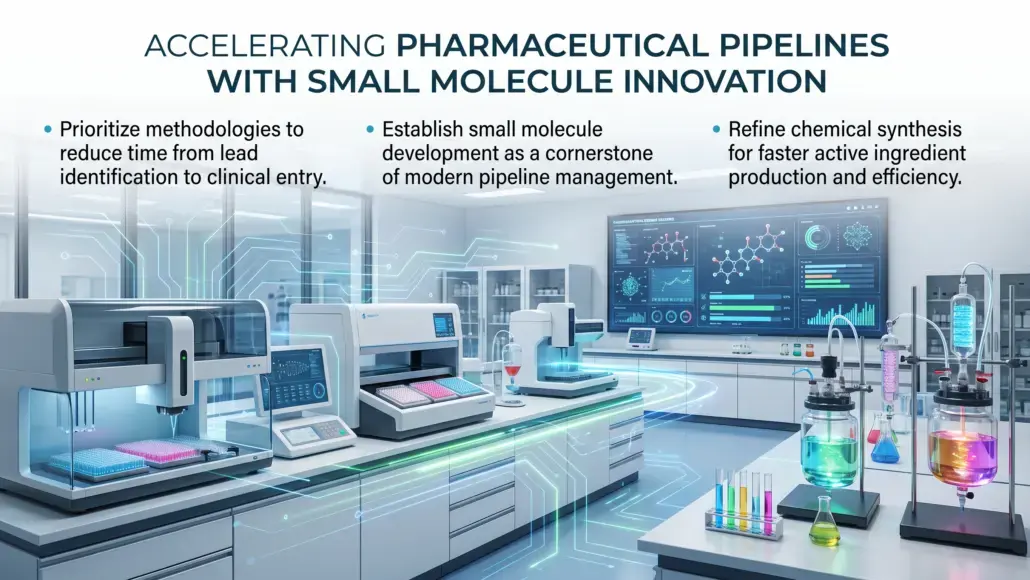
The current state of pharmaceutical research indicates a significant shift toward efficiency in the early stages of drug discovery. Manufacturers are increasingly prioritizing methodologies that reduce the time between lead identification and clinical entry. This focus is particularly evident in the way small molecule development supporting faster pharmaceutical drug development has become a cornerstone of modern pipeline management. By refining the chemical synthesis of active pharmaceutical ingredients, companies are able to address stability concerns much earlier in the cycle. The integration of advanced computational tools allows researchers to predict molecular behavior with higher accuracy, which reduces the necessity for repeated experimental cycles. This technical precision is essential for maintaining a competitive edge in a market where speed to clinic often determines the long term viability of a therapy.
The selection of appropriate solid state forms remains a critical technical challenge that requires deep analytical oversight. Solubility and bioavailability are the primary hurdles in small molecule research, and addressing these factors requires a sophisticated understanding of polymorphism and salt selection. When small molecule development supporting faster pharmaceutical drug development is executed with a focus on these physical properties, the resulting drug candidates exhibit better performance in late stage trials. This technical rigor ensures that formulations are optimized for patient delivery, avoiding the costly delays associated with reformulation during the clinical phase. The industry is moving away from traditional batch processing, opting instead for integrated systems that allow for real time monitoring of chemical reactions and purity levels.
Accelerating lead optimization through automated screening technologies
The adoption of high throughput screening systems has changed the way medicinal chemists approach lead optimization. These systems allow for the rapid evaluation of thousands of compounds against specific biological targets, providing a data centric foundation for decision making. By automating the initial stages of testing, research organizations can identify promising candidates with specific binding affinities in a fraction of the time required by manual methods. This automation extends beyond simple screening to include secondary assays that evaluate safety and metabolic stability. The ability to generate large datasets quickly allows for the application of machine learning algorithms that can predict the success of various chemical modifications.
These predictive models are becoming increasingly sophisticated, incorporating structural data and electronic properties to guide the synthesis of new derivatives. When researchers focus on these initiatives, they often rely on these computational insights to narrow down the chemical space they need to explore. This targeted approach reduces the resource expenditure associated with synthesizing inactive compounds. Additionally, the use of automated parallel synthesis allows for the creation of diverse chemical libraries that can be tested simultaneously. This parallel processing capability is vital for identifying the most potent inhibitors or activators for complex disease pathways. The shift toward data driven optimization reduces human error and provides a more consistent framework for evaluating the therapeutic potential of new chemical entities.
The role of medicinal chemistry in this automated environment is evolving from manual synthesis to high level strategic oversight. Chemists now focus on designing the parameters of the automated systems and interpreting the resulting data to make informed choices about which molecular scaffolds to pursue. This transition is supported by the availability of specialized software that can simulate the interactions between small molecules and protein targets. These simulations provide a theoretical basis for chemical modifications, allowing for a more rational approach to drug design. By minimizing the trial and error aspects of medicinal chemistry, organizations can move through the lead optimization phase with greater confidence and speed.
Implementing continuous manufacturing to compress clinical timelines
The transition from batch manufacturing to continuous processing represents a significant technical advancement in the production of small molecule drugs. Continuous manufacturing involves a steady flow of materials through the production line, which allows for consistent quality monitoring and higher throughput. This approach eliminates the downtime associated with cleaning and reconfiguring equipment between batches, leading to a more streamlined production schedule. For companies engaged in these efforts, continuous processing offers the advantage of scalability. The same equipment used for clinical supply can often be used for commercial production, reducing the risks associated with scale up.
Real time analytical technology is an integral component of continuous manufacturing systems. These sensors provide constant data on the physical and chemical properties of the material as it moves through the system. If a deviation in quality is detected, the system can automatically adjust parameters to bring the material back into specification or divert the off spec product without stopping the entire line. This level of control is difficult to achieve in traditional batch settings, where quality testing is typically performed after the batch is completed. The reduction in waste and the improvement in product consistency contribute to a more efficient development timeline. Additionally, the smaller footprint of continuous manufacturing equipment allows for more flexible facility designs, which can be deployed closer to patient populations or clinical sites.
The regulatory acceptance of continuous manufacturing is also growing, as agencies recognize the inherent quality benefits of real time monitoring. Companies that adopt these systems can often benefit from expedited review processes, as the wealth of data generated during production provides a high level of assurance regarding product safety and efficacy. This regulatory alignment is a key factor in ensuring successful outcomes. By providing a transparent and data rich manufacturing process, sponsors can address potential regulatory concerns proactively. This proactive communication with health authorities is essential for avoiding information requests that can stall the approval process. The long term cost savings associated with reduced inventory and lower operational overhead further justify the investment in these advanced manufacturing platforms.
Refining chemical synthesis pathways for enhanced drug stability
The efficiency of a drug development program is often determined by the complexity of the chemical synthesis required to produce the active ingredient. Complex, multi step syntheses are prone to low yields and high impurity profiles, which can complicate the purification process. By focusing on green chemistry principles and atom economy, researchers can design more efficient pathways that minimize waste and improve the overall yield of the final product. The use of catalytic methods, including organocatalysis and biocatalysis, allows for more selective reactions that occur under milder conditions. These selective methods are particularly useful for creating chiral molecules, which are common in modern small molecule portfolios.
Improving the stability of the final drug substance is another primary objective during the refinement of synthesis pathways. Stability is influenced by the choice of reagents, solvents, and the sequence of chemical transformations. When small molecule development supporting faster pharmaceutical drug development is the goal, researchers must ensure that the final molecule is resistant to degradation during storage and transport. This involves rigorous stress testing and stability studies conducted under various environmental conditions. By identifying potential degradation products early, chemists can modify the synthesis or the final formulation to mitigate these risks. This early intervention prevents the discovery of stability issues during late stage clinical trials, which would otherwise necessitate a complete restart of the development process.
The integration of flow chemistry into the synthesis toolkit provides additional opportunities for process optimization. Flow chemistry allows for the safe handling of highly reactive intermediates and the precise control of reaction temperatures and pressures. These capabilities enable the use of chemistries that are too dangerous or difficult to manage in large scale batch reactors. By utilizing flow systems, companies can produce high quality API with a smaller environmental footprint and lower energy consumption. The ability to rapidly screen reaction conditions in flow systems also accelerates the process of identifying the optimum parameters for large scale production. This technological shift supports a more agile approach to chemical development, where process improvements can be implemented quickly in response to new data.
Strategic regulatory alignment for rapid market entry
Navigating the regulatory requirements for small molecule drugs requires a sophisticated understanding of both global and local standards. Early engagement with regulatory agencies is critical for defining the expectations for safety, efficacy, and quality. By participating in pre IND meetings and seeking scientific advice, companies can align their development plans with the current thinking of health authorities. This alignment is particularly important for programs that qualify for expedited pathways, such as fast track or breakthrough therapy designations. These pathways provide opportunities for more frequent communication with regulators, which can help resolve technical issues before they become major obstacles to approval.
The preparation of the Common Technical Document (CTD) is a labor intensive process that requires the coordination of data from multiple functional areas. A focus on research involves the creation of a centralized data management system that allows for the real time aggregation of clinical and CMC data. This integrated approach ensures that the regulatory submission is consistent and comprehensive, reducing the likelihood of receiving major objections from reviewers. The use of standardized data formats also facilitates the review process, as it allows regulators to evaluate the submission more easily. A well organized and scientifically sound submission is the most effective tool for securing a timely approval.
In addition to the initial approval, companies must also consider the requirements for post approval changes and life cycle management. The ability to implement manufacturing improvements or scale up production after launch is essential for meeting market demand. By building a high degree of process knowledge during the development phase, companies can justify changes to regulators with minimal additional testing. This deep understanding of the design space is a core tenet of the Quality by Design approach, which emphasizes that quality should be built into the product from the beginning. Strategic regulatory alignment thus extends beyond the initial filing, encompassing the entire life cycle of the drug to ensure continued compliance and supply.
Integrating predictive modeling in early stage development
The use of computational modeling to predict the pharmacokinetic and pharmacodynamic properties of new molecules is a powerful tool for reducing attrition in clinical trials. These models incorporate data from in vitro studies and animal models to simulate how a drug will behave in the human body. By identifying potential safety issues or efficacy limitations early, researchers can prioritize the most promising compounds for further development. This selection process is a critical component of small molecule development supporting faster pharmaceutical drug development, as it prevents the investment of resources into candidates that are likely to fail in the clinic. The refinement of these models through the incorporation of human clinical data creates a feedback loop that improves their accuracy over time.
Physiologically based pharmacokinetic modeling is particularly useful for predicting drug-drug interactions and the impact of patient specific factors, such as age or organ function. These insights are essential for designing clinical trials that are both safe and efficient. By identifying the appropriate dose range before the start of Phase 1 trials, companies can minimize the number of cohorts needed to establish safety. The use of modeling and simulation to support dose selection is increasingly accepted by regulatory agencies, often reducing the requirement for extensive clinical dose finding studies. This scientific approach to trial design contributes to a more streamlined development process and a higher probability of success.
The integration of artificial intelligence into predictive modeling is opening new frontiers in drug discovery. AI algorithms can analyze vast amounts of genomic and proteomic data to identify new therapeutic targets and predict the binding affinity of small molecules. This capability allows for the discovery of drugs for targets that were previously considered undruggable. When combined with traditional medicinal chemistry, AI driven insights can significantly shorten the time required to move from target identification to lead optimization. The resulting efficiency in the discovery phase provides a strong foundation for the subsequent stages of development, ensuring that only the most viable candidates enter the pipeline. This holistic integration of technology and science is the future of small molecule research.