
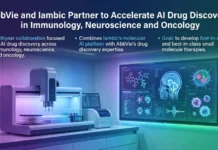









Exscientia, the clinical stage, Artificial Intelligence (AI)-driven pharmatech company, announced that it has entered into a collaboration agreement with Bristol-Myers Squibb Company. This expanded collaboration has the potential to add to the Bristol Myers Squibb drug pipeline whilst enhancing Exscientia’s portfolio of shared assets. The collaboration will use AI to accelerate the discovery of small molecule therapeutic drug candidates in multiple therapeutic areas, including oncology & immunology. The agreement includes up to $50 million in upfront funding, up to $125 million in near to mid-term potential milestones, and additional clinical, regulatory and commercial payments that take the potential value of the deal beyond $1.2 billion. Exscientia will also receive tiered royalties on net sales of any marketed drug products resulting from the collaboration.
This expanded collaboration builds upon Exscientia’s existing collaboration with Bristol Myers Squibb that was initiated in 2019 with Celgene prior to Celgene’s acquisition by Bristol Myers Squibb. Exscientia will take responsibility for AI-design and experimental work necessary to discover drug candidates associated with this collaboration for Bristol Myers Squibb. Molecules will be designed using Exscientia’s AI-driven drug discovery platform, which delivers optimized compounds fulfilling complex design goals faster and more effectively than traditional drug discovery.
Andrew Hopkins, CEO of Exscientia, commented, “We are proud that Bristol Myers Squibb wants to build on our work together with this expanded collaboration and believe it speaks to the strength and promise of Exscientia’s AI technologies and drug discovery expertise. We’re excited to work with such an experienced collaborator as Bristol Myers Squibb to develop the best possible medicines for patients.”
Rupert Vessey, President of Research & Early Development at Bristol Myers Squibb said, “We have been pleased with Exscientia’s work in tackling a number of distinct projects for Bristol Myers Squibb. Exscientia’s application of AI technologies is proving capable of generating best-in-class molecules while also reducing discovery times. Rapid discovery of molecules that can enter the clinic in a timely manner could positively impact our work in discovering treatments for areas of unmet medical need”
Exscientia has already built a strong track record for its drug discovery platform, being the first company to advance AI-designed small molecule drug candidates into clinical studies. In addition to Bristol Myers Squibb, Exscientia has previously entered collaborations with major pharmaceutical companies including Bayer, Sanofi, and Dainippon Sumitomo, multiple emerging biotech companies and the Gates Foundation, demonstrating Exscientia’s reputation as the collaborator of choice for high-value AI-driven drug discovery. The company currently has more than a dozen partnered or wholly owned drugs in development. Exscientia recently secured a $525 million Series D investment, led by Softbank, to further fund expansion of its technology capabilities and proprietary drug pipeline.
About Exscientia
Exscientia’s AI centric, end-to-end drug discovery platform is set to revolutionise the process invention of new drugs, designing therapeutics for areas of high unmet medical need that could positively impact patients, with timelines that are many years shorter than industry standards. As a clinical stage company, Exscientia is the first to advance AI-designed small molecules into a clinical setting, demonstrating the potential of AI to transform the pharmaceutical industry.
Drug design is precision engineering at the molecular scale. To transform the industry, Exscientia has built dedicated AI systems that efficiently learn from the widest range of data and consistently re-apply enhanced knowledge through iterations of design. Because Exscientia’s AI systems learn more rapidly and effectively than human-led efforts, candidate molecules satisfying complex therapeutic requirements are discovered with revolutionary efficiency.