











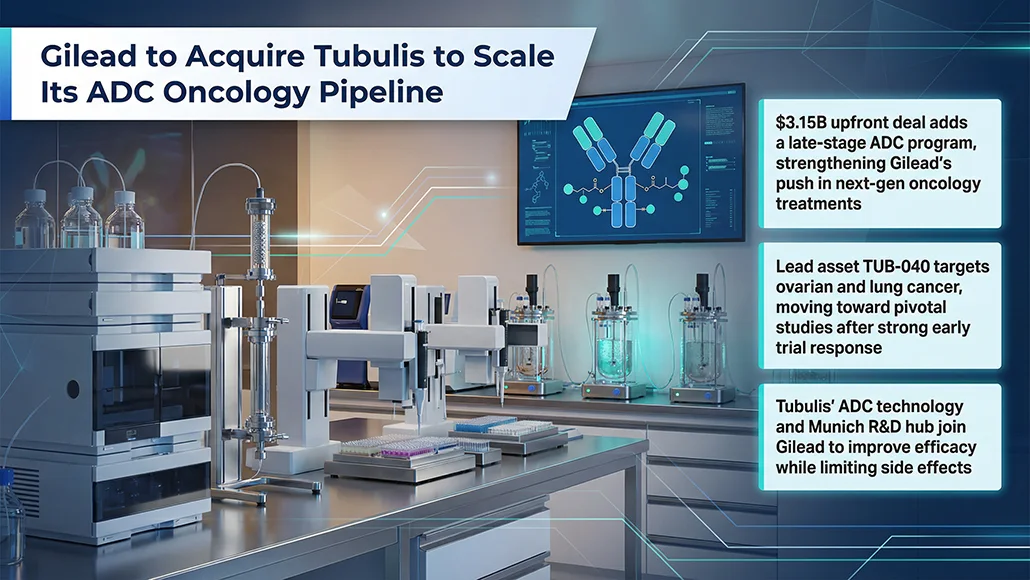
Gilead Sciences has agreed to acquire Germany-based Tubulis in a deal valued at $3.15 billion upfront, with an additional $1.85 billion tied to milestones, as the company advances its position in the rapidly evolving antibody-drug conjugate segment. The acquisition brings in a late-stage asset nearing pivotal trials and marks a significant step in strengthening the group’s ADC pipeline expansion strategy.
The transaction builds on an existing relationship between the two companies. In 2024, Tubulis partnered with Gilead, providing access to its technology platforms while collaborating on an ADC programme. Under that agreement, Gilead paid $20 million upfront and committed up to $415 million in milestones. The partnership followed earlier industry interest, including a collaboration agreement with Bristol Myers Squibb valued at $22.7 million. Tubulis further reinforced its position in the sector by securing €344 million ($401 million) in a series C funding round last year.
This acquisition comes amid a series of deals by Gilead aimed at reinforcing its oncology capabilities. In recent months, the company agreed to acquire Arcellx for $7.8 billion and Ouro Medicines for $1.67 billion, reflecting a sustained push into innovative therapeutic platforms. The strategy gained momentum after CEO Daniel O’Day stated at the J.P.Morgan Healthcare Conference in January that Gilead was pursuing transactions from a “position of strength.”
Tubulis’ lead asset, TUB-040, is a NaPi2b-directed topoisomerase-I inhibitor ADC currently in phase 1b/2 trials targeting platinum-resistant ovarian cancer (PROC) and non-small cell lung cancer. The candidate demonstrated a 59% overall response rate in PROC last year, supporting plans to advance into pivotal studies and broaden its application across earlier disease stages and additional tumour types. Gilead intends to deploy its development capabilities to accelerate progress, positioning the programme as a key component of its ADC pipeline expansion efforts.
The acquisition also provides Gilead with access to Tubulis’ technology, which aims to improve the therapeutic window of ADCs by enhancing efficacy while limiting adverse effects. The Munich-based facility will continue operating as a dedicated research hub, supporting ongoing innovation in the ADC space. The move builds on Gilead’s earlier acquisition of Immunomedics in 2020, which brought the anti-TROP-2 ADC Trodelvy into its portfolio.