














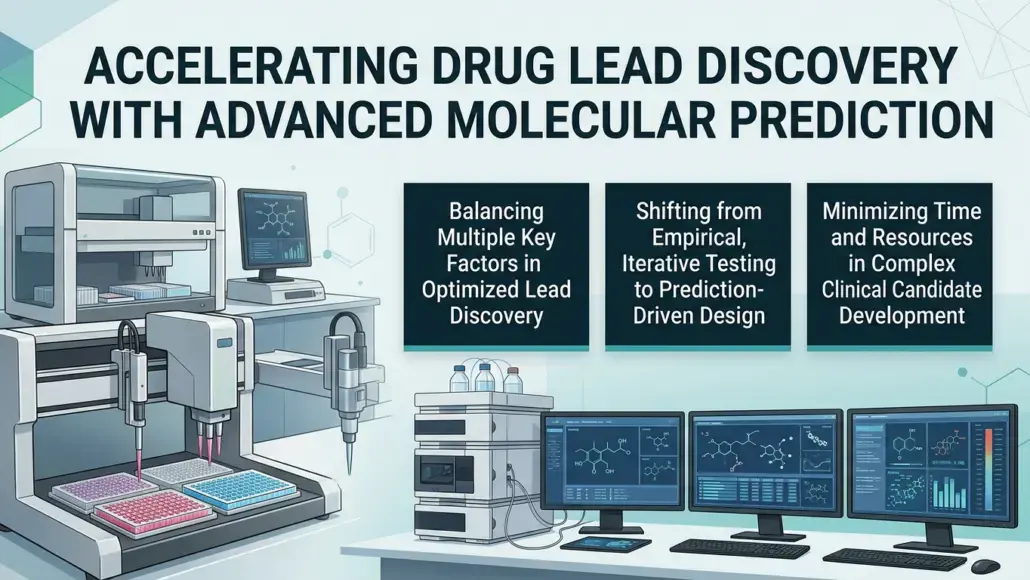
The transformation of a primary “hit” into a clinical candidate is arguably the most complex and resource intensive stage of the drug development lifecycle. This phase, known as lead optimisation, requires the delicate balancing of multiple competing factors, including potency, selectivity, metabolic stability, and safety. Traditionally, this was an empirical process where medicinal chemists synthesized and tested hundreds of analogues in an iterative “Design-Make-Test-Analyze” cycle. The pharmaceutical industry is now shifting toward a more predictive approach where advanced algorithms are used to forecast the properties of a molecule before it is ever synthesized. This shift is driven by the application of sophisticated models for molecular prediction that can evaluate the viability of potential candidates with high precision and speed.
By integrating these predictive tools early in the optimisation phase, researchers can identify and address potential liabilities before significant resources are committed to physical synthesis and biological assay. This foresight allows for a more focused and efficient research program, where only the most promising chemical series are pursued. The goal is to maximize the quality of the candidates that enter the clinical pipeline, thereby reducing the high rates of attrition that have traditionally plagued late stage development. This transition from a reactive to a proactive optimisation strategy is a fundamental advancement in the methodology of modern medicinal chemistry, enabling a more rational and data-driven approach to drug design.
Furthermore, the adoption of digital property prediction addresses the economic pressures facing modern R&D organizations. With the cost of lead optimisation often reaching into the millions of dollars per program, the ability to reduce the number of cycles required to reach a candidate is a major operational advantage. Computational models provide a low cost way to explore thousands of variations in silico, ensuring that laboratory resources are focused on those molecules with the highest probability of success. As these tools become more integrated into the standard workflow, the traditional boundaries between computational and medicinal chemistry continue to dissolve, creating a more collaborative and effective research environment.
Algorithmic Modeling of ADMET and Toxicological Profiles
The technical core of this progress lies in the ability of deep learning models to learn the relationship between a molecule’s chemical structure and its biological behavior. Molecular prediction platforms utilize large datasets of historical experimental results to train neural networks that can forecast a wide range of ADMET (Absorption, Distribution, Metabolism, Excretion, and Toxicity) properties. These models can predict everything from aqueous solubility and membrane permeability to cytochrome P450 inhibition and potential cardiotoxicity. The precision of these predictions is continuously improving as more high quality data is integrated into the training sets, allowing for more nuanced evaluations of complex chemical scaffolds across different biological contexts.
One of the most significant advantages of this approach is the ability to predict potential toxicological issues long before clinical trials. Toxicity remains a leading cause of drug failure, and identifying these risks early is critical for both patient safety and economic efficiency. Algorithms can now screen for structural alerts associated with mutagenicity, hepatotoxicity, and other severe side effects, providing a level of foresight that was previously impossible. By providing a quantitative assessment of risk, these tools allow R&D leadership to make informed “go or no-go” decisions with greater confidence. This data driven risk management is a significant departure from the reliance on animal models, which are often expensive, time consuming, and may not perfectly correlate with human outcomes.
Advanced models are also incorporating physics based descriptors and quantum mechanical calculations to improve the accuracy of their predictions. By understanding the electronic and spatial properties of a molecule, these models can more effectively capture the subtle features that drive biological activity and metabolic stability. This hybrid approach — combining empirical data with fundamental chemical laws — ensures that the predictions are both robust and reliable. As computational power continues to increase, the scale and complexity of these simulations will expand, allowing for the evaluation of even more diverse and exotic chemical structures. The objective is to move toward a state where the majority of the ADMET profile is optimized in a virtual environment, with physical testing reserved for the final confirmation of a candidate’s viability.

Enhancing Multi-Objective Optimization in Medicinal Chemistry
Lead optimisation is fundamentally a multi-objective optimization problem. Improving the potency of a compound often negatively impacts its solubility, metabolic profile, or safety margin. Managing these complex trade-offs requires a sophisticated understanding of the chemical landscape. Molecular prediction tools facilitate this by providing a multi-dimensional view of a molecule’s potential performance. Researchers can use these models to perform “virtual SAR” (Structure-Activity Relationship) studies, exploring thousands of potential modifications in silico to find the optimal balance of properties. This capability allows for the design of “balanced” leads that have a higher probability of succeeding in complex biological systems.
The practical applications of these predictive tools in the medicinal chemistry workflow include:
- Prioritizing the synthesis of analogues with the best predicted safety and efficacy profiles across multiple targets.
- Identifying metabolic “soft spots” in a molecule to guide the design of more stable derivatives with improved half-lives.
- Predicting the brain-blood barrier permeability for central nervous system targets, ensuring that the drug reaches its site of action.
- Optimizing the dosing regimen by forecasting the pharmacokinetic behavior and bioavailability of potential candidates.
- Assessing the potential for reactive metabolite formation, which is a common cause of idiosyncratic toxicity.
- Evaluating the impact of molecular flexibility and polarity on cell permeability and target engagement.
By automating the evaluation of these parameters, organizations can significantly reduce the number of synthesis cycles required to reach a clinical candidate. This acceleration has direct implications for the cost of development and the time to market for novel therapies. The ability to rapidly navigate the chemical space around a lead compound also provides a significant advantage in terms of intellectual property, allowing companies to secure a more robust and defensible patent position. As these tools become more integrated into the standard workflow, the synergy between computational predictions and human expertise will become the primary driver of R&D productivity. This progress is further amplified when foundation models transforming computational drug discovery provide the broad biological context needed for more accurate and generalized property forecasting.
Overcoming Data Heterogeneity and Enhancing Model Reliability
The primary challenge in molecular prediction is the quality and heterogeneity of the underlying data. Experimental results from different laboratories or assays can be inconsistent, leading to “noisy” training sets that degrade model performance and lead to incorrect predictions. To address this, pharmaceutical companies are implementing rigorous data curation and standardization protocols, ensuring that the information used to train their models is as accurate and comparable as possible. There is also a significant move toward “transfer learning,” where models trained on large, public datasets are fine tuned on smaller, high quality proprietary datasets. This approach allows organizations to leverage the vast amount of existing chemical knowledge while still capturing the specific nuances of their own internal research programs.
Another critical area of focus is the development of models that provide an assessment of their own uncertainty. Knowing when a model is “unsure” about a prediction is just as important as the prediction itself, as it prevents researchers from making decisions based on unreliable information. This allows teams to prioritize experimental testing for those compounds where the computational confidence is low, ensuring that laboratory resources are used where they add the most value. As these models become more robust and interpretable, the level of trust among medicinal chemists will continue to grow, leading to more widespread adoption. The ultimate goal is a seamless integration where computational insights are viewed not as a replacement for human judgment, but as an essential tool for augmenting it.
The technical community is also exploring “active learning” strategies, where the model itself selects the most informative compounds for experimental synthesis and testing. By focusing on the most “uncertain” areas of the chemical space, the model can improve its predictive power with the minimum amount of additional experimental data. This iterative process creates a highly efficient learning loop that accelerates the development of accurate property prediction tools. As these systems become more autonomous, the role of the medicinal chemist will shift toward higher-level strategy and the design of novel chemical architectures, while the routine tasks of property optimisation are handled by the AI.
Strategic and Economic Implications for Pharmaceutical R&D
The adoption of advanced molecular prediction technologies is a strategic necessity in an era of increasing pressure on R&D productivity and rising regulatory requirements. The ability to identify high quality leads faster and with a lower failure rate provides a significant competitive advantage in a fast-moving market. This efficiency allows for a more diversified and resilient pipeline, enabling companies to pursue a wider range of therapeutic opportunities with the same level of investment. From an economic perspective, the reduction in the number of “failed” clinical candidates has a profound impact on the overall return on investment for drug discovery programs, ensuring long-term sustainability.
Furthermore, the shift toward predictive modeling supports the development of more personalized and targeted therapies. By understanding the specific molecular properties that correlate with clinical success in different patient populations, pharmaceutical companies can design more effective treatments with fewer side effects. This precision is increasingly important for regulatory approval and for securing favorable pricing and reimbursement terms from global health authorities. As the industry continues to evolve, the integration of data science and traditional medicinal chemistry will remain the hallmark of success. The organizations that can most effectively harness the power of these digital tools will be the ones that define the future of medicine, delivering more effective and safer treatments to patients around the world.
The long term impact of these advancements will be a more ethical and efficient drug discovery process. By reducing the reliance on animal models and by identifying potential safety risks earlier in the process, molecular prediction is contributing to a more sustainable and patient-centric model of innovation. The ability to predict and optimize the properties of a drug at the atomic level is the ultimate goal of the medicinal chemistry discipline, and we are now closer to that reality than ever before. The organizations that lead in the adoption of these technologies will not only see improved commercial outcomes but will also make the most significant contributions to global health and the treatment of complex diseases.