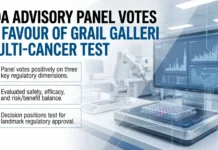












A United States Food and Drug Administration advisory panel has voted in favour of approving GRAIL’s Galleri, positioning the multi-cancer early detection test for a potential landmark regulatory decision in the months ahead.
Panel Votes Across Three Key Dimensions
The ten voting members of the FDA’s Molecular and Clinical Genetics Devices advisory panel evaluated the GRAIL Galleri test across three separate votes, each addressing a distinct dimension of the product’s regulatory profile — safety, effectiveness, and overall benefit-risk assessment — specifically for screening adults aged 50 years and older for the early detection of multiple types of cancer.
The panel voted seven to two in favour of market approval, with one abstention, concluding that the test’s benefits outweighed its risks. The panel unanimously supported Galleri’s safety profile and voted six to four in support of its effectiveness.
How the Galleri Test Works
GRAIL submitted its pre-market approval application for the GRAIL Galleri test to the FDA on 29 January 2026. The test is designed to detect more than 50 types of cancer from a single blood draw. It works by identifying cancer-specific methylation patterns shared across many cancer types through the detection of chemical changes in fragments of cell-free DNA that break off from cancer cells. The test is intended to identify cancer before symptoms appear, including cancers that do not currently have recommended screening protocols in place.
Galleri secured breakthrough device designation from the FDA in 2018. Following the advisory panel’s vote, the FDA is expected to make its final decision on the pre-market approval application in the coming months.
GRAIL Chief Executive Officer Josh Ofman commented on the outcome: “The Galleri test was developed to improve the effectiveness and efficiency of our national cancer screening programme by adding multi-cancer early detection to recommended screening — helping find more cancers safely, when they may be easier and less costly to treat, and it still may be possible for a patient to receive treatment with curative intent.”
Ofman further stated that the panel’s vote reinforced the strength of Galleri’s clinical evidence. “We believe the panel’s recommendations reaffirm a high evidence bar that GRAIL has set for a multi-cancer early detection test,” he concluded.
Panel Endorsement Follows Mixed Results in NHS-Galleri Trial
The FDA panel’s endorsement arrives against the backdrop of a mixed year for the technology. In February, Galleri failed to meet its primary endpoint in a large United Kingdom National Health Service trial. Primary results from the NHS-Galleri trial were presented at the American Society of Clinical Oncology meeting in Chicago in May, with final results from the randomised trial of over 140,000 patients subsequently published in the New England Journal of Medicine on 22 September.
The NHS-Galleri trial sought to determine whether the test’s application within the NHS reduced the likelihood of a late-stage cancer diagnosis in an asymptomatic population. The test’s primary endpoint of a statistically significant Stage III and Stage IV reduction across 12 prespecified cancers was not met.
Despite this outcome, study investigators highlighted that adding annual MCED testing to standard-of-care cancer screening substantially increased screen-detected cancers, reduced Stage IV cancers, and reduced emergency presentations. The investigators suggested that integrating MCED testing into population screening programmes may help reduce late-stage cancer burden.
PATHFINDER 2 Study Findings and Ongoing REACH Study
Also at this year’s American Society of Clinical Oncology meeting, GRAIL presented findings from its 35,878-patient registrational PATHFINDER 2 study. Results indicated that adding Galleri to recommended screenings for breast, cervical, colorectal, and lung cancers — in line with United States Preventive Services Task Force A and B recommendations — led to a 6.5-fold increase in the number of cancers found through screening.
Separately, the GRAIL Galleri test is currently being evaluated in the ongoing United States-based REACH study, which is enrolling 50,000 Medicare beneficiaries who receive usual care alongside a Galleri test. The study includes a matched comparator arm of beneficiaries who receive usual care alone, with the objective of assessing the test’s real-world clinical impact.