








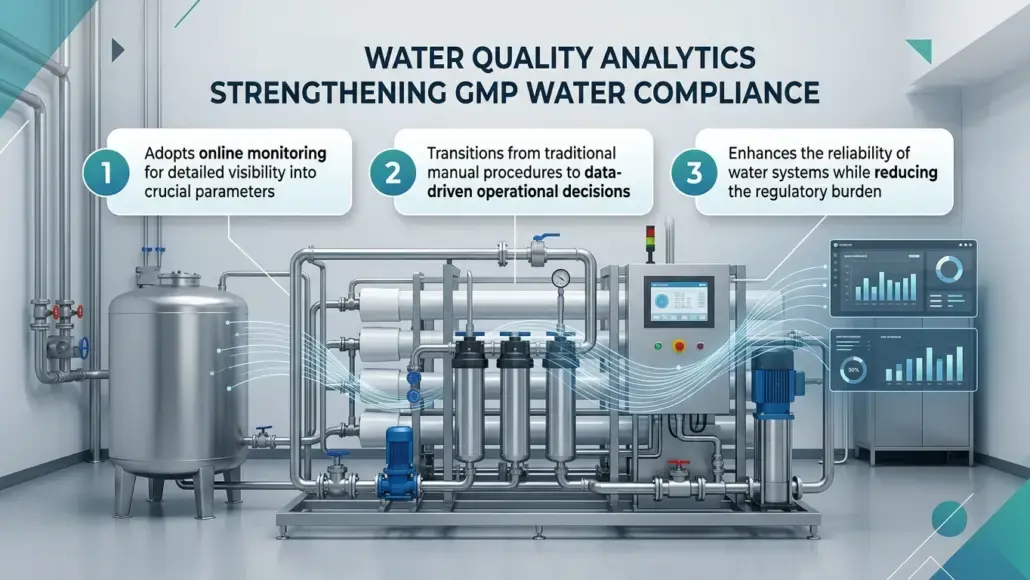
The pharmaceutical industry is undergoing a digital transformation, where data-driven decision-making is replacing traditional manual processes. In the realm of utility management, this shift is most evident in the adoption of monitoring systems that provide a granular view of every critical parameter. Water quality analytics strengthening GMP water compliance has become a strategy for manufacturers looking to improve the reliability of their water systems while reducing the burden of regulatory documentation. By leveraging the power of real-time data, facilities can identify trends, predict potential failures, and maintain a constant state of audit-readiness, thereby ensuring that their water supply always meets the highest standards of purity.
At the heart of this analytical approach is the integration of high-precision sensors with data management platforms. These systems collect an array of information, including conductivity, temperature, total organic carbon, and flow rates, and store it in a secure, centralized database. Unlike paper-based logs, which are prone to errors and difficult to analyze, digital records can be easily queried to provide a history of system performance. This level of transparency is valued by regulatory inspectors, as it demonstrates that the manufacturer has a understanding of their process and is committed to the principles of data integrity.
The use of analytics also allows for more sophisticated levels of process control. By monitoring the performance of individual purification components in real time, manufacturers can identify areas where efficiency can be improved. For example, by analyzing the rejection rates of a reverse osmosis system, engineers can optimize the membrane cleaning schedule, reducing the consumption of chemicals and extending the life of the membranes. This data-driven approach to system management ensures that the water supply remains a reliable and cost-effective utility for pharmaceutical production.
Data Integrity Principles and ALCOA Standards in Analytics
For any analytical system to be used in a GMP environment, it must adhere to data integrity standards. The FDA and other global regulatory bodies have established the ALCOA plus principles to guide the management of electronic records. This means that data must be attributable to the person or system that generated it, legible and permanent, recorded contemporaneously with the event, original or a true copy, and accurate. Water quality analytics strengthening GMP water compliance depends on the implementation of these standards throughout the data lifecycle, from the initial sensor reading to final archival.
Modern analytical platforms achieve this by providing audit trails that track every change to the data or system configuration. User access is strictly controlled through multi-factor authentication, and electronic signatures are used to authorize critical actions. Additionally, the systems are designed with built-in data verification routines that flag any anomalies or suspicious readings for immediate investigation. By automating these compliance tasks, pharmaceutical companies can reduce the risk of human error and ensure that their quality records are always accurate and complete. This foundation of trust in the data is essential for making informed decisions about system operation and maintenance.
The validation of these analytical systems is a critical component of the overall compliance strategy. This involves not only verifying the accuracy of the sensors but also ensuring the security and reliability of the data management software. Computerized System Validation (CSV) is used to demonstrate that the software performs as intended and that it complies with the relevant regulatory requirements. This process includes the development of user requirement specifications, the execution of functional and security testing, and the creation of detailed validation reports. By following a rigorous CSV process, manufacturers can provide a high level of assurance that their water quality analytics are reliable and compliant.
Predictive Analytics and System Maintenance Optimization
One of the applications of water quality analytics strengthening GMP water compliance is in the area of predictive maintenance. By analyzing historical performance data, machine learning algorithms can identify the patterns that precede a component failure. For example, a gradual increase in the differential pressure across a filter or a slow drift in the conductivity of the purified water can indicate that a part is reaching the end of its useful life. By identifying these trends early, maintenance teams can schedule replacements during planned downtime, rather than waiting for a failure to occur during a production run.
This proactive approach not only improves the reliability of the water system but also leads to cost savings. Emergency repairs are often expensive and can lead to production delays and the potential loss of valuable product batches. Additionally, predictive analytics can help to optimize the use of consumables, such as membranes and resins, by ensuring that they are replaced based on actual condition rather than a fixed schedule. This results in less waste and a lower environmental footprint for the manufacturing facility. The integration of these analytical tools into the overall facility management strategy is a driver of operational excellence in the modern pharmaceutical industry.
Predictive models can also be used to simulate the impact of changes in operating conditions on water quality. For example, if the facility expects a significant increase in production demand, the analytical system can predict the impact on the water purification train and suggest necessary adjustments to pump speeds or sanitization frequencies. This allows manufacturers to plan for future demand with confidence, ensuring that the water system always has the capacity and reliability to support the production schedule. This forward-looking approach to system management is a hallmark of a digitally mature pharmaceutical organization.
Enhancing Audit Readiness and Regulatory Reporting
Maintaining a state of constant audit readiness is a challenge for pharmaceutical quality departments. During a regulatory inspection, the ability to quickly and accurately provide documentation for every aspect of the water system is critical. Water quality analytics strengthening GMP water compliance simplifies this process by providing a centralized dashboard where all relevant data and reports can be accessed in seconds. Inspectors can easily review system performance trends, calibration records, and deviation reports, providing them with a picture of the system’s state of control.
The analytical systems can be programmed to automatically generate the periodic reports required by regulatory agencies. This includes the annual product quality reviews and the periodic reviews of the water system validation. By automating the compilation of these reports, quality teams can save hundreds of hours of manual labor and ensure that the information provided is consistent and accurate. The ability to present clear, well-organized data to an inspector not only facilitates a smoother audit process but also builds a positive relationship between the manufacturer and the regulatory body. This transparency is a element of a successful compliance strategy.
The use of analytics also supports the management of deviations and out-of-specification (OOS) events. When a sensor detects a quality excursion, the system can automatically trigger an investigation workflow, collecting all relevant data and providing a structured framework for identifying the root cause. This ensures that deviations are addressed in a timely and consistent manner and that the corrective and preventive actions (CAPA) are thoroughly documented. By streamlining the deviation management process, pharmaceutical companies can minimize the impact of quality issues on production and maintain a high level of GMP compliance.
Future Trends in Digital Water Management and AI Integration
As technology continues to evolve, the capabilities of water quality analytics strengthening GMP water compliance will only continue to expand. The integration of artificial intelligence and the Internet of Things (IoT) will allow for even sophisticated levels of system control and optimization. For example, AI-powered systems could automatically adjust the operation of the purification train in response to changes in feed water quality or production demand, ensuring that water is always produced at the lowest possible cost. Additionally, the use of blockchain technology could provide an even secure and immutable record of water quality data, further enhancing data integrity.
The transition to digital water management also provides an opportunity for greater collaboration and data sharing across the pharmaceutical industry. By benchmarking their performance against industry standards, manufacturers can identify areas for improvement and adopt best practices from their peers. This collective focus on quality and innovation will drive the development of more efficient and sustainable water systems, supporting the delivery of safe and effective medications to patients around the world. The role of analytics in this process is fundamental, providing the insights needed to manage the regulatory and technical environment of pharmaceutical manufacturing.
Another emerging trend is the use of virtual reality (VR) and augmented reality (AR) for operator training and system maintenance. By overlaying digital information on the physical water system, AR can guide technicians through complex maintenance tasks and provide real-time performance data. VR can be used to create immersive training simulations where operators can practice responding to system alarms and deviations in a safe environment. These technologies, when integrated with a comprehensive analytical platform, provide a powerful tool for improving the skills and efficiency of the facility staff, further enhancing the reliability and compliance of the pharmaceutical water system.
Integrating Water Analytics into the Quality Management System
The value of water quality analytics is maximized when it is integrated into the facility’s overall quality management system (QMS). This ensures that water quality data is used to inform manufacturing decisions and that any quality issues are addressed within a structured framework. For example, the analytical system can be linked to the Enterprise Resource Planning (ERP) system to ensure that production is only scheduled when the water system is in a state of control. Similarly, integration with the Laboratory Information Management System (LIMS) allows for a more comprehensive view of water quality by combining online sensor data with the results of manual microbial testing.
This integrated approach to quality management provides a level of oversight and control that is essential for modern pharmaceutical manufacturing. It allows for the identification of systemic quality issues and the development of facility-wide improvement initiatives. By making water quality data accessible to all relevant departments, from production and maintenance to quality assurance and regulatory affairs, manufacturers can foster a culture of quality and ensure that everyone is working toward the same goal of producing safe and effective medications. This approach is therefore a technical tool and a strategic asset for the entire organization.
The final element of a successful analytical strategy is a commitment to continuous improvement. Pharmaceutical companies should regularly review their analytical capabilities and their data management procedures to identify areas for enhancement. This may involve the adoption of new sensor technologies, the refinement of predictive models, or the expansion of the data integration framework. By staying at the forefront of digital innovation, manufacturers can ensure that their water systems remain compliant and effective in an increasingly demanding global market. This ongoing focus on excellence is essential for the long-term success of pharmaceutical manufacturing and for the safety and well-being of patients.