













Close
CDMO Safety Testing 2026
Novotech

Fujifilm Advances Drug Discovery with New Cyclic Peptide Screening Platform

Note* - All images used are for editorial and illustrative purposes only and may not originate from the original news provider or associated company.

Subscribe

- Never miss a story with notifications

- Gain full access to our premium content

- Browse free from any location or device.

Media Packs

Expand Your Reach With Our Customized Solutions Empowering Your Campaigns To Maximize Your Reach & Drive Real Results!

โ€“ Access the Media Pack Now

โ€“ Book a Conference Call

โ€“ Leave Message for Us to Get Back

Related stories

BeOne Signs $2B Trispecific Antibody Deal with Huahui Health

BeOne Medicines has entered into a high-value agreement with...

Quantum Machine Learning in Pharma Research Growth

The convergence of artificial intelligence and quantum processing is opening new avenues for rapid discovery and innovation within the life sciences. By utilizing advanced mathematical models that operate across multi-dimensional datasets, researchers can now identify complex biological patterns and predict molecular behaviors with a speed that surpasses traditional computational methods. This transformation is accelerating the development of novel therapies and providing deeper insights into disease mechanisms, fundamentally altering the trajectory of pharmaceutical research and development.
- Advertisement -

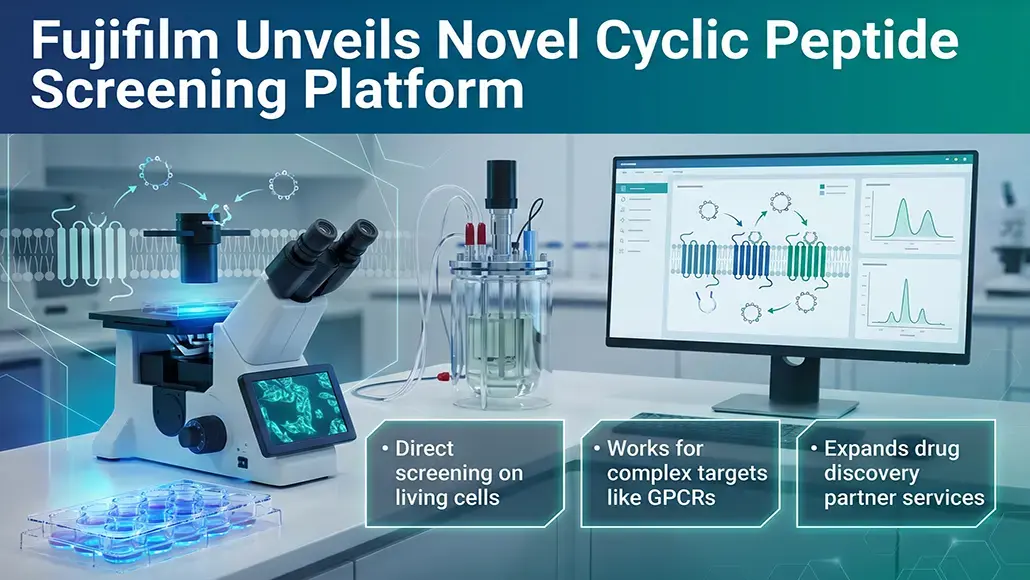
FUJIFILM Corporation has developed a new screening methodology aimed at identifying cyclic peptides with high affinity toward membrane proteins, including complex multi-pass transmembrane proteins that have traditionally been difficult to target in drug discovery research. The company announced that the technology will be presented during the TIDES USA exhibition taking place from May 11 to 14, 2026, at the Hynes Convention Center. The development strengthens Fujifilmโ€™s peptide discovery services, which have utilized proprietary mRNA display technology since 2023. The company said the newly developed approach broadens the potential of cyclic peptide screening for membrane protein targets that are beyond the reach of conventional methods.

Cyclic peptides containing unnatural amino acids are gaining attention in pharmaceutical research because of properties such as tissue permeability, synthetic flexibility, and high target affinity. Fujifilm noted that previous screening methods depended on the isolation and purification of target proteins, a process that can disrupt the native three-dimensional structures of proteins such as multi-pass transmembrane proteins. The company also stated that using live cells for peptide discovery created additional limitations because mRNA tags in peptide libraries were susceptible to degradation in cell culture media under earlier techniques.

To address these issues, Fujifilm designed a peptide library incorporating mRNA tags resistant to degradation in cell culture media. This enabled direct screening of peptides against multi-pass transmembrane proteins expressed on living cell surfaces. Using the method, the company identified peptides that selectively bind to G protein-coupled receptors (GPCRs), which are regarded as important pharmaceutical targets among multi-pass transmembrane proteins. Fujifilm said the technology is expected to expand opportunities for peptide discovery involving challenging membrane proteins while supporting a broader range of customer requirements in drug discovery research. The company added that it continues to expand global services related to peptide therapeutics, including peptide discovery, high-throughput screening, structural optimization, peptide chemical synthesis, and target protein expression and purification. Fujifilm said the advancement of cyclic peptide screening aligns with its broader healthcare research and development initiatives focused on peptide therapeutics.


Latest stories

Related stories

BeOne Signs $2B Trispecific Antibody Deal with Huahui Health

BeOne Medicines has entered into a high-value agreement with...

Quantum Machine Learning in Pharma Research Growth

The convergence of artificial intelligence and quantum processing is opening new avenues for rapid discovery and innovation within the life sciences. By utilizing advanced mathematical models that operate across multi-dimensional datasets, researchers can now identify complex biological patterns and predict molecular behaviors with a speed that surpasses traditional computational methods. This transformation is accelerating the development of novel therapies and providing deeper insights into disease mechanisms, fundamentally altering the trajectory of pharmaceutical research and development.

Quantum Sensors Enabling Advanced Drug Diagnostics

The landscape of medical diagnostics is being reshaped by the introduction of sensing technologies that operate with atomic-level sensitivity. By providing high-fidelity measurements and real-time data, these tools allow for the detection of subtle biological changes and chemical markers that were previously invisible to conventional equipment. This advancement is enhancing the precision of drug testing and clinical monitoring, leading to earlier disease detection and more effective therapeutic interventions across the global healthcare spectrum.

Subscribe

- Never miss a story with notifications

- Gain full access to our premium content

- Browse free from any location or device.

Media Packs

Expand Your Reach With Our Customized Solutions Empowering Your Campaigns To Maximize Your Reach & Drive Real Results!

โ€“ Access theMedia Pack Now

โ€“ Book a Conference Call

โ€“ Leave Message for Us to Get Back

Translate ยป