






The pharmaceutical industry stands at a historical crossroads where the traditional methods of drug development are no longer sufficient to meet the rising global demand for complex therapies. For decades, the process of bringing a new drug to market has been characterized by astronomical costs, high failure rates, and timelines that span over a decade. At the heart of this inefficiency lies a fundamental computational bottleneck: the inability of classical computers to accurately model the quantum mechanical behavior of molecules. As we move deeper into the twenty-first century, the integration of quantum computing drug discovery models is emerging as the definitive solution to these challenges, promising to redefine the boundaries of medical science and therapeutic innovation.
The fundamental shift from classical to quantum architectures
To understand why quantum computing drug discovery is so transformative, one must first recognize the inherent limitations of the binary systems that have powered research for the last fifty years. Classical computers operate on bits units of information that are either a zero or a one. While these systems are incredibly efficient for bookkeeping and simple logical operations, they struggle immensely when tasked with simulating the natural world at a molecular level. Molecules are quantum systems; their properties are governed by the complex interplay of electrons and nuclei, which exist in states of probability and overlap. Attempting to simulate a medium-sized molecule on a classical supercomputer requires an exponential increase in memory and processing power for every atom added. Consequently, researchers have been forced to rely on approximations and simplified models, which often fail to predict how a drug will actually behave in the human body.
Quantum computers diverge from this binary path by utilizing qubits. Unlike bits, qubits can exist in a state of superposition, representing both zero and one simultaneously. Furthermore, through the phenomenon of entanglement, qubits can be linked such that the state of one instantaneously influences the state of another, regardless of distance. This unique architecture allows quantum systems to process information in a way that mirrors the actual physics of molecules. Instead of approximating a chemical reaction, a quantum computer can simulate it exactly. This capability is the cornerstone of drug discovery innovation, providing a digital laboratory where molecular interactions are mapped with absolute precision before a single physical experiment is ever conducted in a wet lab.
Overcoming the hurdles of molecular simulation and target identification
One of the most critical stages in the pharmaceutical pipeline is target identification the process of finding a specific biological molecule, usually a protein, that is involved in a disease. Once a target is identified, researchers must find a “lead” compound that can bind to this target and modify its activity. In the current landscape, this is often a “trial and error” process at a massive scale. Scientists screen libraries of millions of chemical compounds, hoping to find a match. This high-throughput screening is expensive and frequently results in false positives or compounds that show promise in a petri dish but fail in human trials due to unforeseen toxicity or lack of efficacy.
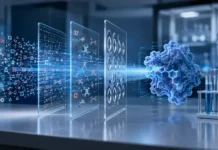
Quantum computing drug discovery models revolutionize this stage by enabling deep molecular simulation. By accurately calculating the binding affinity of a compound to a target protein, quantum algorithms can identify the most promising candidates with a much higher success rate. This precision is particularly vital when dealing with “undruggable” targets proteins with complex structures that classical models cannot accurately map. With the ability to simulate the electronic structure of these proteins, quantum technology allows scientists to design custom molecules that fit like a key into a lock. This shift from discovery to design is a hallmark of pharma R&D technology, moving the industry away from randomized searching toward intentional, data-driven engineering.
Enhancing lead optimization and pharmacokinetic modeling
After a potential compound is identified, it must undergo lead optimization to improve its safety and effectiveness. This involves making minor adjustments to the molecule’s structure to enhance its ability to reach the target site in the body while minimizing side effects. This phase is notoriously difficult because changing one atom in a molecule can drastically alter its entire chemical profile. Classical simulations often miss these subtle shifts, leading to failures late in the development cycle.
The application of quantum computing drug discovery in lead optimization allows for the exploration of a much wider chemical space. Researchers can use quantum algorithms to predict the stability, solubility, and metabolic pathways of a drug candidate with extreme accuracy. This is part of the broader trend in pharma R&D technology where computational models are used to “fail fast” and “fail cheap.” By identifying problematic molecules in the digital phase, companies can focus their resources on the candidates that have the highest probability of success. This not only accelerates the timeline but also ensures that the drugs reaching clinical trials are safer and more effective.
The economic impact and global R&D efficiency
Beyond the scientific breakthroughs, the adoption of quantum computing drug discovery has profound economic implications for the global healthcare system. The current “Eroom’s Law” the observation that drug discovery is becoming slower and more expensive over time despite technological advances has put immense pressure on healthcare budgets. The cost of failure is the primary driver of high drug prices. When nine out of ten drugs fail in clinical trials, the cost of those failures must be recouped by the one drug that succeeds.
By improving the predictive power of early-stage research, quantum technology directly addresses the root cause of these failures. A more efficient pharma R&D technology landscape means that fewer resources are wasted on dead-end leads. This efficiency could lead to a dramatic reduction in the cost of developing new medicines, potentially making rare disease treatments and personalized therapies more affordable for patients worldwide. Furthermore, the speed at which quantum systems can process complex datasets allows the industry to respond more rapidly to emerging health threats, such as new viral strains or antibiotic-resistant bacteria, highlighting the role of quantum algorithms healthcare in global biosecurity.
Strategic partnerships and the path to quantum advantage
The transition to a quantum-powered pharmaceutical industry is not happening in isolation. It is characterized by a surge in strategic partnerships between technology giants, quantum startups, and global pharmaceutical leaders. Companies like IBM, Google, and IonQ are working closely with researchers at organizations like Bayer, Boehringer Ingelheim, and Roche to develop specialized quantum algorithms tailored for chemical simulation. These collaborations are essential because they bridge the gap between hardware development and domain-specific expertise.
We are currently in the “Noisy Intermediate-Scale Quantum” (NISQ) era, where quantum computers are powerful but still prone to errors. However, even in this stage, hybrid models which combine the strengths of classical and quantum systems are already showing promise. These hybrid approaches use classical computers for data management and quantum processors for the heavy lifting of chemical calculations. As hardware continues to mature and error-correction techniques improve, the industry will reach “quantum advantage,” the point at which quantum systems can perform tasks that are simply impossible for any classical computer. This milestone will mark the beginning of a new era in drug discovery innovation, where the most complex biological puzzles can be solved in a matter of weeks rather than decades.
Integrating quantum insights into a holistic healthcare ecosystem
The long-term vision for quantum computing drug discovery extends beyond the lab and into the broader healthcare ecosystem. As our understanding of molecular biology deepens through quantum insights, we will see a convergence of genomics, proteomics, and drug development. This holistic approach will enable the creation of “digital twins” of patients highly accurate computational models that allow doctors to test the efficacy of a drug on a virtual version of a patient before prescribing it.
This level of treatment personalization is the ultimate goal of modern medicine. By combining quantum computing pharma capabilities with real-world patient data, the industry can move toward a preventive model of healthcare. Instead of treating symptoms, we will be able to intervene at the molecular level to correct imbalances before they manifest as disease. The integration of quantum algorithms healthcare is thus not just a tool for drug companies, but a foundational technology for a healthier and more resilient global population.
Conclusion: Embracing the quantum future of medicine
The journey toward fully realizing the potential of quantum computing drug discovery is a marathon, not a sprint. It requires significant investment in infrastructure, a new generation of scientists trained in both quantum physics and biology, and a regulatory framework that can keep pace with rapid technological change. However, the evidence is clear: the classical approach to drug development has reached its limit. To overcome the diseases of the future, we must embrace the physics of the future.
Quantum technology offers more than just a faster way to do things; it offers a different way to think about biology. It provides the clarity needed to navigate the vast and complex chemical universe, ensuring that the medicines of tomorrow are discovered with precision, developed with efficiency, and delivered with the certainty that they will work. As we continue to refine these models and scale the technology, the dream of a world where no disease is “untreatable” becomes a tangible reality. The era of quantum-accelerated drug discovery has begun, and its impact will be felt for generations to come.