












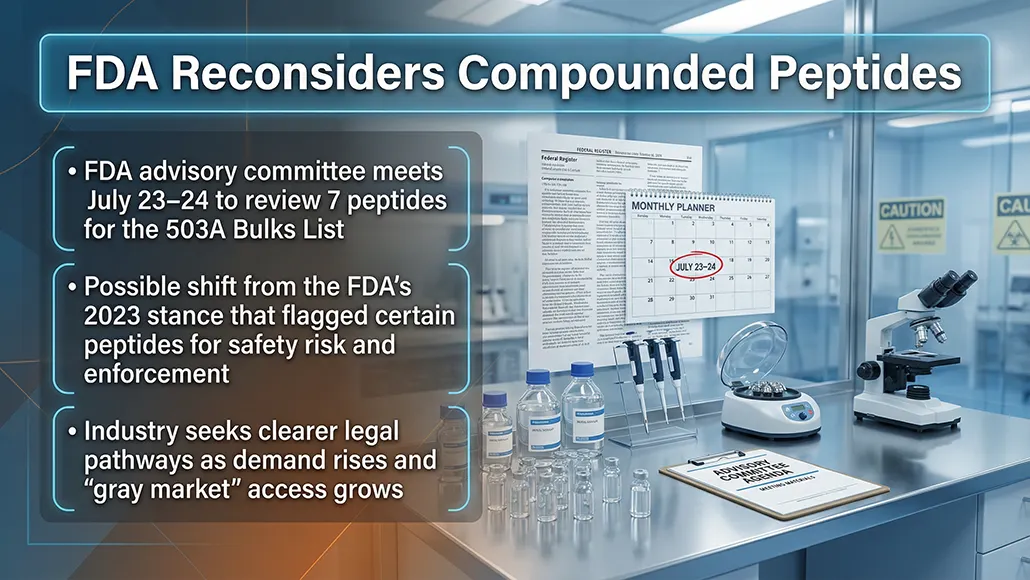
The U.S. Food and Drug Administration is preparing to revisit its stance on a group of peptide substances, as its Pharmacy Compounding Advisory Committee schedules a summer meeting that could influence how these products are regulated. The FDA advisory panel is set to evaluate whether certain peptides currently restricted from compounding use should be reconsidered, marking a possible shift from the agency’s 2023 position. The discussion reflects growing pressure from both industry stakeholders and policymakers amid increasing demand for peptide-based treatments in wellness and therapeutic applications.
According to a notice in the Federal Register, the committee will meet on July 23 and July 24 to assess seven peptide substances proposed for inclusion on the 503A Bulks List. This list identifies substances that can be used by physicians and pharmacies to compound medications. These peptides are being examined for potential applications including ulcerative colitis, wound healing, obesity, and opioid withdrawal. In 2023, the FDA removed 17 substances from consideration for the same list, assigning them to category 2 due to safety concerns. Category 2 classification indicates that the agency “would consider” enforcement action against compounders using these substances, citing that it has “identified significant safety risks relating to the use of these substances in compounding.”
The FDA’s earlier restrictions were largely based on insufficient clinical data supporting both safety and efficacy in human use. Reports have highlighted that many of these substances lack meaningful evidence to substantiate their therapeutic claims. However, the regulatory outlook appears to be evolving, partly influenced by broader policy discussions. Robert F. Kennedy Jr., Secretary of the Department of Health and Human Services, has publicly supported peptides, stating he is a “big fan” and has used them “with really good effect” on prior injuries. He also argued that the FDA “illegally” categorized certain peptides under stricter controls during the Biden administration, which he claims contributed to the emergence of a “black market” for these products.
The renewed scrutiny comes as the FDA intensifies oversight of compounding practices, particularly in relation to GLP-1 drugs used for weight loss. Following the resolution of shortages of branded GLP-1 medications from Novo Nordisk and Eli Lilly, compounded versions were deemed illegal, prompting pharmacies to argue that personalized formulations remain permissible. Industry participants have responded to the upcoming review with cautious optimism. Hims & Hers, a company active in compounding GLP-1 drugs, described the FDA advisory panel plans as “an important step toward moving these treatments out of the gray market, and into more trusted channels,” according to its chief medical officer, Pat Carroll, M.D. The July session will also mark the end of a nine-month gap in advisory committee meetings, with the last discussion on bulk drug substances held in late 2024.