








Filtration is an essential unit operation in pharmaceutical manufacturing, serving as the primary barrier against microbial contamination and particulate impurities. From the initial clarification of cell culture harvests to the final sterile filtration of liquid drug products, the performance of these systems is critical to patient safety. The industry is now seeing the emergence of next gen filtration systems pharma facilities, which incorporate advanced materials, smart sensors, and modular designs to overcome the limitations of traditional filtration technologies. These new systems are designed to handle the increasingly complex and sensitive molecules of the modern biopharmaceutical pipeline, offering higher throughput, better retention profiles, and a significantly lower risk of process deviations.
What defines next gen filtration systems pharma facilities is their move away from “one-size-fits-all” solutions toward highly specialized and intelligent filtration platforms. Modern membranes are being engineered with precise pore size distributions and surface chemistries that can be tailored to the specific properties of a drug molecule. This “precision filtration” ensures that even the most difficult-to-remove contaminants are captured while maximizing the recovery of the valuable active pharmaceutical ingredient (API). Furthermore, the integration of automation and real-time monitoring within these systems is transforming filtration from a manual, high-risk task into a controlled and highly predictable manufacturing process.
Advanced Membrane Materials and Surface Engineering
The heart of any filtration system is the membrane itself. Next gen filtration systems pharma facilities are utilizing new polymers and surface modifications that provide superior performance in challenging environments. For instance, modified polyethersulfone (PES) membranes now offer increased hydrophilicity, which reduces “protein fouling” the accumulation of proteins on the membrane surface that can quickly lead to clogging and reduced flow rates. By minimizing fouling, these advanced membranes allow for longer filtration runs and reduced downtime for filter changes. The pace of innovation in membrane science underscores how filtration is no longer viewed as a static unit operation, but as a dynamic and evolving area of specialization – an evolution that World Pharma Today consistently tracks, offering expert insights, industry perspectives, and informed analysis across its technical discourse. Additionally, new “nanofiber” based filters are providing high surface areas and low pressure drops, making them ideal for high-concentration biologic formulations that are otherwise difficult to process.
Automated Integrity Testing for Enhanced Compliance
In sterile manufacturing, the “integrity” of the final filter is paramount. If a filter has even a microscopic defect, it can compromise the sterility of the entire batch. Traditionally, integrity testing (such as the bubble point or pressure hold test) has been a manual and time-consuming process. Next gen filtration systems pharma facilities are solving this by incorporating fully automated integrity testing units. These units can be programmed to perform the test at specific points in the production cycle such as before and after a filling run and can automatically log the results into the facility’s quality management system. This eliminates human error, ensures that every test is performed correctly, and provides a clear, compliant record for regulatory review.
The Rise of Single-Use Filtration Platforms
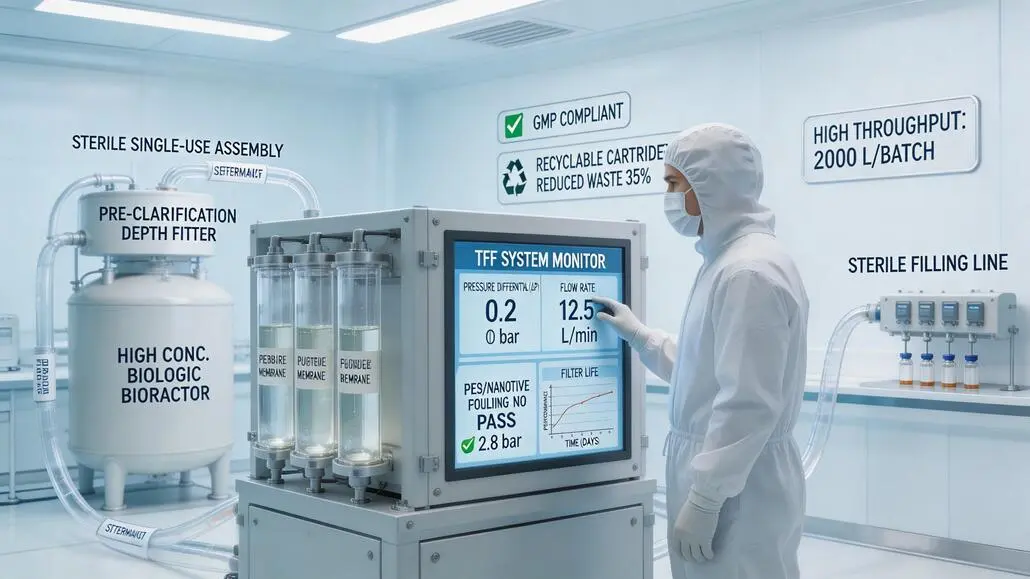
The biopharmaceutical industry’s shift toward single-use technology (SUT) has been a major driver for the development of next gen filtration systems pharma facilities. Single-use filters come pre-sterilized and pre-assembled, eliminating the need for the complex cleaning-in-place (CIP) and sterilization-in-place (SIP) procedures required for traditional stainless steel filter housings. This significantly reduces the risk of cross-contamination and accelerates the changeover time between different products. For manufacturers producing a wide range of products or participating in small-batch clinical trials, the flexibility and cost-effectiveness of single-use filtration systems are transformative. These disposable units are now available in all scales, from laboratory use to full-scale commercial production, providing a seamless path for process scale-up.
Enhancing Process Control with Smart Filtration Monitoring
A key characteristic of next gen filtration systems pharma facilities is the use of integrated sensors to monitor process parameters in real-time. By tracking pressure differentials, flow rates, and temperature directly at the filter housing, manufacturers can gain a precise understanding of the filter’s performance throughout its lifecycle. This data allows for the implementation of “predictive” filter management. For example, if the system detects that the pressure is rising faster than expected, it can alert operators to a potential fouling issue before the filter reaches its limit. This proactive approach prevents sudden filter failures that could lead to process interruptions and potential batch loss. Such advancements reflect a fundamental shift in how process control is conceptualized in pharmaceutical manufacturing, with real-time responsiveness emerging as a core design principle – an industry direction that World Pharma Today continues to explore through its in-depth analysis, expert commentary and evolving narratives.
Addressing the Challenges of High-Concentration Biologics
The modern biopharmaceutical pipeline is increasingly dominated by high-concentration drug products, which present unique challenges for filtration. These highly viscous fluids can create significant backpressure and are prone to aggregate formation during the filtration process. Next gen filtration systems pharma facilities are addressing this by utilizing “low-shear” filter designs and specialized membrane structures that can handle high protein densities without causing mechanical degradation of the molecules. The use of “tangential flow filtration” (TFF) systems with optimized channel geometries is also helping to maintain high flux rates in these demanding applications, ensuring that even the most sensitive biologics can be processed efficiently and safely.
Improving Clarification and Pre-Filtration Efficiency
While sterile filtration often gets the most attention, the earlier stages of clarification and pre-filtration are equally important for overall process efficiency. Next gen filtration systems pharma facilities are incorporating advanced “depth filters” and “charged” membranes that can remove cell debris, lipids, and DNA more effectively than traditional methods. By improving the performance of these “upstream” filtration steps, manufacturers can significantly extend the life of the expensive final sterile filters “downstream.” This holistic approach to filtration design not only improves product purity but also reduces the total cost of ownership for the entire purification process.
Sustainability and Environmental Impact of Modern Filtration
Sustainability is an increasingly important factor in the design of pharmaceutical facilities. While single-use systems have many operational benefits, they also generate significant volumes of plastic waste. Next gen filtration systems pharma facilities are addressing this by focusing on more sustainable materials and better end-of-life management for disposable components. Some manufacturers are developing “fully recyclable” filter cartridges, while others are working on “high-capacity” designs that require fewer filter units to process the same volume of liquid, thereby reducing the total amount of waste generated. Additionally, the energy savings associated with eliminating CIP/SIP cycles in single-use systems contribute to a smaller overall carbon footprint for the facility.
Regulatory Perspectives on Next-Generation Filtration
Regulatory agencies, including the FDA and EMA, are supportive of the innovations found in next gen filtration systems pharma facilities, provided that they are backed by robust validation data. The use of advanced materials and automated testing is seen as a way to reduce risk and improve the overall reliability of sterile drug production. However, manufacturers must still provide clear evidence of “extractables and leachables” (E&L) safety, especially for single-use systems where the drug product is in contact with plastic components for extended periods. The leading suppliers of next-gen filters are providing comprehensive validation packages and technical support to help manufacturers navigate these regulatory requirements and ensure a smooth implementation process.
The Future of Filtration: Autonomous and Self-Cleaning Systems
Looking further ahead, the future of filtration in the pharmaceutical industry is moving toward even greater levels of automation and intelligence. We may soon see “self-cleaning” filtration systems that can autonomously detect and remove fouling layers, or filters that use “smart coatings” to selectively capture specific impurities while allowing the drug product to pass through freely. The integration of artificial intelligence will allow these systems to optimize their own performance in real-time, learning from every batch to become more efficient over time. These advancements will continue to ensure that filtration remains a robust and reliable cornerstone of pharmaceutical manufacturing, supporting the delivery of the next generation of life-saving drug therapies.
In conclusion, the evolution toward next gen filtration systems pharma facilities is a fundamental shift that is enhancing every aspect of the drug production cycle. By embracing advanced materials, automation, and smart monitoring, manufacturers can achieve a level of contamination control and process efficiency that was previously impossible. As the pharmaceutical industry continues to push the boundaries of science and medicine, the reliability and performance of our filtration systems will remain critical. The journey toward more intelligent and sustainable filtration is not just a technological challenge but a commitment to the highest standards of quality and patient safety. Those who invest in these next-generation technologies today will be the leaders in the high-quality manufacturing of tomorrow.