









The pharmaceutical industry has undergone a monumental shift in recent years, with the focus moving from simple small-molecule drugs to complex, large-molecule biologics. These advanced therapies, which include monoclonal antibodies (mAbs), recombinant proteins, and vaccines, are the result of sophisticated bio technological processes. However, their complexity comes with a significant challenge: these molecules are inherently fragile. Unlike their small-molecule counterparts, biologics are highly sensitive to their physical environment. They can easily denature or aggregate when exposed to mechanical stresses, such as those generated by the pumps used in manufacturing loops. Consequently, the implementation of low shear pumping for sensitive biologic drugs stability has become a non-negotiable requirement for biopharmaceutical manufacturers seeking to maintain product integrity and patient safety. Across the evolving biologics landscape, industry narratives increasingly point to fluid handling precision as a defining factor in process success – an area gaining heightened attention in ongoing coverage by World Pharma Today.
Shear stress is a mechanical force that occurs when different layers of a fluid are moved at different velocities. In a typical pump, high-speed rotating components like the impellers in a centrifugal pump or the teeth in a gear pump create intense velocity gradients. For a large, folded protein molecule, these forces can be devastating. The shear stress can physically “unfold” the protein, a process known as denaturation, or it can cause the molecules to collide and stick together, forming aggregates. Aggregation is a major quality concern, as it can reduce the biological activity of the drug and, more critically, increase its “immunogenicity” the risk that the drug will trigger a dangerous immune response in the patient. Low shear pumping for sensitive biologic drugs stability addresses these risks by providing a gentle fluid transport mechanism that preserves the delicate tertiary and quaternary structures of the molecules.
The Molecular Science of Shear Sensitivity in Bioprocessing
To understand why low shear pumping for sensitive biologic drugs stability is so critical, one must look at the molecular level. Proteins are held together by a combination of weak hydrogen bonds, van der Waals forces, and hydrophobic interactions. These forces are enough to maintain the protein’s functional 3D shape under physiological conditions, but they are easily overwhelmed by the turbulent forces found inside standard pumps. When a protein denatures, its hydrophobic core is exposed to the surrounding aqueous environment. In an attempt to hide these “water-fearing” regions, the unfolded proteins will clump together. This aggregation is often irreversible and can lead to the presence of visible or sub-visible particles in the final drug product, both of which are grounds for batch rejection by regulatory authorities.
Evaluating Pump Technologies for Gentle Fluid Handling
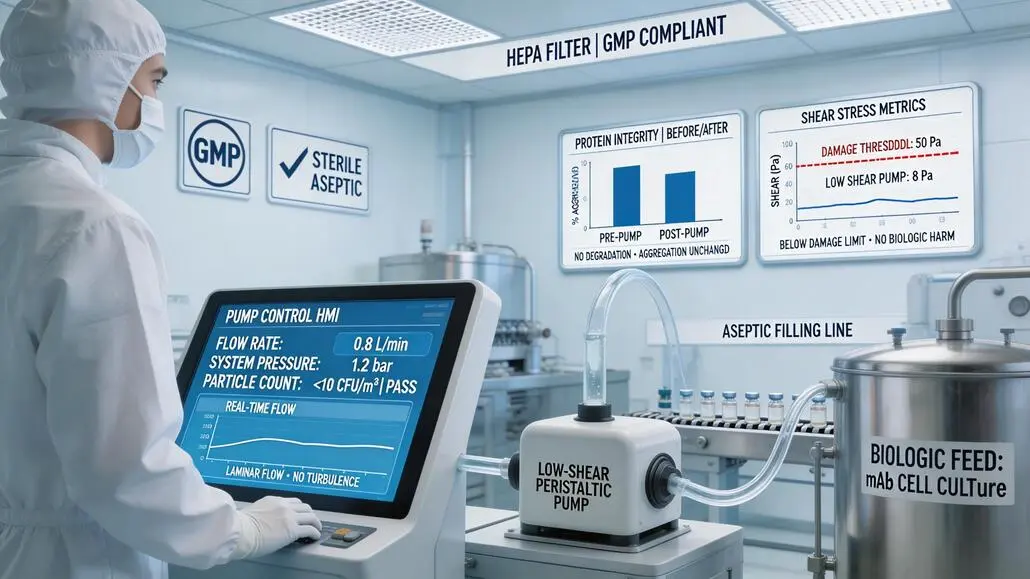
The choice of pump technology is the most important factor in achieving low shear pumping for sensitive biologic drugs stability. Several specialized pump types have been developed specifically for this purpose. Peristaltic pumps are widely used in laboratories and small-scale production because they move the fluid by gently squeezing a flexible tube, avoiding any contact between the fluid and moving mechanical parts. For larger scales, quaternary diaphragm pumps are a popular choice. These pumps use four chambers that work in a synchronized sequence to provide a very smooth, low-pulsation flow that minimizes shear. Another innovative solution is the “levitating” centrifugal pump, which uses magnetic bearings to keep the impeller suspended in a magnetic field. This eliminates friction and reduces the turbulent hotspots that are common in traditional centrifugal designs, making it an ideal choice for the most sensitive biologics.
Balancing Throughput and Stability in Fill-Finish Operations
The final stages of biopharmaceutical production, known as the fill-finish process, are a particularly high-risk area for shear-induced damage. During fill-finish, the drug product must be rapidly and accurately dispensed into vials, syringes, or cartridges. The high speeds required to meet production targets can lead to significant shear stress at the pump head and the filling nozzle. Low shear pumping for sensitive biologic drugs stability is essential here to ensure that the drug reaches the final container in its most potent and safe form. Manufacturers often use precision-controlled low-shear pumps that can deliver a “pulse-free” flow, which not only protects the molecules but also improves the accuracy of the fill volume, reducing product waste and ensuring that every patient receives the correct dose.
Quality by Design (QbD) and the Role of Process Characterization
The selection of a pumping system is no longer a matter of trial and error; it is now a core part of the “Quality by Design” (QbD) framework. QbD requires manufacturers to have a deep understanding of their product and the processes used to make it. This involves “process characterization” studies, where the biologic is exposed to varying levels of shear in a controlled environment to determine its specific “shear threshold.” Once this threshold is known, engineers can select and validate a pumping system that operates well within those safety limits. Low shear pumping for sensitive biologic drugs stability is thus a measurable and manageable part of the overall quality strategy, providing documented evidence that the manufacturing process is designed to protect the molecule’s integrity from the very beginning.
Scaling Up Bioprocesses with Integrity in Mind
One of the most challenging aspects of biomanufacturing is the transition from small-scale laboratory development to large-scale commercial production. A pumping solution that is gentle enough at a 5-liter scale may introduce unacceptable levels of shear when scaled up to a 2000-liter bioreactor loop. This is because shear stress is often a function of the pump’s tip speed and the diameter of the distribution piping. Low shear pumping for sensitive biologic drugs stability must be carefully re-evaluated during every step of the scale-up process. Advanced engineering tools, such as Computational Fluid Dynamics (CFD), are used to create “virtual” models of the scaled-up system, allowing engineers to visualize flow patterns and identify potential areas of high shear before the physical equipment is even purchased. This predictive approach is essential for maintaining product consistency and safety as a drug moves toward the market.
The Synergy of Low Shear Pumps and Single-Use Technologies
The adoption of low shear pumping for sensitive biologic drugs stability has been further accelerated by the rise of single-use technology (SUT). Many low-shear pumps, especially peristaltic and quaternary diaphragm types, are available with disposable, pre-sterilized pump heads and tubing sets. This combination offers a dual benefit: the gentle handling required by the biologic and the significantly reduced risk of cross-contamination offered by single-use systems. SUT also eliminates the need for time-consuming and energy-intensive cleaning-in-place (CIP) and sterilization-in-place (SIP) procedures. This makes the entire manufacturing process more agile and allows for faster changeovers between different products, which is particularly valuable for facilities producing multiple types of biologic drugs or participating in “contract manufacturing” (CMO) operations.
Future Innovations in Protein-Safe Fluid Transport
As the biopharmaceutical industry moves toward even more advanced therapies such as gene-edited cells and viral vectors the requirements for gentle handling will become even more stringent. Future innovations in low shear pumping for sensitive biologic drugs stability will likely focus on “smart” pumps that can use integrated sensors to detect the onset of protein aggregation in real-time. These pumps could autonomously adjust their speed or flow patterns to mitigate shear before damage occurs. Additionally, the development of new biocompatible materials for pump components will further reduce the risk of surface-induced denaturation. These advancements will continue to ensure that the fluid handling systems of tomorrow are fully optimized for the complex and sensitive medicines they are designed to produce.
In conclusion, the implementation of low shear pumping for sensitive biologic drugs stability is a fundamental pillar of modern biopharmaceutical manufacturing. By understanding the fragile nature of biologic molecules and choosing the right pumping technology, manufacturers can protect the potency and safety of their products throughout the entire production cycle. This focus on gentle handling is a testament to the industry’s commitment to quality and patient care. As the complexity of our medicines continues to grow, the role of low-shear fluid handling will only become more critical, serving as the “silent guardian” of the molecular integrity that makes these life-saving therapies possible. From an industry-wide perspective, the growing emphasis on molecule-sensitive processing reflects a broader shift toward engineering systems that are as sophisticated as the therapies they support – an evolution closely tracked by World Pharma Today.