












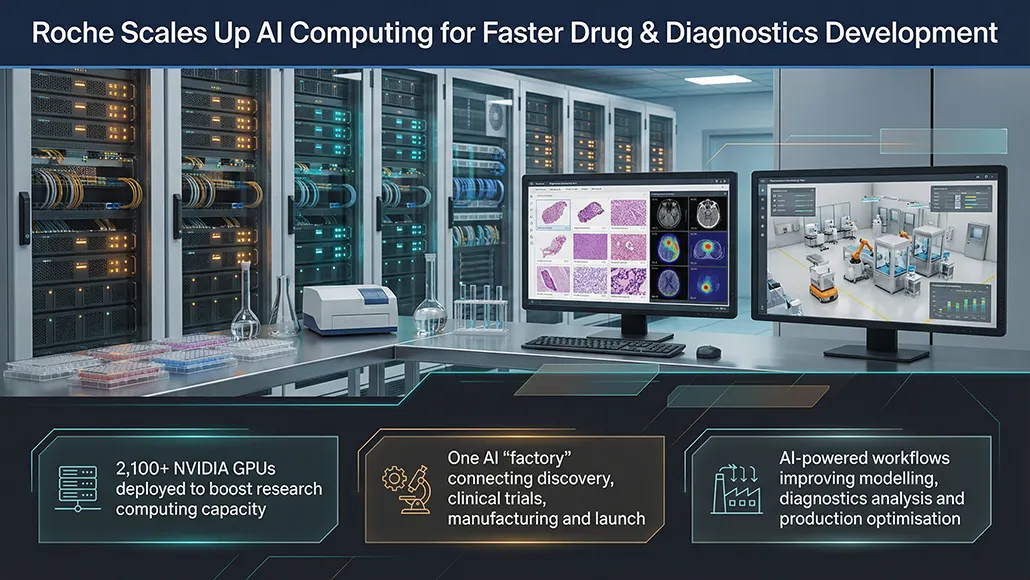
Swiss drugmaker Roche has expanded its artificial intelligence infrastructure by deploying more than 2,100 NVIDIA chips, strengthening its computational capabilities to accelerate drug and diagnostics development. The move, centred on a large-scale Roche AI factory, reflects the company’s ongoing investment in advanced computing to streamline research and development processes across its global operations.
The expansion includes the deployment of 2,176 NVIDIA Blackwell graphics processing units (GPUs) across Roche’s sites in the United States and Europe. With this addition, Roche’s combined on-premise and cloud-based infrastructure now exceeds 3,500 GPUs, representing the largest announced GPU footprint within the pharmaceutical industry. The Roche AI factory is designed to integrate high-performance computing across the full value chain, from early discovery through to manufacturing and commercialisation.
The initiative builds on a strategic collaboration between Roche and NVIDIA that began in 2023, with a focus on embedding artificial intelligence into core pharmaceutical workflows. The enhanced infrastructure is expected to support modelling, data analysis, and clinical trial processes, enabling faster and more efficient research outcomes. The investment also aligns with broader industry trends, as pharmaceutical companies increasingly deploy AI tools to reduce development timelines and control costs.
Roche stated that the new computational capabilities will play a central role in advancing its vision of becoming an AI-accelerated healthcare organisation. In research and development, the NVIDIA BioNeMo platform supports Roche’s “Lab-in-the-Loop” approach, connecting biological and chemistry experiments with AI models to test hypotheses at scale. This integration allows scientists to accelerate discovery cycles and generate insights that were previously difficult to achieve.
Operationally, the infrastructure also extends into manufacturing and diagnostics. Digital twins powered by NVIDIA Omniverse libraries enable optimisation of production processes and factory design, while NVIDIA Parabricks software facilitates large-scale data analysis in diagnostics. In digital pathology, AI systems process extensive image datasets to detect subtle disease patterns, and in digital health, NVIDIA NeMo Guardrails supports the deployment of healthcare-grade conversational AI systems.
“In healthcare, time is the most critical variable; every day saved means a life-changing medicine or diagnostic reaches a patient sooner,” said Wafaa Mamilli, Roche’s Chief Digital and Technology Officer. The company emphasised that the integration of AI across its operations is intended to accelerate the delivery of next-generation therapeutics and diagnostics solutions.
Roche executives also highlighted the strategic importance of computational scale in advancing AI-driven drug discovery. Aviv Regev, Executive Vice President and Head of Genentech Research and Early Development (gRED), stated that the expanded infrastructure enables scientists to build more sophisticated predictive models and shorten the pathway from biological insight to clinical application.
The development comes amid a broader surge in artificial intelligence adoption across the pharmaceutical sector, with companies entering partnerships and investing in infrastructure to harness AI-driven efficiencies. According to consultancy McKinsey, agentic AI technologies could increase clinical development productivity by approximately 35% to 45% over the next five years, underscoring the competitive significance of such investments.