














Close
Novotech
Jabsco PureFlo 21 Single Use

ChargePoint Technology launches new robotic solution to help transform the future of GMP manufacturing

Note* - All images used are for editorial and illustrative purposes only and may not originate from the original news provider or associated company.

Subscribe

- Never miss a story with notifications

- Gain full access to our premium content

- Browse free from any location or device.

Media Packs

Expand Your Reach With Our Customized Solutions Empowering Your Campaigns To Maximize Your Reach & Drive Real Results!

– Access the Media Pack Now

– Book a Conference Call

Leave Message for Us to Get Back

Related stories

Designing Biotech Financial Models for Series B Success

Building a compelling Series B case in biopharma goes well beyond efficacy data and market size projections. Sophisticated investors are increasingly focused on CMC risk, licensing obligations, and the defensibility of your manufacturing timeline. This article breaks down what the financial model behind a strong Series B actually looks like and what quietly kills deals that should have worked.

CMC Bottleneck in Drug Development and IND Delays

Ask any experienced biopharma program manager what derails an IND filing most often, and the answer is rarely surprising: it is CMC. Not insufficient efficacy data, not toxicology surprises CMC. This article examines why Chemistry, Manufacturing, and Controls continues to be the most underestimated risk in early drug development, and what program leaders can do about it.
- Advertisement -

ChargePoint Technology, a powder and liquid transfer specialist, has announced the launch of a new robotic material handling solution aimed at increasing safety and efficiency in solid dosage drug manufacturing.

The new robotics solution will improve efficiency for manufacturers looking to automate and update their production processes to meet future demand for delivering life-saving drug products to market. This could be revamping portions of existing lines to create semi-continuous cells or developing fully autonomous manufacturing for the more advanced facilities of tomorrow.

The solution will help prevent potential risks associated with manual intervention by eliminating ergonomic and manual handling concerns as well as reducing the risk of cross contamination from personnel.

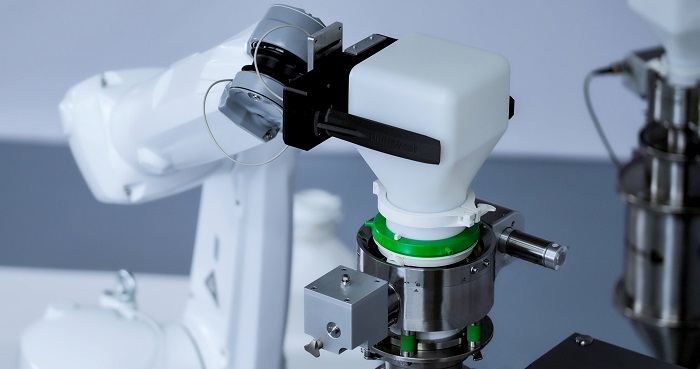
Combining new PuroGrip, PuroVaso containers and the ChargePoint SBV, the robotic approach will allow manufacturers to upgrade their manufacturing practices by creating a handling system that can be deployed quickly from pre-engineered and off the shelf components

The robotic PuroGrip has been developed to create a seamless connection between robotic arms used in pharmaceutical process lines and ChargePoint’s range of lightweight PuroVaso containers. The PuroGrip will be used to effortlessly dock PuroVaso containers into ChargePoint’s automated Split Butterfly Valve to create a contained solution for material transfer.

Chris Eccles, CEO of ChargePoint Technology, commented on the news: “Contained robotic powder handling is the future of the industry. Recent reports have found that the pharmaceutical robots industry is expected to rise at a CAGR of 6.7% over the next 10 years (1) and we have already seen many of our customers turning to us for a solution to advance their current production processes.

“We understand how important speed, quality and safety is to our customers and we will continue to evolve our solutions to provide our customers with the best technology to meet their manufacturing needs”.

ChargePoint Technology plans to unveil the robotic solution at ACHEMA in Frankfurt (10-14th June) and the PuroGrip will also be displayed in ChargePoint’s new facility in Liverpool for demonstration and testing purposes.

ChargePoint Technology offers containment and aseptic transfer valves, single-use and fluid storage and management solutions that are essential for the safe transfer of powders and liquids during pharmaceutical and biopharmaceutical manufacturing.

Latest stories

Related stories

Designing Biotech Financial Models for Series B Success

Building a compelling Series B case in biopharma goes well beyond efficacy data and market size projections. Sophisticated investors are increasingly focused on CMC risk, licensing obligations, and the defensibility of your manufacturing timeline. This article breaks down what the financial model behind a strong Series B actually looks like and what quietly kills deals that should have worked.

CMC Bottleneck in Drug Development and IND Delays

Ask any experienced biopharma program manager what derails an IND filing most often, and the answer is rarely surprising: it is CMC. Not insufficient efficacy data, not toxicology surprises CMC. This article examines why Chemistry, Manufacturing, and Controls continues to be the most underestimated risk in early drug development, and what program leaders can do about it.

The Hidden Cost of Licensing in Biologic Drug Development

Royalties, milestone payments, and license fees are often treated as the cost of doing business in biopharma. But for early-stage biotech companies building toward an IND, these obligations can quietly reshape financial models, complicate investor conversations, and create downstream deal terms that are difficult to unwind. Here is what founders need to know.

Subscribe

- Never miss a story with notifications

- Gain full access to our premium content

- Browse free from any location or device.

Media Packs

Expand Your Reach With Our Customized Solutions Empowering Your Campaigns To Maximize Your Reach & Drive Real Results!

– Access theMedia Pack Now

– Book a Conference Call

Leave Message for Us to Get Back

Translate »