







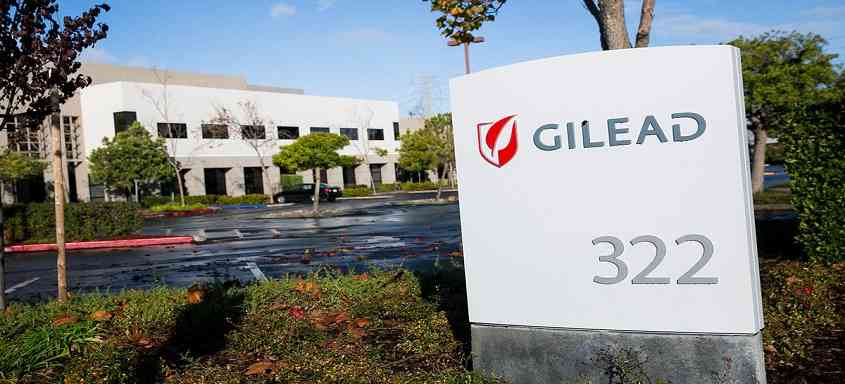
Merck & Co. fell after a federal judge tossed a record $2.54 billion verdict it had won against Gilead Sciences Inc. over a hepatitis treatment.
A federal jury in 2016 had said that Gilead owed Merck 10 percent of the sales of its Sovaldi and Harvoni hepatitis C drugs. District Court Judge Leonard Stark in Wilmington, Delaware, agreed Friday with Gilead’s argument that the Merck patent was invalid.
Merck was down by 1.9 percent to $55.23 at 1:05 p.m. in New York trading. Foster City, California-Gilead was up 1 percent to $81.49.
The patent, issued in 2009, is for a compound that Merck’s Idenix unit contends is the basis for all major treatments for hepatitis C, including ones made by Gilead. Merck claimed it was first to synthesize the compound, while Gilead said it didn’t cover a new idea.
Patent owners are required to describe inventions with enough detail to allow others to replicate them without unnecessary time and effort. In this case, Stark said, Merck’s patent covered so many potential compounds that it would take “excessive experimentation” to narrow them down.
Based on that, “the only reasonable finding” is that the patent is invalid, Stark said in the decision.
Merck, based in Kenilworth, New Jersey, pledged to appeal the judge’s findings, saying it “does not reflect the facts of the case.” “The patent at issue in this case facilitated significant advances in the treatment of patients with HCV infection, and achieving these advancements required many years of research and significant investment by our subsidiary and its partners,” the company said in a statement.
“We believe strong patent protection is essential to innovation,” the company added. “Given that it guarantees a firm a period of return on investment, patent protection provides the research-based pharmaceutical and biotechnology industries with an incentive to invest in research and development.”
Officials with Gilead didn’t immediately return messages seeking comment. A lawyer for Gilead on the case, Josh Rosenkranz of the Orrick law firm, said in a statementthe legal team was “thrilled” with the decision.
Sovaldi was approved by the U.S. Food and Drug Administration in 2013 and Harvoni got regulatory go-ahead a year later. Merck’s drug, Zepatier, was approved in 2016.
Gilead had conceded infringement of the patent, a common legal tactic that allowed it to focus on the validity issue during trial. After rejecting Gilead’s argument about the patent, the jury said that Gilead owed 10 percent royalties on $25.4 billion in total sales for the two drugs.
In a separate part of the ruling, Stark rejected Gilead’s argument that the damages amount was unfair — an issue that becomes important only if the patent is later revived on appeal.
The verdict was the largest patent-infringement verdict in U.S. history, dwarfing the next biggest, a $1.67 billion verdict won by Johnson & Johnson against Abbott
Laboratories that was later thrown out on appeal, according to data compiled by Bloomberg.
The case is Idenix Pharmaceuticals LLC v. Gilead Sciences Inc., 14-846, U.S. District Court, District of Delaware (Wilmington).