












The Centers for Medicare & Medicaid Services (CMS) in the US has moved to extend the enrolment window for its GENEROUS pilot programme, an initiative aimed at introducing most-favoured-nation (MFN) pricing for outpatient drugs reimbursed by Medicaid. The agency has revised the participation deadline, shifting it from the end of this month to 30th April. The change has prompted speculation that CMS may be encountering difficulty in securing sufficient interest from companies willing to join the model.
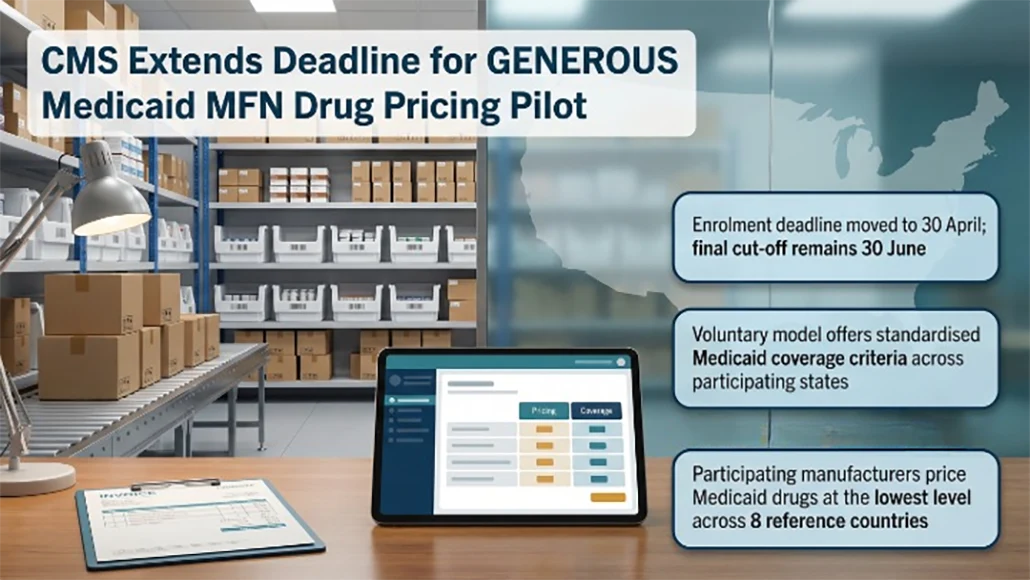
In a formal update, CMS said the additional time will “provide interested drug manufacturers more opportunity to join the model,” noting that meetings with manufacturers expressing interest will begin at the start of April. The agency also confirmed plans to convene a town hall meeting later this spring to address the operational and methodological details underpinning the model. Despite the extension to the initial participation deadline, CMS emphasised that the final cut-off date of 30th June remains in place. The agency is specifically seeking volunteers from small- and mid-sized companies.
First unveiled last November, GENEROUS (GENErating cost Reductions fOr US Medicaid) is structured as a voluntary initiative. It invites pharmaceutical manufacturers to negotiate standardised coverage criteria for each of their products with Medicaid. The objective is to remove the need for companies to negotiate separate access agreements across individual states. In practical terms, participating drugmakers would secure uniform coverage across all Medicaid programmes taking part in the scheme. In exchange, they would agree to price medicines supplied through Medicaid in the US at the lowest level charged in eight designated reference countries: the UK, France, Germany, Italy, Canada, Japan, Denmark, and Switzerland.
“Based on feedback from drug manufacturers, CMS has decided to give interested companies additional time to apply for the GENEROUS Model,” commented CMS Administrator Mehmet Oz. “We are committed to partnering with states and manufacturers to drive down drug prices and ensure that the most vulnerable Americans have access to life-saving medications.”
Since its announcement, GENEROUS has drawn criticism from some quarters. Commentators have warned that the MFN-based pricing structure could lead certain manufacturers to reconsider offering specific products through Medicaid, which provides health insurance to Americans with limited income and resources. A letter (PDF) signed by more than 150 economists and sent to HHS last year cautioned that MFN policies – which are also being applied to Medicare by the Trump administration – could diminish patient access to medicines, reduce investment in industry R&D, and prompt cost-shifting that raises prices for other treatments. Separately, the centre-right political think-tank American Action Forum stated in a recently-published analysis that participation in GENEROUS would be a “poor business decision” for drugmakers, arguing it remains unclear “how these rebates would compare to payments already in place and if this new approach will undermine preferred drug lists.”
CMS, for its part, has highlighted the scale of Medicaid prescription spending. The agency noted that outlays reached $100 billion in 2024 – or $60 billion after manufacturer rebates – representing a $10 billion increase compared with the previous year and underscoring what it described as the “urgency for reform.”