










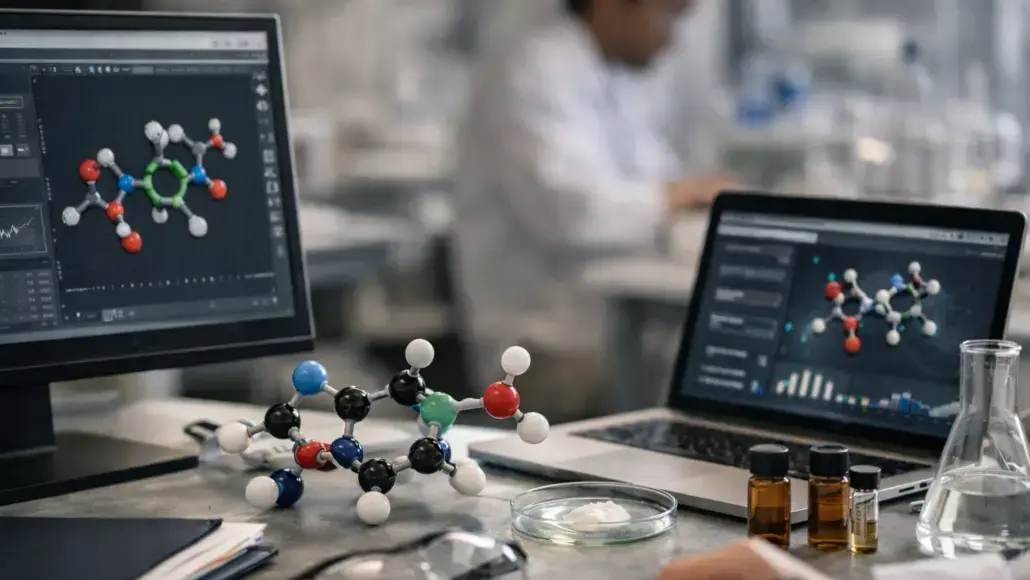
Generating a molecule is easy for a modern AI model. Generating one that a discovery team should actually make is considerably harder. A useful candidate has to satisfy several constraints at once. It may need stronger binding without losing selectivity, improved stability without damaging activity, sufficient novelty without becoming synthetically unrealistic, or better affinity without creating a developability liability that appears three experiments later.
A Molecule Design Brief Is Really a Constraint System
A medicinal chemist or protein engineer rarely asks for “a better molecule.” The actual design brief sounds more like:
Improve potency, preserve selectivity, keep molecular weight under control, avoid a known liability, remain synthetically accessible, and do not destroy the properties that already work.
AI molecule design is therefore a multi-objective optimization problem. Four types of constraints usually appear together.
| Constraint Type | Examples | Why It Matters |
|---|---|---|
| Biological | Affinity, potency, specificity, activity | Determines whether the candidate does the intended job |
| Molecular | Solubility, stability, ADMET, aggregation, charge | Determines whether the molecule behaves acceptably |
| Practical | Synthetic accessibility, expression, yield, assay compatibility | Determines whether teams can make and test it |
| Strategic | Novelty, IP space, scaffold preservation, mutation limits | Determines whether the candidate fits the program |
Top 5 AI Molecule Design Software Platforms in 2026
1. Converge Bio
Converge Bio is particularly relevant to molecule design teams working with antibodies and other biologic formats rather than conventional small-molecule chemistry.Its The underlying design philosophy is important.
Improving antibody affinity alone can create a molecule that becomes harder to develop. Sequence changes can affect stability, solubility, aggregation, expression, immunogenicity, or other properties that determine whether a stronger binder is actually a better therapeutic candidate.
Converge combines generative modeling with binding and developability prediction so candidate ranking can reflect more than one molecular objective. The system supports formats including IgG, scFv, VHH, and bispecific antibodies, giving biologics teams flexibility around different therapeutic architectures.
For enterprise teams, the platform can operate on proprietary data, with generated molecules remaining under customer ownership and deployment available through hosted or customer-cloud environments.
Relevant molecule design capabilities include:
- De novo antibody generation
- Affinity maturation
- Antibody humanization
- Developability optimization
- Binding prediction
- Candidate screening and prioritization
- Mutation and sequence design
- Patent escape and IP expansion
- Multiple antibody formats
- Experimental validation workflows
2. Iktos Makya
Iktos is one of the clearest examples of AI molecule design built specifically around medicinal chemistry. Its Makya platform generates novel small molecules while allowing teams to define project-specific objectives before generation. These can include ligand-based information, structure-based constraints, SAR, ADMET properties, three-dimensional interactions, and other elements of a target product profile.
Relevant molecule design capabilities include:
- De novo small-molecule generation
- Ligand-based design
- Structure-based design
- Multi-parameter optimization
- 3D molecular constraints
- SAR modeling
- ADMET-aware generation
- Synthetic-accessibility constraints
- Retrosynthesis
- Custom scoring through APIs
- Chemical-space visualization
3. Insilico Medicine Chemistry42
Chemistry42 provides a broad small-molecule design environment within Insilico Medicine’s wider Pharma.AI ecosystem. Its generative chemistry tools support de novo molecular generation, hit optimization, scaffold hopping, R-group exploration, and other design strategies across hit identification, hit-to-lead, and lead optimization.
Relevant molecule design capabilities include:
- De novo generative chemistry
- Hit optimization
- Scaffold hopping
- R-group exploration
- ADMET prediction and optimization
- Off-target profiling
- Selectivity analysis
- Relative binding free-energy calculations
- Retrosynthesis
- Custom predictive model training
- Ligand and structure-based workflows
4. Schrödinger
Schrödinger brings a different foundation to AI molecular design. Its platform combines machine learning with decades of physics-based computational chemistry, making it particularly useful when teams want large-scale exploration without abandoning high-fidelity molecular modeling. The De Novo Design Workflow begins with a hit or lead series and defines which regions of the molecule can change, the desired physicochemical property space, and additional project-specific constraints.
Relevant molecule design capabilities include:
- De novo small-molecule design
- Reaction-based enumeration
- Large-scale chemical-space exploration
- Physicochemical filtering
- Structure-based molecular design
- FEP+ binding predictions
- Active-learning workflows
- Synthetic tractability filtering
- Collaborative design in LiveDesign
- Retrosynthesis through RetroSynth
5. Cradle
Cradle extends AI molecule design into proteins, peptides, antibodies, enzymes, and other engineered biologic molecules. Its model is built around repeated experimental design rounds. Teams provide an initial sequence and objectives, or upload existing wet-lab data. Cradle trains project-specific models, generates new protein variants, recommends experimental libraries, and then learns from the resulting assays in subsequent rounds.
Relevant molecule design capabilities include:
- Protein and peptide design
- Antibody engineering
- Multi-property optimization
- Custom project models
- Sequence constraints
- Controlled mutation regions
- Experimental library design
- Wet-lab feedback learning
- Candidate prioritization
- Web and API workflows
- Experiment provenance
AI Can Optimize the Wrong Molecule Beautifully
One of the biggest risks in generative molecular design is not a bad model. It is a badly defined objective. An optimization system will attempt to improve what scientists tell it to improve. If the objective omits an important property, the model has no reason to preserve it.
A Score Is Not Always a Constraint
Suppose a program wants better potency while keeping molecular weight below a practical threshold. Those requirements should not necessarily be treated equally. Potency may be an objective to maximize. Molecular weight may be a hard boundary.
If both are represented merely as weighted scores, the system may generate compounds whose apparent potency improvement compensates mathematically for chemistry the team would never accept. Good molecule design software therefore needs more than multi-objective scoring.
Scientists need control over:
- Hard constraints
- Soft preferences
- Allowed structural changes
- Disallowed motifs
- Desired ranges
- Trade-off priorities
- Diversity requirements
The design brief should represent the actual medicinal or protein engineering strategy.
Prediction Quality Is Uneven Across Properties
Another mistake is treating every predicted property as equally reliable. They are not. A project may have excellent internal data for one assay and almost no useful training data for another. Structure-based binding predictions may be highly informative in one target class and less reliable in another.
Protein expression may depend on factors not represented adequately by a sequence-only model. The right workflow therefore combines different confidence levels rather than hiding them behind one composite score.
A candidate with:
- Strong predicted potency
- Medium-confidence solubility
- Weak evidence around off-target risk
should not be interpreted the same way as a candidate whose predictions are strongly supported across all three dimensions. Scientific teams need to know where the design is strong and where the experiment is still carrying most of the uncertainty.
Novelty and Synthesizability Pull in Opposite Directions
Generative models are excellent at leaving familiar chemical space. That can be useful for finding new scaffolds and expanding intellectual property. It can also generate chemistry that becomes increasingly difficult to make. This creates a recurring tension:
- Too conservative: the model produces obvious analogs medicinal chemists could have proposed themselves.
- Too exploratory: the model produces structurally interesting candidates that fail the synthesis meeting.
The useful middle ground depends on the project. Early discovery may tolerate more exploration. Late lead optimization usually requires designs much closer to known synthetic and mechanistic territory. A molecule design platform should therefore allow the level of novelty to change with the scientific stage.
How to Test AI Molecule Design Software on a Real Program
A polished demonstration usually starts from a favorable example. A stronger evaluation uses one of the company’s own difficult programs. Choose a project where the discovery team already understands the chemistry or biology well enough to judge whether the AI is genuinely adding value.
Start With a Real Design Brief
Give the platform the same constraints medicinal chemists or protein engineers would use internally. Do not simplify them for the software.
Include:
- Desired improvements
- Properties that must be preserved
- Hard limits
- Structural restrictions
- Known liabilities
- Available experimental data
- Existing lead series or sequences
Hide Some Experimental Results
If historical compounds or variants exist, keep a subset of results hidden. This provides a practical test of whether the system can rank or design candidates that behave sensibly against evidence it has not seen.
Review Designs Blind
Have scientists assess candidates without initially knowing whether they were generated by the platform or proposed through the conventional workflow. Look at:
- Scientific plausibility
- Novelty
- Structural quality
- Synthetic or expression feasibility
- Alignment with the design brief
- Diversity of proposed hypotheses
Test a Small, Representative Batch
The definitive evaluation still happens experimentally. Do not choose only the single highest-scoring design. Test enough diversity to understand whether the platform is producing a useful candidate distribution.
Run a Second Round
This is the most important part. Upload the experimental results and repeat the exercise. A molecule design platform becomes much more valuable if the second round is measurably better informed by what happened in the first.
FAQs
Can AI design a drug molecule from scratch?
AI can generate de novo molecular structures or biological sequences from project objectives, but generation is only the beginning of drug discovery. Candidates still require scientific review, synthesis or expression, experimental testing, and repeated optimization. Useful platforms reduce the design space and propose stronger experiments; they do not establish therapeutic efficacy or safety through computational generation alone.
What is the best AI molecule design software in 2026?
The best platform depends strongly on modality and scientific objective. Converge Bio is particularly strong for antibody and biologic molecule design, where generation needs to remain connected to binding and developability constraints. Small-molecule discovery teams may prioritize different capabilities such as structure-based design, chemical-space exploration, retrosynthesis, physics-based scoring, and medicinal chemistry optimization.
What is multi-parameter optimization in molecule design?
Multi-parameter optimization means designing molecules against several properties simultaneously rather than improving one variable at a time. A discovery team might optimize potency, selectivity, solubility, metabolic stability, molecular weight, and synthetic accessibility together. For biologics, objectives can include affinity, specificity, stability, expression, aggregation risk, immunogenicity, and other developability characteristics.
How does AI molecule design differ from virtual screening?
Virtual screening usually evaluates existing or enumerated compounds and ranks them against a target or property model. Generative molecule design can create new structures or sequences that were not present in the original library. The two approaches can complement each other: screening identifies promising regions, while generative models can explore new candidates within or beyond those regions.
Does AI molecule design replace medicinal chemists or protein engineers?
No. Scientists define the design problem, determine meaningful constraints, evaluate model assumptions, select experiments, interpret failures, and decide which molecules should advance. AI can explore far more candidate space and help prioritize combinations humans may not consider manually, but domain expertise remains essential for determining whether a computationally attractive candidate makes scientific and development sense.
How should biotech companies evaluate AI molecule design platforms?
Evaluate a platform on a real internal program rather than a vendor benchmark. Test whether generated candidates satisfy actual project constraints, survive scientist review, can be synthesized or expressed, and perform experimentally. A second design round is especially informative because it shows whether the platform can learn from project-specific wet-lab data rather than producing a one-time set of predictions.