









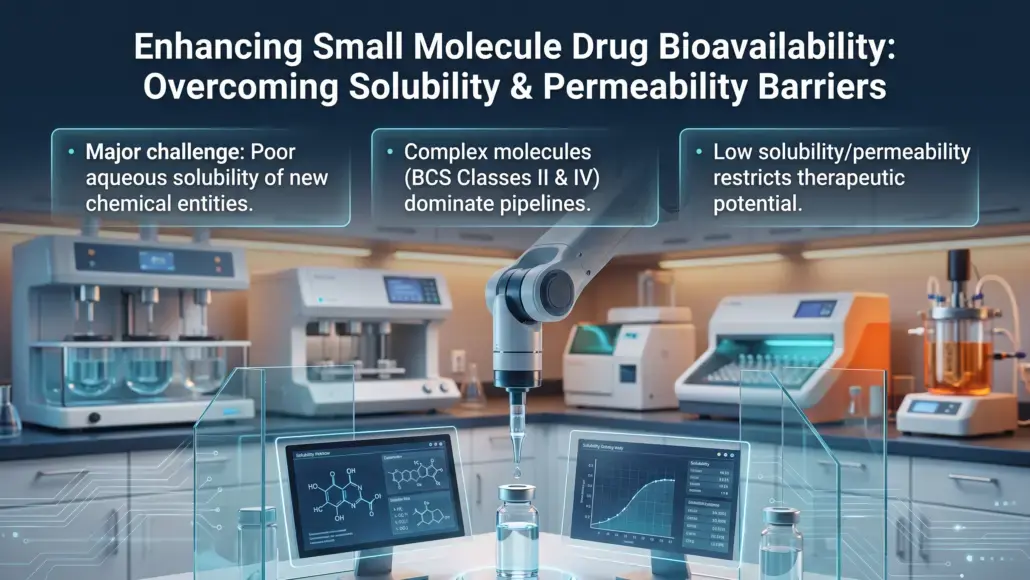
The pharmaceutical sector continues to encounter significant hurdles in small molecule drug development, primarily due to the poor aqueous solubility of emerging chemical entities. As drug discovery pipelines shift toward more complex molecular structures, a high percentage of new chemical entities fall into Classes II and IV of the Biopharmaceutical Classification System. These compounds exhibit low solubility or low permeability, which directly impacts their therapeutic potential. Addressing these limitations requires a sophisticated understanding of how bioavailability optimization techniques can bridge the gap between discovery and clinical success. Without adequate solubility, a drug cannot achieve the necessary systemic concentration to produce a therapeutic effect, leading to inconsistent pharmacokinetics and potential project failure in early clinical stages.
Molecular weight and lipophilicity often increase as researchers target more specific biological receptors, which typically results in hydrophobic molecules that resist dissolution in gastric fluids. The physical state of the active pharmaceutical ingredient plays a critical role in this process. Crystalline structures, while stable, often possess high lattice energy that must be overcome for dissolution to occur. Amorphous solid dispersions have emerged as a primary solution, where the drug is dispersed in a polymer matrix to maintain a disordered state, thus providing a higher apparent solubility compared to the crystalline form. This approach requires precise control over manufacturing parameters to prevent recrystallization during storage, which would negate the benefits of the formulation.
Permeability remains the second major barrier to effective drug absorption. Even if a compound is successfully dissolved, it must cross the intestinal epithelium to enter the bloodstream. Passive diffusion is the most common route, but large or highly polar molecules face significant resistance. Formulators are increasingly looking at permeation enhancers and lipid-based delivery systems to facilitate this transport. By integrating these strategies, developers can ensure that the biological activity observed in vitro translates effectively to in vivo models. The focus remains on optimizing the physical and chemical properties of the drug to overcome these physiological barriers efficiently.
Amorphous Solid Dispersions and Polymeric Carriers
The application of amorphous solid dispersions represents one of the most effective bioavailability optimization techniques available to modern formulation scientists. By converting a crystalline drug into its amorphous counterpart, the energy required for dissolution is significantly reduced. This transition is typically achieved through spray drying or hot-melt extrusion, both of which are scalable industrial processes. The choice of polymer carrier is essential in these systems, as the polymer must not only stabilize the amorphous state but also enhance the wettability of the drug particles when they encounter aqueous media.
Polyvinylpyrrolidone and hydroxypropyl methylcellulose are among the most frequently utilized polymers due to their ability to form hydrogen bonds with drug molecules, effectively trapping them in a stable matrix. The interaction between the drug and the polymer prevents the long-range molecular order necessary for crystal growth. This stabilization is vital for maintaining the supersaturated state in the gastrointestinal tract, which provides a higher concentration gradient for absorption. However, the selection process must account for the glass transition temperature of the mixture, as a low glass transition temperature can lead to physical instability under humid conditions.
Beyond stabilization, these polymeric systems can be engineered to control the release rate of the drug. By adjusting the polymer-to-drug ratio, scientists can fine-tune the dissolution profile to match the desired pharmacokinetic window. This level of control is necessary for drugs with a narrow therapeutic index or those that require a specific absorption site in the small intestine. The integration of advanced characterization tools, such as X-ray powder diffraction and differential scanning calorimetry, allows for the monitoring of the physical state of the dispersion throughout the development cycle, ensuring that quality and performance remain consistent across different production batches.
Lipid Based Delivery Systems for Lipophilic Compounds
Lipid-based formulations offer a versatile alternative for molecules that exhibit high lipophilicity but poor aqueous solubility. These systems, including self-emulsifying drug delivery systems, work by presenting the drug in a pre-dissolved state within an oil phase. Upon ingestion and contact with gastric fluids, the formulation spontaneously forms fine oil-in-water emulsions, providing a large surface area for drug absorption. The use of lipids can also tap into the natural lymphatic transport pathways, potentially bypassing first-pass metabolism in the liver and increasing the overall systemic exposure of the drug.
The selection of excipients in lipid-based systems is complex, requiring a balance between oils, surfactants, and co-solvents. Medium-chain triglycerides are often favored for their solvency power, while non-ionic surfactants are chosen for their safety profile and ability to promote emulsification. The performance of these systems is highly dependent on the digestive processes of the patient. The digestion of dietary lipids triggers the secretion of bile salts and phospholipids, which further stabilize the drug-containing droplets. Understanding this interplay between the formulation and human physiology is a cornerstone of effective bioavailability optimization techniques in the context of lipophilic drug development.
Recent advancements in this field include the development of solid lipid nanoparticles and nanostructured lipid carriers. These formulations combine the benefits of lipid-based delivery with the stability of solid dosage forms. By using lipids that are solid at room temperature, formulators can achieve controlled release and protect the drug from chemical degradation. These carriers are particularly useful for sensitive molecules that might otherwise be degraded by stomach acid or enzymes. As the industry continues to push the boundaries of drug delivery, these lipid-based strategies provide a critical pathway for bringing challenging small molecules to market without compromising on patient outcomes or manufacturing efficiency.
Particle Engineering and Nanotechnology Applications
Reducing the particle size of an active pharmaceutical ingredient is a fundamental method for increasing the surface area available for dissolution. According to the Noyes-Whitney equation, the rate of dissolution is directly proportional to the surface area of the solute. Traditional milling techniques often reach a limit in particle size reduction, leading to the adoption of nanotechnology. Nanocrystals, produced through wet ball milling or high-pressure homogenization, allow for significant increases in the saturation solubility and dissolution velocity of poorly soluble drugs. This approach is particularly beneficial for high-dose compounds where other formulation strategies might lead to excessive pill size.
The stability of nanocrystals is maintained through the use of stabilizers, such as surfactants or polymers, which coat the surface of the nanoparticles to prevent agglomeration. The resulting suspensions, often referred to as nanosuspensions, can be further processed into solid dosage forms like tablets or capsules. One of the unique advantages of nanotechnology is the ability to improve the performance of drugs that are otherwise difficult to formulate. By increasing the dissolution rate, nanocrystals can reduce the time to reach peak plasma concentration, which is essential for acute treatments where rapid onset of action is required.
Particle engineering also extends to the creation of cocrystals, where a drug and a co-former are combined in a single crystalline lattice. This does not change the molecular structure of the drug but alters its physical properties, such as solubility and stability. Cocrystal technology is gaining traction as a way to improve the bioavailability of neutral molecules that cannot form salts. By carefully selecting the co-former, scientists can design crystals with specific dissolution profiles tailored to the needs of the patient. These advancements highlight the importance of diverse bioavailability optimization techniques in addressing the unique chemical challenges posed by the modern pharmaceutical pipeline.
Regulatory Considerations and Scalable Manufacturing
Transitioning an optimized formulation from the laboratory to commercial production requires a focus on scalability and regulatory compliance. Bioavailability optimization techniques must be compatible with standard pharmaceutical manufacturing equipment to ensure economic viability. Processes like spray drying and hot-melt extrusion have become more sophisticated, with real-time monitoring through process analytical technology ensuring that every batch meets stringent quality standards. Regulatory agencies, such as the Food and Drug Administration, require detailed data on the physical stability and pharmacokinetic performance of these advanced delivery systems to ensure patient safety.
The concept of quality by design is central to this transition. By defining a design space within which the manufacturing parameters can vary without affecting the final product quality, developers can create more resilient production processes. For amorphous dispersions, this involves understanding the impact of temperature, pressure, and solvent evaporation rates on the final physical state of the drug. For lipid-based systems, the focus is on the consistency of the excipient grades and the stability of the emulsion droplets under various storage conditions. This rigorous approach to manufacturing ensures that the benefits of bioavailability optimization techniques are realized in the final commercial product.
Documentation and validation are also critical components of the regulatory submission. Clinical data must demonstrate that the chosen formulation provides a consistent and predictable therapeutic response in patients. Any significant change in the formulation or manufacturing process after the initial clinical trials may require additional bioequivalence studies. As the industry moves toward more personalized medicine, the ability to rapidly develop and scale these formulations will be a key differentiator for pharmaceutical companies. By prioritizing bioavailability from the earliest stages of development, organizations can reduce the risk of clinical failure and accelerate the delivery of life-saving small molecule therapies to the global market.