














Research Peptides in Modern Drug Discovery: Quality, Purity, and Sourcing Standards
Peptides have been a part of research for many years. The way scientists handle peptides has changed a lot. New methods for making them, better tools to analyze them, machines that can screen them quickly, and new ways to change their structure have made it possible to study peptides that were once too hard to build or understand.
Their appeal is simple to see. Peptides can bind to biological targets. This gives them an ability to reach interactions that regular small molecules can’t. They also bring their own challenges. Stability can be poor. Enzymes may degrade them rapidly, structural changes can alter biological activity, and manufacturing is capable of producing impurities that are chemically very similar to the intended sequence.
So the peptide itself is only one part of the experiment. For laboratories using synthetic peptides in early-stage research, knowing what is in the vial — and how well it has been characterized — can matter just as much as selecting the sequence in the first place.
Why peptides have become important research tools
A peptide is not simply a protein in miniature. Its size and amino acid sequence and chemical characteristics present a different set of possibilities.
Researchers use peptides to study receptors, signaling pathways, molecular recognition and protein interactions. They also can change the structure of the peptide in ways that can change the way the molecule behaves. Individual amino acids may be replaced, termini modified, sequences cyclized or chemical groups added to alter stability and other properties. Sometimes a little change goes a long way.
That flexibility is part of the reason peptides continue to be useful in drug discovery. Researchers can compare related sequences, investigate structure-activity relationships, or observe the effect of a specific modification on activity in a defined experimental model. This type of work has become much more feasible with advances in solid-phase peptide synthesis, including for sequences containing non-natural amino acids or more complex structural features.
But experimental flexibility creates a quality-control problem as well. A chemically synthesized peptide is not automatically a perfectly uniform material.
A purity percentage is only the beginning
Peptide synthesis involves a sequence of chemical reactions, and not every reaction proceeds perfectly. Incomplete coupling can produce deletion sequences. Other processes can result in truncated peptides, stereochemical variants or related impurities. Oxidation and other forms of degradation may occur later, including during storage.
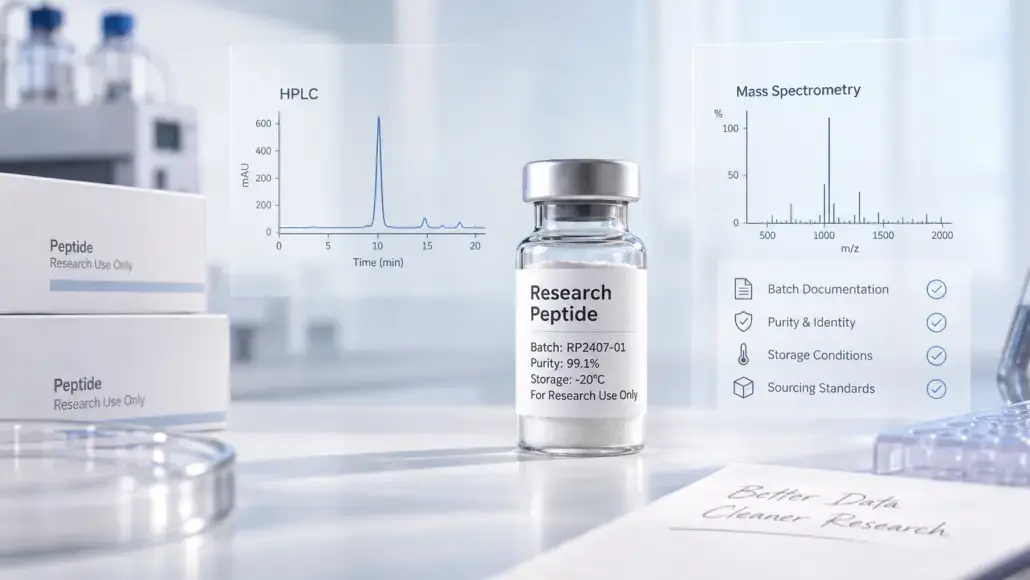
Some of these compounds can be remarkably similar to the target peptide. That is where analytical methods come in. High-performance liquid chromatography, or HPLC, is commonly used to separate components in a sample and estimate chromatographic purity. It can show that the principal component accounts for a large proportion of the detected material under the conditions used for the analysis.
What it cannot do, on its own, is answer every question about identity.
Mass spectrometry provides another layer of information by examining molecular mass and related structural characteristics. In pharmaceutical peptide analysis, chromatography and mass spectrometry are often used together precisely because the two methods tell researchers different things. More specialized analytical approaches may be needed when closely related structural or stereochemical impurities are involved.
A result such as 98% or 99% is meaningful in the context of the analytical method, the sample tested and the other information available about that material.
What good documentation can tell a laboratory
For routine research procurement, researchers are unlikely to reproduce a pharmaceutical manufacturer’s entire analytical program. The level of characterization should fit the purpose of the work.
A certificate of analysis can help connect a vial to a particular batch and provide information about tests performed on that material. The details vary considerably between suppliers. Some documentation provides little more than a product name and stated purity; more useful records identify the batch and report actual analytical results associated with it.
For laboratories that order peptides online, supplier evaluation can include fairly practical questions. Is the material identified by batch? Is analytical documentation available? What method was used to assess purity? Is there evidence supporting identity? Are storage conditions specified? Can the documentation supplied with the material be traced to the batch received?
These questions help reduce avoidable uncertainty before the experiment begins.
Batch variation can become experimental variation
Reproducibility problems are rarely caused by one factor. Experimental design, equipment, biological models, operator technique and data analysis can all contribute. Research material is another variable, and it is not always given the same attention.
Imagine an assay performed with one peptide batch and repeated several months later with another. If the results differ, the obvious question is biological: what changed in the experimental system? The less obvious question is whether the material changed too.
Differences in purity profile, degradation, concentration or handling can complicate comparisons between experiments. That does not mean every minor analytical difference will produce a measurable biological effect. Often it will not. Without adequate records, however, researchers may have no way to evaluate material-related variation if unexpected results appear.
Keeping batch numbers and associated analytical records alongside experimental data is a simple safeguard. For longer projects, it becomes particularly useful.
Quality does not stop when the shipment arrives
Peptide quality is usually discussed in terms of synthesis and testing, yet storage deserves the same attention. The material continues to exist chemically after it leaves the supplier.
Peptides can undergo several forms of degradation, and susceptibility varies substantially between sequences. Oxidation, hydrolysis, deamidation and aggregation are among the processes that may affect peptide materials under certain conditions. Moisture, temperature, light and repeated handling can also matter. There is no single storage rule that covers every peptide.
Product-specific instructions should therefore take priority over assumptions about how “peptides” in general are stored. Laboratories also need procedures for recording preparation dates, storage conditions and handling where those factors are relevant to the study. Once a peptide is reconstituted, the situation may change again because stability in solution depends on the molecule and experimental conditions.
Matching quality standards to the research question
Not every experiment requires pharmaceutical-grade characterization. An exploratory screening assay and a late-stage development program have very different analytical needs.
Early-stage research often starts with testing peptide sequences — sometimes dozens, even hundreds. At this stage the main aim is to cut down the number of candidates and find the ones that show promise. Because of the number of samples, it’s not feasible to do deep analysis on each one.
Once a peptide moves forward in development, things change. Now researchers need more certainty. They want to confirm the identity of the peptide, check how pure it is and get a picture of any impurities. They also need to know how much peptide is in the sample and how stable it is over time. The material is being studied closely, and so are the results it produces.
There’s a reason for this shift. If two experiments give different results, scientists must ask: was the difference due to the biology being studied, or was it caused by differences in the peptide material used? While better characterization can’t eliminate all variables, it does make differences in quality easier to spot and understand.
That way researchers can focus on biological effects rather than confusing results from inconsistent materials. This approach is more useful than treating one purity threshold as a universal definition of quality.
Quality control is not about collecting paperwork for its own sake. It is about understanding enough about the material to judge whether it is appropriate for the experiment being performed.
Better-defined materials make cleaner research possible
Peptide research now spans everything from basic biochemical experiments to sophisticated drug-discovery programs. The analytical technology surrounding it has evolved accordingly. Researchers can characterize peptide materials in far greater detail than a simple catalog specification might suggest.
That does not mean every laboratory needs every available test. It does mean that sourcing should be treated as part of experimental planning rather than a separate purchasing decision. Purity matters, but so do identity, batch documentation, storage history and consistency. When those pieces are recorded properly, researchers have fewer unknowns to deal with if an experiment produces an unexpected result.
Research peptides are laboratory materials, not evidence of therapeutic benefit by themselves. Findings obtained in biochemical assays, cell cultures or animal models also cannot establish that an investigational peptide is safe or effective in humans. Those questions require an entirely different level of evidence.
For drug-discovery research, the more immediate goal is simpler: know the molecule being studied, understand the limits of its characterization and control the variables that can reasonably be controlled. Good peptide sourcing begins there.