














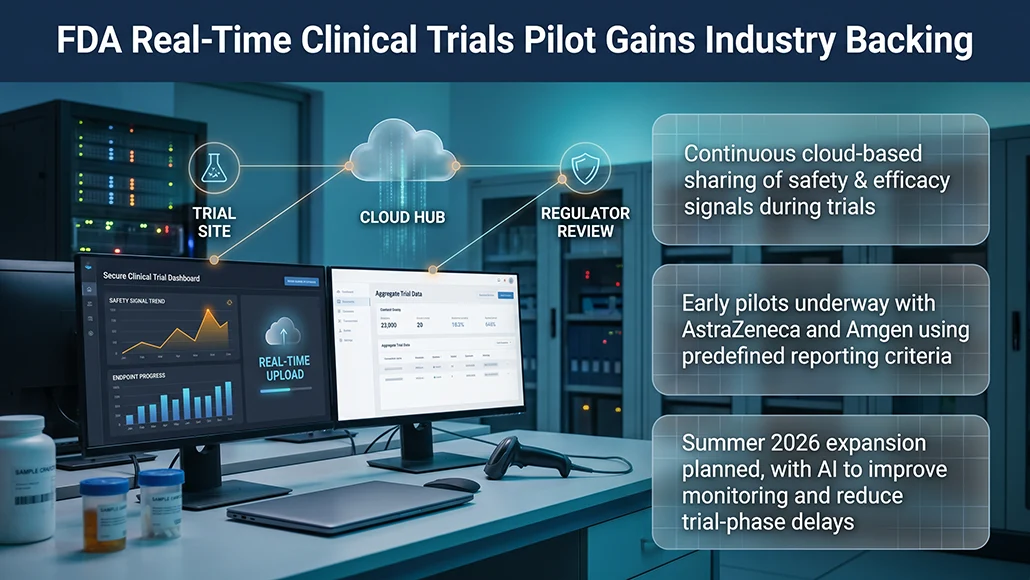
The U.S. Food and Drug Administration has unveiled a new regulatory initiative to enable real-time clinical trials, marking a structural shift in how drug development data is reviewed. The program, already supported by AstraZeneca and Amgen, introduces a model where safety and efficacy data are transmitted continuously to regulators rather than submitted after trial completion.
Regulatory Shift Towards Continuous Data Review
Announced on April 28, 2026, the FDA initiative introduces proof-of-concept trials that allow regulators to access clinical endpoints and safety signals as they emerge. Commissioner Marty Makary stated that the approach enables FDA reviewers to “view safety signals and clinical endpoints in the cloud in real time as they are occurring,” potentially allowing regulatory decisions to be made without waiting for trial completion.
This framework is designed to address long-standing inefficiencies in drug development timelines. The FDA estimates that traditional pathways, which typically span 10 to 12 years, are significantly slowed by administrative processes, with nearly 45% of clinical development time spent on non-research activities such as documentation and data handling.
Industry Participation and Trial Deployment
The real-time clinical trials initiative is being tested through two early-stage programs:
- AstraZeneca’s Phase 2 TRAVERSE trial evaluating Calquence in combination therapies for mantle cell lymphoma
- Amgen’s Phase 1b STREAM-SCLC trial assessing Imdelltra (tarlatamab) in small-cell lung cancer
The FDA confirmed that real-time data from AstraZeneca’s trial has already been received and validated through a digital platform developed by Paradigm Health, demonstrating operational feasibility. Both trials were structured with predefined criteria for real-time signal reporting agreed upon between sponsors and the agency.
Executives from both companies positioned the pilot as complementary to existing regulatory pathways. Amy McKee of AstraZeneca noted that the program is aimed at strengthening data collection and accelerating therapy development timelines, while Amgen’s Chief Medical Officer Paul Burton emphasized that the model will operate alongside conventional randomized studies.
AI Integration and Pilot Expansion Plans
Alongside the proof-of-concept trials, the FDA has issued a Request for Information (RFI) for a broader pilot program expected to launch in summer 2026. The agency is seeking input on trial design, evaluation metrics, and implementation frameworks, with final selection criteria expected in July and pilot onboarding in August.
A key component of the expansion involves leveraging artificial intelligence to optimise early-stage trials. According to FDA Chief AI Officer Jeremy Walsh, advancements in AI and data science create opportunities to improve efficiency, enhance safety monitoring, and reduce delays between trial phases. The long-term objective is to transition towards continuous clinical trial models, eliminating traditional gaps between development stages.
Operational and Regulatory Implications
From a regulatory standpoint, the FDA clarified that real-time access will focus on predefined safety and efficacy endpoints rather than patient-level data, mitigating immediate privacy concerns. Walsh emphasised that the agency is not seeking granular patient data but instead aims to monitor aggregate signals to support faster decision-making.
The initiative does not replace existing regulatory interactions, with review committees retaining discretion over how real-time data informs approvals. Instead, it introduces an additional layer of oversight that could enable earlier transitions between trial phases, particularly from Phase 1 to Phase 2.
As observed by World Pharma Today, the initiative reflects a broader regulatory trend toward integrating digital infrastructure and AI into drug development oversight, aligning review processes with evolving clinical trial methodologies.
Strategic Significance for Drug Development
The FDA positions real-time clinical trials as a foundational step toward enhancing the United States’ competitiveness in the global biopharma landscape and improving responsiveness during public health emergencies. By reducing delays associated with traditional data submission cycles, the model could accelerate access to new therapies while maintaining regulatory oversight.
However, experts have highlighted the need to balance speed with scientific rigor. Concerns remain that faster review cycles could risk insufficient validation of therapies, potentially influencing innovation incentives across the sector. The FDA has therefore framed the initiative as a pilot, with outcomes to be evaluated before broader implementation.
From an industry perspective, the move signals a gradual but significant shift toward data-driven, adaptive regulatory frameworks. If successfully scaled, real-time clinical trials could redefine operational timelines, resource allocation, and regulatory engagement strategies across the pharmaceutical sector.