









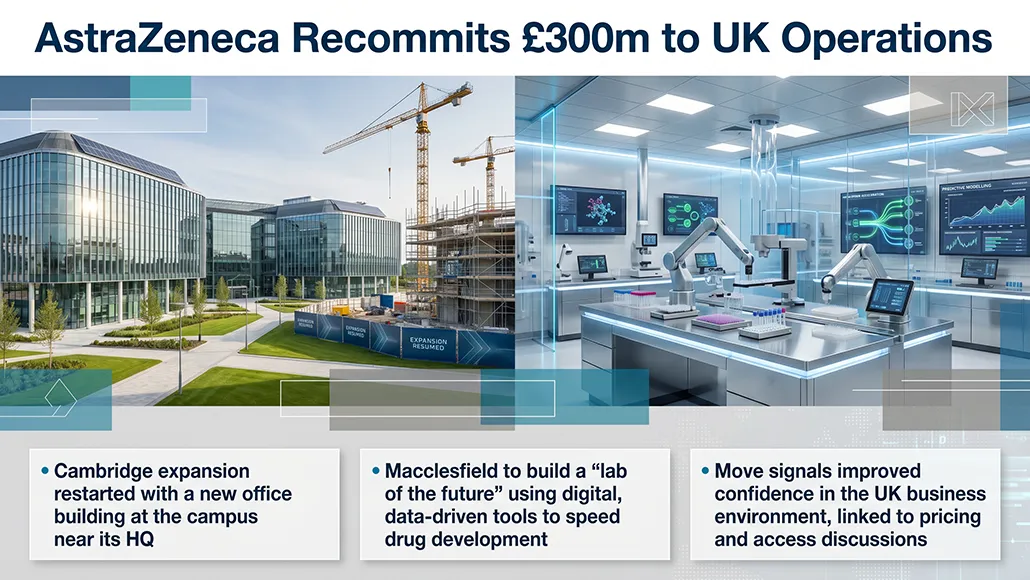
In a reversal of its earlier stance, AstraZeneca has confirmed a £300m commitment to the UK, marking a renewed push into domestic operations after previously halting major projects. The announcement, delivered in Parliament by Keir Starmer, signals a shift in direction following concerns over the UK’s business climate, including access to new medicines through the NHS and pricing frameworks. The AstraZeneca UK investment will be directed toward two existing sites, reviving a previously paused £200m expansion in Cambridge and allocating £100m to its Macclesfield facility.
The company outlined that construction will resume on an office building at its Cambridge campus, known as the Disc, located near its headquarters. At the same time, investment in Macclesfield will fund a lab of the future equipped with advanced digital and data-driven tools aimed at accelerating drug development. Chief executive Pascal Soriot indicated that the Macclesfield project is expected to generate new scientific roles, although exact figures remain unspecified. In Cambridge, staff from multiple sites will relocate into the new facility, named after Rosalind Franklin, consolidating teams focused on data analysis and molecular science.
The investment follows a period of retrenchment, including the suspension of the same Cambridge project last September and the earlier cancellation of a £450m vaccine manufacturing plan in Speke. AstraZeneca attributed those decisions to reduced government support after extended negotiations. The company currently employs around 10,000 people across the UK, with major concentrations in Cambridge and Macclesfield. Starmer described the renewed commitment as made possible by the pharmaceutical arrangement we have struck with the United States to future-proof thousands of jobs, highlighting the role of a bilateral pricing agreement reached in December.
Under that agreement, US prescription drug prices are expected to decline while NHS spending on medicines increases, alongside tariff relief for UK pharmaceutical firms. Soriot acknowledged these developments, stating, we look forward to further enhancing the access and the reimbursement environment and build a strong life sciences sector. Officials including Liz Kendall also framed the move as a reinforcement of the country’s research ecosystem. While the AstraZeneca UK investment underscores renewed confidence, it remains modest compared with the company’s significantly larger funding commitments in the US and China.