










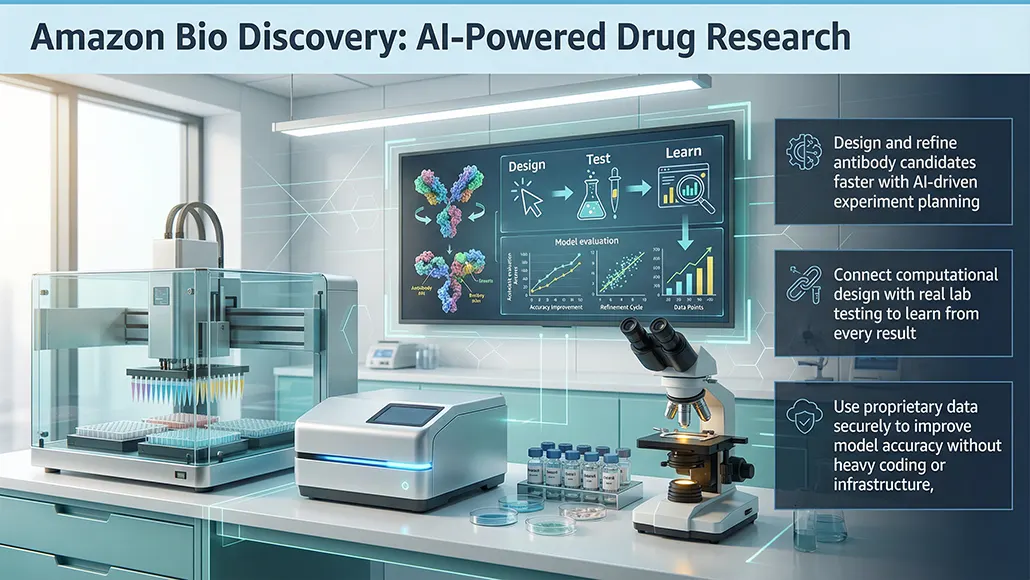
Amazon Web Services has introduced Amazon Bio Discovery, an AI-powered application designed to streamline drug research by enabling scientists to design, test, and refine novel therapies with greater speed and precision. The platform leverages biological foundation models trained on extensive biological datasets to generate and evaluate potential drug candidates, particularly in early-stage antibody development. By integrating computational design with lab testing, the system creates a continuous feedback loop in which each experimental outcome informs the next phase of discovery. Early collaboration with Memorial Sloan Kettering Cancer Center demonstrated the platform’s ability to compress antibody design timelines from months to weeks.
At its core, Amazon Bio Discovery provides researchers with access to a curated library of AI models alongside an intelligent agent capable of guiding experiment design, optimizing inputs, and benchmarking model performance. Scientists can interact with the system using natural language, eliminating the need for advanced coding skills or complex infrastructure management. The platform also enables users to train models using proprietary experimental data, improving predictive accuracy while ensuring data privacy and ownership. “AI agents make powerful scientific capabilities accessible to all drug researchers, not just those with computational expertise,” said Rajiv Chopra, vice president of AWS Healthcare AI and Life Sciences. “These AI systems can help scientists design drug molecules, coordinate testing, learn from results, and get smarter with each experiment. This combination of cutting-edge AI and the robust, secure infrastructure AWS has built for regulated industries allows scientists to accelerate antibody discovery in ways that weren’t possible before.”
The application addresses longstanding barriers in AI adoption within drug discovery, where fragmented data systems, limited access to computational expertise, and complex model selection have slowed progress. By consolidating workflows into a single environment, Amazon Bio Discovery allows researchers to design experiment pipelines, benchmark candidate performance, and directly connect with laboratory partners for synthesis and testing. Integrated partners such as Twist Bioscience and Ginkgo Bioworks support physical validation, with results automatically routed back into the system to refine subsequent experiments.
The platform builds on AWS’s established presence in the pharmaceutical sector, where 19 of the top 20 global pharmaceutical companies already rely on its infrastructure for sensitive research workloads. With early adopters including Bayer, the Broad Institute, Fred Hutch Cancer Center, and Voyager Therapeutics, Amazon Bio Discovery aims to standardize AI-driven research workflows across pharmaceutical, biotech, and academic environments. “We’re glad to be able to join forces with Amazon Bio Discovery to develop the next generation of antibodies that will potentially speed up the process to help patients worldwide,” said Cheung. “As researchers, we spent 20 years just to prove that the first generation of antibody worked, and then we spent another 13 years getting it into the human form before getting FDA approval. This path has been very inefficient. Patients come here with a clock. We need results sooner.”