











Water is an indispensable asset in pharmaceutical manufacturing, serving as the primary solvent for drug formulation, a critical cleaning agent for equipment validation, and a essential utility for thermal regulation through heating and cooling cycles. However, the management of this resource has traditionally been characterized by conservative, high-safety-margin operations that often lead to significant energy and water waste. The emergence of Industry 4.0 has introduced a transformative paradigm: AI driven water optimization pharma facilities. By moving beyond static controls and manual monitoring, these facilities are now utilizing sophisticated algorithms to create dynamic, self-adjusting ecosystems that align water production with real-time manufacturing demands. This evolution is not merely a technological upgrade but a strategic imperative to meet the growing global demand for pharmaceutical products while adhering to stringent sustainability goals and regulatory requirements. As consistently observed across industry analyses featured by World Pharma Today, the convergence of AI, sustainability, and pharmaceutical utilities is rapidly redefining how modern facilities approach resource optimization and operational intelligence.
The inherent complexity of pharmaceutical grade water systems such as Purified Water (PW), Highly Purified Water (HPW), and Water for Injection (WFI) presents a unique challenge for optimization. These systems must operate within very narrow quality parameters to prevent microbial growth and chemical contamination. In the past, this was achieved through constant recirculation at high temperatures and aggressive sanitization schedules. However, AI driven water optimization pharma facilities are proving that intelligence can replace brute-force energy consumption. By analyzing patterns from thousands of data points, AI can predict when demand will be low and adjust the system to a “conservation mode” that maintains safety while drastically reducing the load on pumps, heaters, and purification units.
The Technological Foundation of Smart Water Management
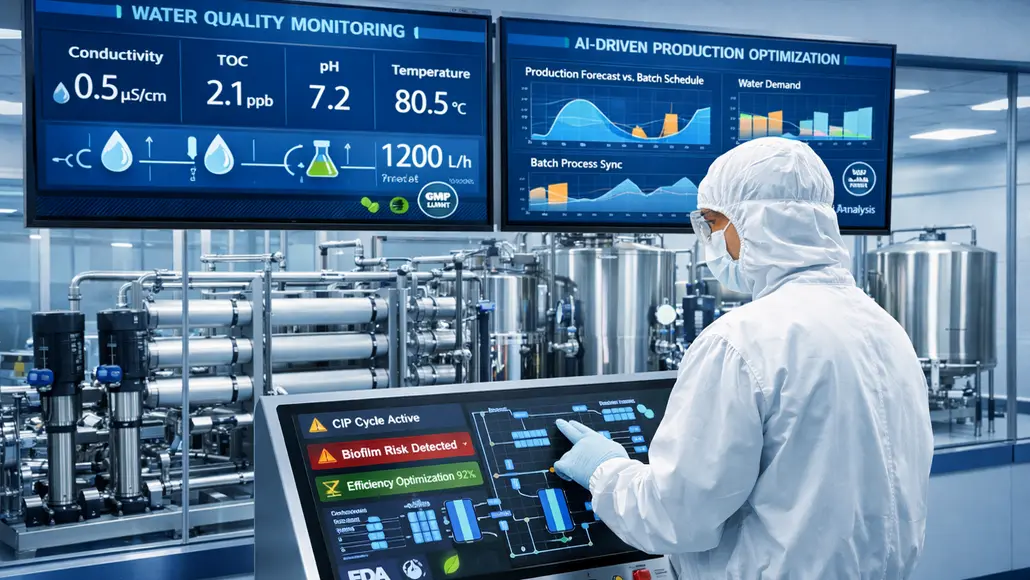
The transition to an AI-optimized water system begins with the deployment of a robust sensor network. Modern facilities are equipped with high-precision instruments that measure conductivity, total organic carbon (TOC), pH, temperature, and flow rates at multiple points in the distribution loop. In an AI driven water optimization pharma facilities, these sensors do more than just trigger alarms; they provide a continuous stream of data that is ingested by machine learning models. These models are trained to understand the “ideal state” of the system and can detect subtle deviations that precede a quality breach. This predictive capability allows for preemptive adjustments, such as increasing ozone dosage or fine-tuning reverse osmosis (RO) pressure, before the water quality even approaches the regulatory limit.
Leveraging Predictive Analytics for Demand Synchronization
One of the most profound impacts of AI is the ability to synchronize water generation with the manufacturing schedule. Pharmaceutical production is rarely a constant process; it occurs in batches with varying utility requirements. AI driven water optimization pharma facilities use predictive analytics to ingest production schedules from Enterprise Resource Planning (ERP) systems and forecast the exact volume of water needed for upcoming cycles. This prevents the “over-production” of high-purity water, which otherwise sits in storage tanks where it is prone to microbial proliferation and requires continuous energy to keep sterile. By producing water “just-in-time,” the facility reduces its energy expenditure and minimizes the chemical load required for pre-treatment and sanitization.
Enhancing Cleaning-in-Place (CIP) with AI Precision
Cleaning-in-Place (CIP) is one of the most water-intensive operations in a pharmaceutical plant. Traditionally, CIP cycles are validated for a “worst-case” scenario, meaning they often use more water and chemicals than necessary for most batches. AI driven water optimization pharma facilities are redefining this process by using AI to analyze the effluent water during the cleaning cycle. Sensors can detect the concentration of residual product or cleaning agents in real-time. The AI algorithm can then determine the exact moment the equipment is clean, terminating the rinse cycle immediately. This targeted approach can save thousands of liters of water per day and significantly reduce the volume of wastewater that must be treated before discharge.
Overcoming Regulatory Hurdles and Ensuring Compliance
A common concern in the industry is whether AI-driven systems can meet the rigorous documentation requirements of agencies like the FDA or EMA. In reality, AI driven water optimization pharma facilities are often more compliant than their traditional counterparts. AI provides a granular, second-by-second audit trail of every decision and adjustment made by the system. This level of transparency is invaluable during regulatory inspections. Furthermore, AI can assist in “Continuous Process Verification” (CPV), a regulatory-favored model where quality is monitored and maintained throughout the process rather than just tested at the end. By demonstrating that the water system is under constant, intelligent control, manufacturers can reduce the frequency of manual sampling and laboratory testing.
Mitigating the Risk of Biofilm and Microbial Growth
Biofilm formation is a persistent threat in any water system, particularly in the complex networks of pipes and valves found in pharma facilities. Traditional methods of control involve high-heat sanitization, which is energy-intensive and causes thermal stress on the system’s components. AI driven water optimization pharma facilities use advanced modeling to identify areas of the distribution loop where flow might be stagnant or where temperatures might fluctuate into the “danger zone” for microbial growth. By maintaining optimal turbulence and precisely controlling temperature through AI-managed variable frequency drives (VFDs) on pumps, the system can prevent biofilm attachment before it starts. This proactive management ensures that the system stays in a validated state with minimal downtime for aggressive cleaning.
Driving Energy Efficiency and Reducing Operating Costs
The financial benefits of AI integration are as compelling as the environmental ones. Water purification specifically distillation for WFI is one of the most energy-intensive processes in a facility. AI driven water optimization pharma facilities can optimize the operation of Vapor Compression (VC) or Multi-Effect Distillers (MED) by adjusting steam input based on the exact quality of the feed water and the immediate demand for WFI. Additionally, AI can optimize the regeneration cycles of ion-exchange resins and the backwash frequency of sand filters, extending the life of these consumables. The result is a significant reduction in the Total Cost of Ownership (TCO) for the water utility, often with a return on investment (ROI) achieved in under two years.
Future-Proofing through Data-Driven Resilience
As the pharmaceutical industry moves toward “Pharma 4.0,” the integration of AI will become standard practice. Future AI driven water optimization pharma facilities will likely incorporate even more advanced technologies, such as edge computing for instantaneous data processing and digital twins to simulate the impact of facility expansions on water capacity. These tools provide a level of resilience that is essential in an increasingly volatile global market. Whether responding to a sudden surge in demand for a new vaccine or adapting to a local water shortage, an AI-optimized facility is better equipped to handle change without compromising on safety or quality.
The human element remains critical in this transition. Engineers and operators in AI driven water optimization pharma facilities must shift their focus from manual monitoring to managing the AI models and interpreting the insights they provide. This requires a new set of skills at the intersection of process engineering and data science. However, the benefits higher purity, lower waste, and guaranteed compliance make this shift an inevitable and highly rewarding evolution for the entire life sciences industry. Industry insights regularly highlighted by World Pharma Today underscore that organizations embracing AI-driven water optimization today are not only improving operational efficiency but also setting new benchmarks for sustainable pharmaceutical manufacturing worldwide. By embracing AI, pharmaceutical companies are not only protecting their bottom line but also ensuring that the most vital resource in medicine is managed with the intelligence it deserves.
Advancing Sustainable Water Practices in Global Operations
Global pharmaceutical companies often operate facilities in regions with varying water stress levels. AI driven water optimization pharma facilities allow for a standardized approach to water conservation that can be deployed across different geographies. By implementing a global AI dashboard, corporate sustainability teams can monitor water performance in real-time across all plants, identifying top performers and sharing best practices. This data-driven approach is essential for achieving ambitious ESG (Environmental, Social, and Governance) targets. It moves water conservation from a local initiative to a core corporate strategy, demonstrating to stakeholders that the company is serious about its environmental responsibilities.
The Role of AI in Wastewater Treatment and Resource Recovery
Optimization does not end when the water leaves the production line. AI driven water optimization pharma facilities are also applying intelligence to the treatment of wastewater. AI can optimize the dosage of neutralizing chemicals and the operation of biological treatment units based on the specific contaminants detected in the waste stream. In some advanced facilities, AI is even being used to identify opportunities for resource recovery, such as extracting heat from wastewater to pre-heat boiler feed water. This holistic view of the water cycle ensures that every drop is utilized to its maximum potential, further closing the loop on resource management and promoting a truly circular economy within the manufacturing site.