












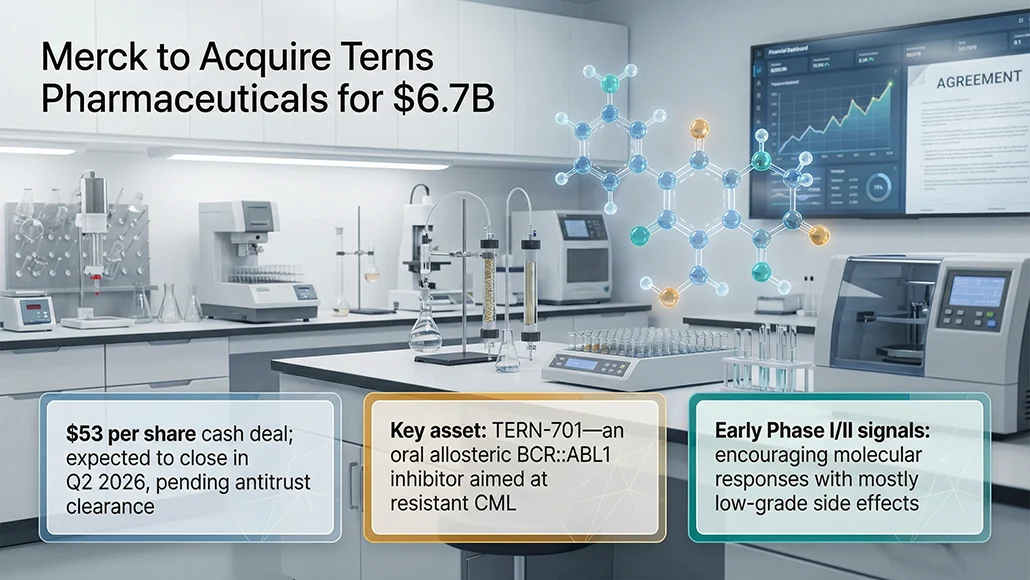
Merck, known as MSD outside the United States and Canada, confirmed it has signed a definitive agreement to acquire Terns Pharmaceuticals in a deal valued at approximately $6.7 billion. The transaction, priced at $53.00 per share in cash, has been approved by both companies’ boards and is expected to close in the second quarter of 2026, subject to antitrust clearance and a majority tender of shares. As part of the agreement, Merck acquires Terns Pharmaceuticals to strengthen its oncology and hematology portfolio, with the deal reflecting a premium of roughly 31% to Terns’ 60-day and 42% to its 90-day volume-weighted average stock price.
Central to the acquisition is TERN-701, an investigational oral therapy designed to bind to the ABL myristoyl pocket, offering a differentiated mechanism compared to ATP-binding site-targeted therapies. This approach reinforces the growing focus on allosteric inhibition as a strategy to address resistance in hematologic malignancies, particularly chronic myeloid leukemia. The acquisition of Terns builds on our growing presence in hematology with TERN-701, a potential best-in-class candidate for the treatment of certain patients with chronic myeloid leukemia, said Robert M. Davis, chairman and chief executive officer, Merck, in a press release.1 This transaction further diversifies and strengthens our position in oncology as we continue to look for opportunities to broaden our portfolio into other therapeutic areas.
TERN-701 is currently under evaluation in the Cardinal trial, a global Phase I/II study targeting patients with Philadelphia chromosome-positive chronic phase chronic myeloid leukemia who have experienced prior treatment challenges. The dose escalation phase concluded in January 2025 without dose-limiting toxicities up to 500mg once daily, while subsequent expansion phases have explored multiple dosing cohorts and resistance mutations, including T315I. Early clinical data demonstrated encouraging major molecular response and deep molecular response rates by week 24, alongside a safety profile marked by predominantly low-grade adverse events. Based on early clinical evidence, TERN-701, a novel allosteric BCR::ABL1 inhibitor, may have the potential to provide a meaningfully differentiated option for certain patients living with chronic myeloid leukemia, said Dean Y. Li, MD, PhD, president, Merck Research Laboratories, in a press release.1
The Merck acquires Terns Pharmaceuticals transaction also reflects a broader industry trend toward earlier-stage pipeline consolidation, with companies increasingly committing to assets supported by Phase I/II data when clinical rationale and unmet need align. Chronic myeloid leukemia continues to present challenges related to resistance mutations and treatment tolerability, sustaining demand for next-generation therapies. The first approval of a BCR::ABL1 tyrosine kinase inhibitor 25 years ago transformed the prognosis for many patients with chronic myeloid leukemia. Despite new therapeutic options, there is significant need for innovative, well-tolerated therapies with faster time to onset of molecular response leading to deeper responses and better disease control, added Li.1 The transaction is expected to generate a charge of approximately $5.8 billion, recorded in both second quarter and full year 2026 results, as Merck integrates the asset into its broader hematology pipeline.