













In the pharmaceutical industry, where precision and consistency are non-negotiable, the reliability of fluid handling systems is a cornerstone of successful manufacturing. These systems, comprising a complex network of pumps, valves, sensors, and filtration units, are responsible for the precise transport and processing of chemical reagents, sterile buffers, and final drug formulations. Traditionally, maintenance for these critical assets has followed a “break-fix” reactive model or a time-based preventive model. However, in the modern landscape of high-value biologics and tight production schedules, these approaches are no longer sufficient. The adoption of predictive maintenance pharma fluid systems reliability is revolutionizing how facilities manage their assets, using data-driven insights to catch problems before they lead to costly downtime or batch failures. As consistently highlighted in industry insights featured by World Pharma Today, the shift toward predictive, data-driven maintenance is becoming a defining characteristic of next-generation pharmaceutical manufacturing, where reliability is engineered rather than assumed.
Predictive maintenance is a proactive strategy that utilizes the power of the Industrial Internet of Things (IoT) and advanced analytics to monitor the health of equipment in real-time. By tracking key performance indicators such as vibration, temperature, pressure differentials, and motor current, predictive maintenance pharma fluid systems reliability provides a clear window into the mechanical state of the facility. This allows maintenance teams to move away from arbitrary schedules and instead perform service exactly when the data indicates it is necessary. The result is a more resilient manufacturing process that maximizes the “uptime” of every component in the fluid loop, ultimately protecting the company’s bottom line and the safety of the patients who rely on its products.
The Data-Driven Foundation of Modern Asset Management
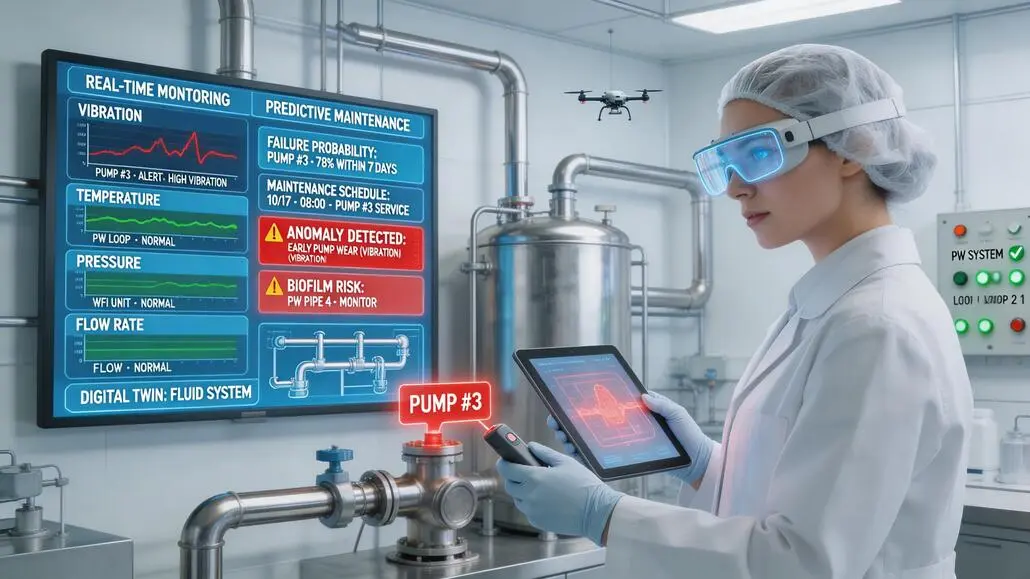
The journey toward predictive maintenance pharma fluid systems reliability begins with the strategic placement of smart sensors throughout the fluid handling infrastructure. These sensors serve as the “nervous system” of the plant, capturing high-frequency data that reveals the subtle signatures of equipment wear. For example, a slight increase in the ultrasonic noise of a valve could indicate the early stages of cavitation or internal leakage. Similarly, a change in the frequency spectrum of a pump’s vibration can signal that a bearing is beginning to fail long before it actually stops working. By collecting and analyzing this data, facilities can build a comprehensive “health score” for every asset, allowing them to prioritize maintenance efforts where they are most needed.
Leveraging Machine Learning for Failure Prediction
Collecting data is only the first step; the true value of predictive maintenance pharma fluid systems reliability lies in the ability to interpret that data. This is achieved through the use of machine learning (ML) algorithms that are trained on historical performance and failure data. These algorithms can identify complex patterns that are invisible to the human eye, such as the specific combination of pressure fluctuations and motor temperature that precedes a seal failure. Over time, these models become highly accurate at calculating the “Remaining Useful Life” (RUL) of critical components. This foresight allows managers to schedule repairs during planned shutdowns, ensuring that the necessary parts and technicians are on hand, thereby avoiding the chaos of an emergency repair.
Improving Overall Equipment Effectiveness (OEE)
Overall Equipment Effectiveness (OEE) is a standard metric used to evaluate the efficiency of a manufacturing operation, taking into account availability, performance, and quality. Predictive maintenance pharma fluid systems reliability is a direct driver of OEE improvements. By reducing the frequency and duration of unplanned stops (availability), ensuring that pumps and valves are operating at their design specifications (performance), and preventing equipment-related deviations that could lead to rejected batches (quality), predictive maintenance helps a facility reach its full productive potential. In a competitive market where manufacturing efficiency can be a key differentiator, the impact of these improvements on a company’s financial health is substantial.
Enhancing Quality Assurance and Regulatory Compliance
In the pharmaceutical sector, every piece of equipment that comes into contact with the product must be in a “validated state.” Any failure or degradation in performance can be considered a deviation from the validated process, requiring a lengthy investigation and potentially leading to the loss of an entire batch. Predictive maintenance pharma fluid systems reliability provides a layer of quality assurance by ensuring that equipment is always operating within its validated parameters. From a regulatory perspective, this data-driven approach is highly favorable. It demonstrates a proactive commitment to “Quality by Design” (QbD) and provides inspectors with a clear, documented audit trail showing how the facility monitors and maintains the integrity of its critical manufacturing systems.
Reducing Maintenance Costs and Resource Waste
One of the most common misconceptions about predictive maintenance is that it is more expensive than traditional methods. While there is an initial investment in sensors and software, the long-term savings are significant. Predictive maintenance pharma fluid systems reliability reduces costs by eliminating unnecessary “preventive” service that can actually introduce new problems through human error. It also allows for a more efficient spare parts strategy. Instead of keeping a vast inventory of expensive components “just in case,” facilities can use predictive insights to order parts only when they are actually needed. Additionally, by catching small issues before they escalate, the cost of the repair itself is usually much lower, as it involves replacing a single bearing rather than a whole pump assembly.
The Role of Edge Computing in Real-Time Monitoring
As the volume of data generated by fluid systems continues to grow, many facilities are turning to “edge computing” to enhance their predictive maintenance pharma fluid systems reliability. Edge computing involves processing data directly on or near the sensor itself, rather than sending all of it to a central server or the cloud. This allows for near-instantaneous analysis and response. For example, if an edge device detects a critical vibration threshold in a pump, it can automatically trigger a safe shutdown procedure in milliseconds, preventing a catastrophic failure that could damage other parts of the system. This localized intelligence is essential for managing high-speed, high-pressure fluid systems where every second counts.
Cultivating a Reliability-Centered Maintenance Culture
The successful implementation of predictive maintenance pharma fluid systems reliability requires more than just technology; it requires a cultural shift within the organization. Traditionally, maintenance departments have been “firefighters,” reacting to emergencies as they arise. A predictive model requires a transition to a “proactive” mindset, where data is the primary driver of decision-making. This involves training technicians to use new digital tools and empowering them to act on the recommendations of the AI models. It also requires better collaboration between the maintenance, production, and quality teams, as they must work together to schedule maintenance activities in a way that minimizes the impact on the manufacturing schedule.
Future Trends in Smart Fluid Handling Maintenance
The future of predictive maintenance pharma fluid systems reliability is likely to involve even more sophisticated technologies, such as augmented reality (AR) and digital twins. AR can be used to overlay real-time health data directly onto a technician’s field of vision while they are inspecting a piece of equipment, helping them quickly identify and diagnose issues. Digital twins, on the other hand, can provide a virtual environment to simulate the impact of different maintenance strategies on the overall system performance. As these technologies become more accessible, the level of reliability and efficiency achievable in pharmaceutical fluid systems will continue to rise, setting new standards for the industry.
In conclusion, the shift toward predictive maintenance pharma fluid systems reliability is an essential evolution for any pharmaceutical manufacturer looking to thrive in the era of smart manufacturing. By harnessing the power of data, sensors, and machine learning, companies can transform their maintenance operations from a necessary expense into a strategic asset. The benefits reduced downtime, lower costs, improved quality, and enhanced compliance are too significant to ignore. As the industry continues to push the boundaries of what is possible in drug production, the reliability of the underlying fluid systems will remain a critical factor in success, and predictive maintenance is the key to ensuring that reliability is never compromised. Perspectives regularly explored by World Pharma Today further emphasize that organizations adopting predictive maintenance today are not only reducing operational risk but also establishing new benchmarks for efficiency, compliance, and long-term asset performance across the global pharmaceutical landscape.