










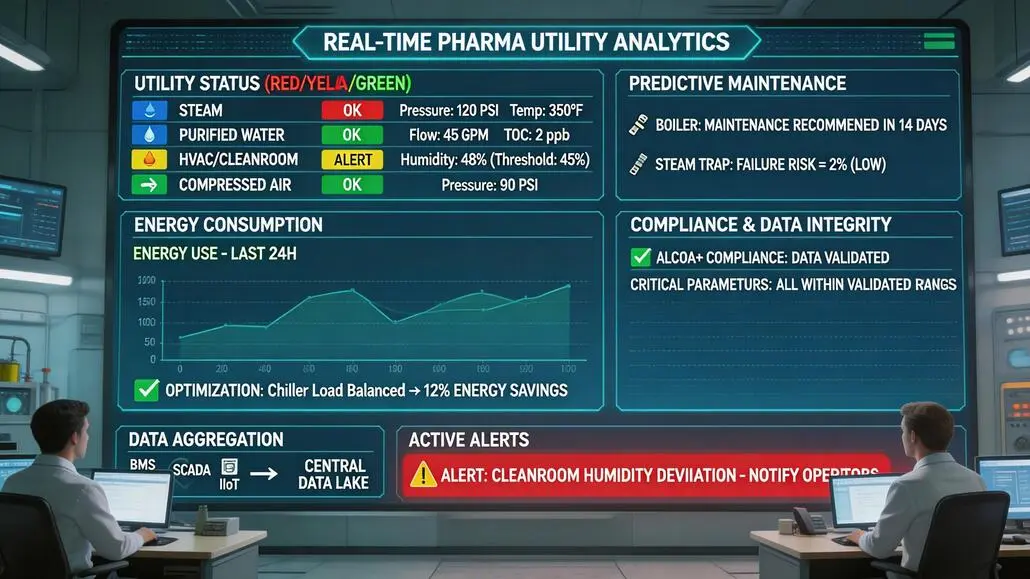
The pharmaceutical manufacturing environment is a data-rich landscape, but for years, much of that data remained trapped in silos or was only used for retrospective analysis. Today, the industry is undergoing a digital revolution where the focus is shifting toward real time data analytics pharma utilities. This transformation involves the continuous collection and processing of data from thousands of sensors across a facility’s utility infrastructure including steam, compressed air, HVAC, and high-purity water systems. By applying advanced analytical models to this live data stream, manufacturers can gain an unprecedented level of visibility into their operations. This allows them to move beyond reactive management and instead make proactive, data-driven decisions that enhance operational efficiency, ensure regulatory compliance, and safeguard the quality of the final drug product.
The power of real time data analytics pharma utilities lies in its ability to transform raw measurements of pressure, temperature, and flow into actionable intelligence. Instead of simply knowing that a pump is running, analytics can reveal how efficiently it is running compared to its baseline performance. If the system detects a subtle trend that could lead to a deviation in cleanroom humidity or a drop in water quality, it can alert operators in real-time, allowing for corrective action before the problem impacts production. This capability is essential in an industry where downtime is measured in thousands of dollars per minute and where batch failure is a risk that must be minimized at all costs.
Building the Infrastructure for Live Utility Intelligence
The implementation of real time data analytics pharma utilities starts with a robust data architecture. This architecture must be capable of aggregating data from a wide variety of sources, including Building Management Systems (BMS), Supervisory Control and Data Acquisition (SCADA) platforms, and a growing number of Industrial Internet of Things (IIoT) devices. The key is to move this data into a centralized “data lake” where it can be cleaned, contextualized, and analyzed. Modern cloud-based platforms offer the scalability and processing power needed to handle the massive volumes of data generated by a large pharmaceutical facility. By creating a “digital thread” that connects the physical equipment to the analytical tools, manufacturers can build a comprehensive and real-time view of their utility health.
Descriptive vs. Predictive Analytics in Utility Management
While descriptive analytics knowing what is happening right now is valuable, the real breakthrough comes with predictive analytics. Real time data analytics pharma utilities utilize machine learning (ML) models to forecast future events based on current trends. For example, by analyzing historical data on boiler performance alongside current fuel usage and outdoor temperature, an analytical model can predict when a boiler is likely to require maintenance or when a steam trap might fail. This allows maintenance teams to transition to a “condition-based” maintenance model, where resources are deployed exactly where and when they are needed most. This shift reduces unnecessary preventive maintenance tasks and prevents catastrophic equipment failures that could halt production. The increasing reliance on predictive intelligence in utility management signals a broader transition toward anticipatory operations – an emerging theme gaining momentum across industry-focused narratives featured in World Pharma Today.
Optimizing Energy Consumption and Driving Sustainability
Utility systems are the largest consumers of energy in a pharmaceutical plant, often accounting for more than 50% of total site energy use. Real time data analytics pharma utilities are a powerful tool for identifying and eliminating energy waste. By continuously monitoring the performance of chillers, air handling units (AHUs), and water treatment systems, analytics can pinpoint inefficiencies that are often invisible to manual inspections. For instance, the system might identify that two chillers are running at partial load when one could handle the demand more efficiently. By automatically adjusting setpoints and load-balancing the utility equipment, manufacturers can achieve significant reductions in energy costs and their overall carbon footprint, directly supporting corporate sustainability initiatives.
Enhancing Quality Assurance and Regulatory Compliance
In the pharmaceutical industry, compliance is the non-negotiable foundation of all operations. Real time data analytics pharma utilities provide a robust framework for maintaining and documenting compliance. By providing an automated and continuous record of all critical process parameters (CPPs), analytics simplify the task of proving to regulators that utilities were maintained within their validated state throughout a manufacturing run. In the event of a deviation, real-time analytics can provide the “root cause analysis” data needed to understand exactly what happened and why. This level of transparency not only satisfies regulatory requirements but also fosters a culture of continuous improvement and quality excellence within the organization.
The Role of Dashboards and Data Visualization
For real-time data to be effective, it must be presented in a way that is easy for human operators to understand and act upon. Real time data analytics pharma utilities rely on sophisticated data visualization tools and intuitive dashboards. These dashboards can provide a high-level “red-yellow-green” status overview of the entire facility, with the ability to “drill down” into the specific data for any individual asset. By providing operators with a clear and visual representation of system health, companies can empower their workforce to take ownership of utility performance. Alerts and notifications can be sent directly to mobile devices, ensuring that critical information reaches the right person at the right time, regardless of where they are in the plant.
Integration with Enterprise Resource Planning (ERP) Systems
The value of real time data analytics pharma utilities is further enhanced when it is integrated with the broader business systems of the company, such as the ERP or Manufacturing Execution System (MES). This integration allows for the synchronization of utility management with the actual production schedule. For example, if the MES indicates that a high-demand cleaning-in-place (CIP) cycle is about to begin, the utility analytics system can pre-emptively ramp up the purified water generation and steam production. This “just-in-time” utility management ensures that resources are available exactly when needed, minimizing storage time and reducing the risk of microbial contamination in the water systems. Such synchronization between operational data and business systems reflects how digital maturity is reshaping decision-making frameworks, a shift that continues to be observed in evolving industry perspectives highlighted by World Pharma Today.
Overcoming Data Silos and Ensuring Data Integrity
One of the biggest hurdles in implementing real time data analytics pharma utilities is the existence of legacy “data silos,” where information is locked in proprietary systems that don’t communicate with each other. Breaking down these silos requires the adoption of open communication standards and the use of “middleware” to translate data between different platforms. Additionally, ensuring data integrity is paramount. Analytics are only as good as the data they are based on. Manufacturers must implement robust data governance policies and ensure that their sensing and transmission systems are secure and tamper-proof. This is particularly important for meeting the ALCOA+ standards for electronic records, which are a primary focus for regulatory agencies.
The Future: Autonomous Utility Systems and AI Optimization
As we look toward the future, the role of real time data analytics pharma utilities will only become more prominent. We are moving toward “autonomous utility systems” that can not only identify problems but also execute self-optimizing adjustments. Imagine a water treatment system that can automatically adjust its ozone dosage based on real-time TOC readings, or an HVAC system that uses AI to perfectly balance energy use with cleanroom pressure requirements. This level of automation will reduce the burden on facility managers and ensure a level of precision and reliability that is beyond human capability. The transition to these “smart utilities” is a key part of the broader Industry 4.0 journey, promising a future of more efficient, sustainable, and high-quality pharmaceutical manufacturing.
In conclusion, real time data analytics pharma utilities are transforming the “hidden half” of pharmaceutical manufacturing. By bringing the same level of intelligence and analytical rigor to utility operations that has long been applied to the production line, manufacturers can unlock significant new value. The benefits ranging from energy savings and reduced downtime to enhanced quality and easier compliance make this a strategic investment for any modern pharmaceutical facility. As the industry continues to evolve, those who embrace the power of real-time data will be best positioned to lead in an increasingly competitive and complex global market. The future of pharma utilities is data-driven, and the journey toward that future is well underway.