










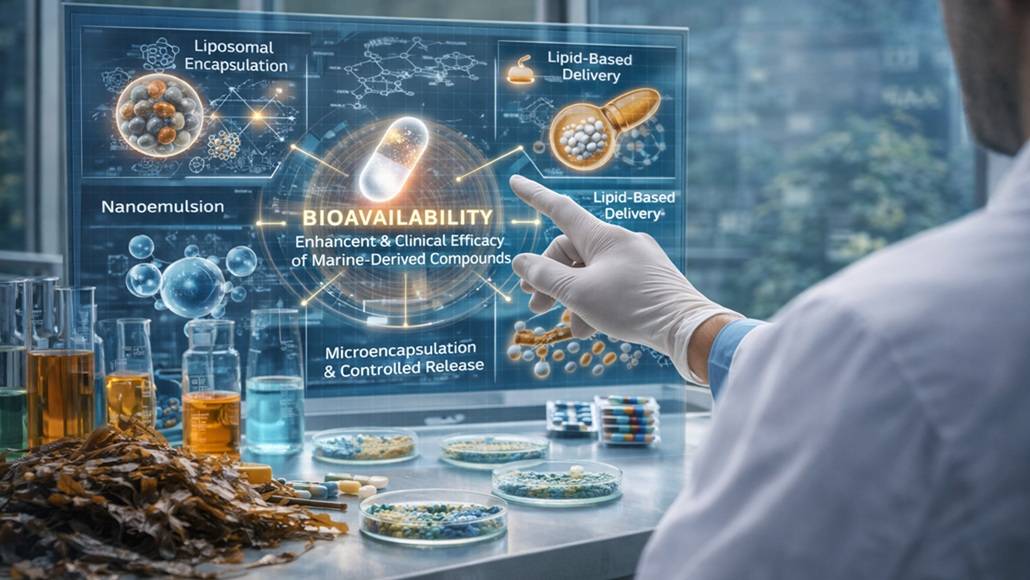
Bioavailability in Nutraceuticals and Pharmaceuticals: Enhancing Absorption and Clinical Efficacy of Marine-Derived Compounds
The effectiveness of nutraceutical and pharmaceutical formulations is fundamentally dependent on bioavailability the extent and rate at which an active compound is absorbed and becomes available at its site of action. As marine-derived bioactives gain prominence in modern healthcare, optimizing their bioavailability has become a critical focus in both research and product development.
Marine-derived compounds such as polysaccharides, omega-3 fatty acids, and carotenoids possess significant therapeutic potential. However, their structural complexity and sensitivity to physiological conditions often limit their absorption and systemic availability.
Addressing these challenges requires advanced formulation strategies, standardized ingredient sourcing, and the integration of pharmaceutical-grade delivery systems.
Understanding Bioavailability in Healthcare Applications
Bioavailability is a key pharmacokinetic parameter that determines the clinical performance of bioactive compounds. Even highly potent ingredients may fail to deliver desired outcomes if they are not efficiently absorbed or utilized by the body.
Several factors influence bioavailability, including:
- Molecular size and structural complexity
- Solubility and permeability
- Stability under gastrointestinal conditions
- Interaction with enzymes and transport proteins
- Formulation and delivery mechanisms
Marine-derived compounds often exhibit high molecular weight and complex biochemical structures, which can hinder passive absorption and require specialized delivery approaches.
Challenges in Marine Bioactive Absorption
The incorporation of marine-derived ingredients into nutraceutical and pharmaceutical products presents several formulation challenges:
- Limited intestinal permeability: Large molecular structures restrict efficient transport across epithelial barriers
- Gastrointestinal degradation: Exposure to acidic and enzymatic conditions can reduce active compound integrity
- Poor solubility: Many marine compounds require lipid-based systems for improved absorption
- Variability in raw materials: Differences in sourcing and extraction methods can affect consistency and efficacy
These challenges highlight the need for advanced delivery technologies to enhance the clinical performance of marine bioactives.
Advanced Formulation and Delivery Technologies
To overcome bioavailability limitations, manufacturers are increasingly adopting innovative drug delivery systems:
- Liposomal Encapsulation
Liposomal systems encapsulate bioactives within lipid bilayers, improving stability and facilitating cellular uptake. This approach enhances absorption while protecting compounds from degradation.
- Nanoemulsion and Nanoparticle Systems
Reducing particle size to the nanoscale significantly improves solubility and absorption. These systems are particularly effective for lipid-soluble compounds such as omega-3 fatty acids.
- Microencapsulation and Controlled Release
Encapsulation technologies protect sensitive compounds and enable targeted or sustained release within the gastrointestinal tract, improving efficacy and reducing dosage frequency.
- Lipid-Based Delivery Platforms
Lipid carriers enhance the absorption of poorly water-soluble compounds, increasing their bioavailability and therapeutic potential.
Role of Ingredient Standardization
The bioavailability of marine-derived compounds is closely linked to their molecular characteristics. Parameters such as molecular weight, structural composition, and purity significantly influence absorption and biological activity.
Standardization ensures:
- Consistent pharmacokinetic behavior
- Reproducible clinical outcomes
- Reliable formulation performance
Leading nutraceutical ingredient suppliers are focusing on producing high-purity, well-characterized extracts that meet both nutraceutical and pharmaceutical standards, supporting improved bioavailability and efficacy.
Clinical Implications and Therapeutic Relevance
Enhanced bioavailability directly contributes to improved therapeutic outcomes. Optimized formulations can:
- Increase systemic absorption
- Reduce required dosage levels
- Improve patient compliance
- Enable more predictable clinical responses
In pharmaceutical contexts, improved bioavailability is critical for developing adjunct therapies, particularly in areas such as oncology, metabolic disorders, and immune-related conditions.
Applications Across Healthcare Segments
Bioavailability optimization is essential across a wide range of applications, including:
- Cardiovascular health and lipid management
- Immune modulation and inflammation control
- Gastrointestinal and microbiome-targeted therapies
- Cognitive and neurological health
- Oncology-supportive care
Marine-derived bioactives, when effectively delivered, offer multifunctional benefits that support both preventive and therapeutic healthcare strategies.
Industry and Commercial Perspective
As the global healthcare market becomes increasingly competitive, bioavailability has emerged as a key differentiator in product development. Both nutraceutical and pharmaceutical companies are investing in advanced formulation technologies to enhance the clinical value of their products.
Ingredient suppliers play a pivotal role by providing standardized, high-quality bioactives supported by scientific validation. The integration of pharmaceutical-grade technologies into nutraceutical manufacturing is further driving innovation and market growth.
Future Outlook
The future of bioavailability enhancement lies in the convergence of nanotechnology, biotechnology, and precision medicine. Personalized nutrition and targeted delivery systems are expected to redefine how bioactive compounds are formulated and administered.
Marine-derived compounds will continue to benefit from these advancements, with ongoing research focused on improving targeted delivery, stability, and therapeutic efficacy.
Conclusion
Bioavailability is a critical determinant of the success of both nutraceutical and pharmaceutical products. As marine-derived bioactives gain increasing relevance in healthcare, optimizing their absorption and delivery is essential for achieving meaningful clinical outcomes.
Through advancements in formulation science, ingredient standardization, and delivery technologies, the industry is well-positioned to unlock the full potential of marine bioactives in modern healthcare.