












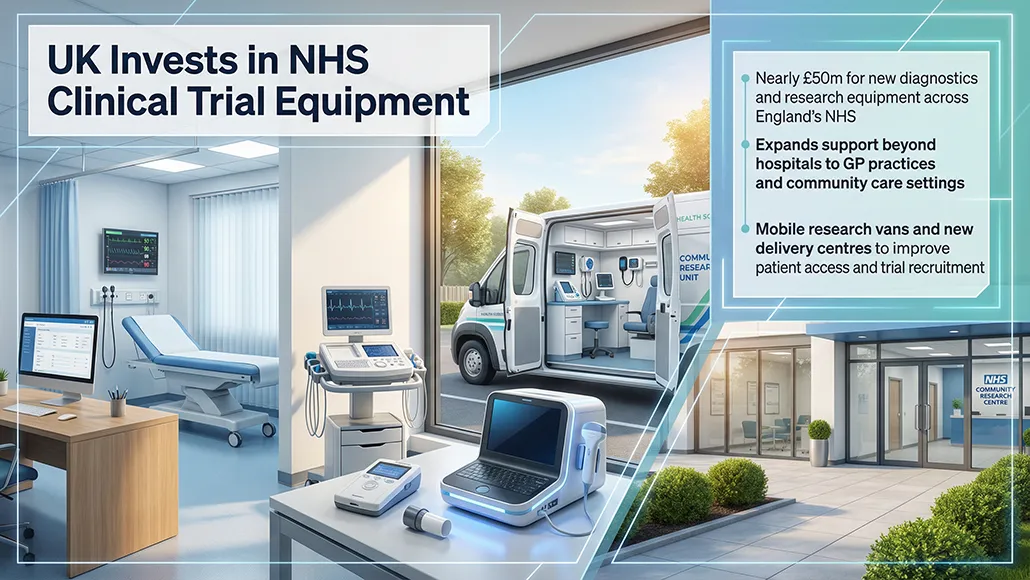
The UK government has announced nearly £50 million in funding aimed at strengthening the NHS’s capacity to conduct commercial research projects and clinical trials supported partly by the pharmaceutical industry. The investment is intended to supply critical research and diagnostic equipment to healthcare providers across England. A total of 51 NHS Trusts and 79 primary care organisations will receive equipment ranging from diagnostic tools such as spirometers and ECG machines to advanced scanners and mobile research vans.
This funding forms part of the Voluntary Branded Medicines Pricing, Access and Growth (VPAG) Investment Programme. Under this arrangement, a portion of the rebates that pharmaceutical companies return to the NHS calculated as a percentage of their sales when spending on branded medicines exceeds an agreed growth rate is redirected toward research infrastructure. The VPAG framework, introduced in 2024 and scheduled to run until 2028, represents the latest version of the voluntary rebate agreement between the UK government and the pharmaceutical industry.
For the first time, the scheme also includes an industry-funded investment programme designed to channel approximately £400 million into the UK’s health and life sciences sector. The equipment funding will complement several additional initiatives aimed at strengthening research capabilities, including plans to establish up to 18 new Commercial Research Delivery Centres (CRDCs) across the four UK nations. These centres are expected to support improved patient recruitment and facilitate the running of clinical studies.
The £47.8 million allocation announced by the government marks the third year of capital investment under the programme. This round of funding has been expanded for the first time to include all non-commercial NHS providers, extending beyond NHS trusts to cover organisations such as GP practices. The expansion reflects an effort to enhance the NHS’s ability to run innovative clinical trials and address a prolonged decline in the number of commercially sponsored studies conducted in the UK.
According to the National Institute for Health and Care Research (NIHR), which is responsible for distributing the funds, around 60% of the new investment will be directed toward primary care organisations. The goal is to enable these providers to run commercial clinical trials within local communities. Health Innovation and Safety Minister, Dr Zubir Ahmed, said the investment will help the NHS run trials in hospitals as well as community settings across England.
“By targeting primary care, we are changing that – giving patients everywhere the chance to benefit from the latest medical breakthroughs on their doorstep, regardless of where they live or their background,” he said. “This is how we will build an NHS fit for the future, keep the UK at the cutting-edge of global life sciences, and drive the economic growth our country needs.”
Among the assets funded through the NIHR programme is a fleet of mobile research vans designed for screening and diagnostic work. These units are intended to support patient recruitment and reduce geographic inequalities in regions including Leicestershire, Nottinghamshire, Cambridgeshire, and Norfolk. The funding will also cover new scanning equipment and specialty pharmacy refurbishments.
The Association of the British Pharmaceutical Industry (ABPI) welcomed the funding announcement, stating that the investment will broaden access to clinical trials, help address equipment shortages that can slow hospital-based research, and give GP practices and community providers more opportunities to “offer research opportunities closer to where people live.”