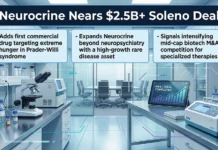






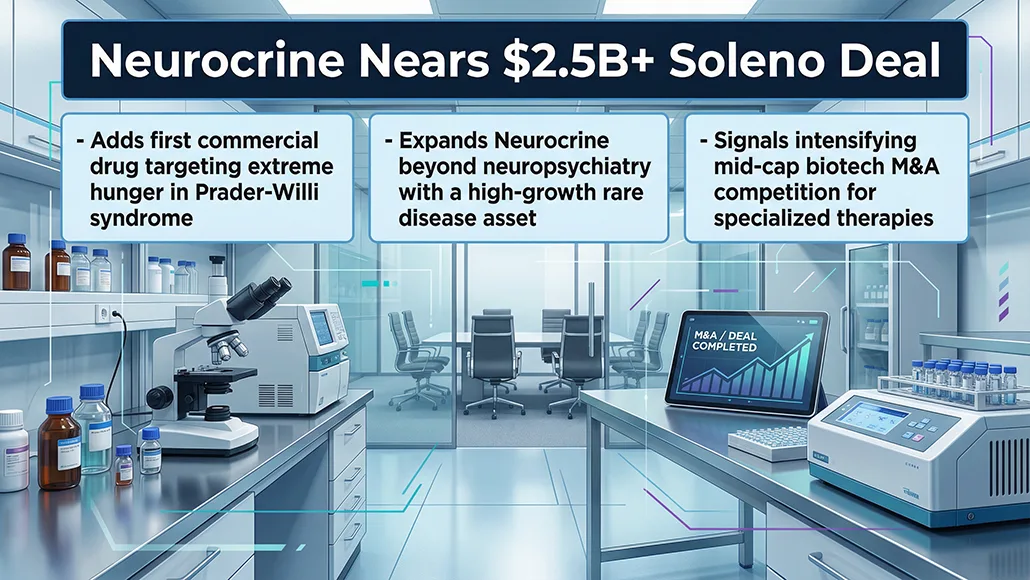
Neurocrine Biosciences is close to securing a more than $2.5bn acquisition of Soleno Therapeutics, the developer of a treatment for a rare genetic form of obesity. The talks, described as advanced, highlight how midsized drugmakers are increasingly pursuing strategic deals to expand their portfolios. Neurocrine, known for its focus on neuropsychiatric medicines, is seeking to integrate Soleno’s therapy designed to address extreme hunger linked to Prader-Willi syndrome.
This genetic condition typically emerges in childhood and results in hyperphagia, a persistent and uncontrollable drive to eat, often leading to obesity and serious health complications. Soleno has developed the first commercialised drug targeting this aspect of the disorder. According to people familiar with the matter, the proposed transaction could value Soleno shares in the low-to-mid $50s, placing the overall deal above $2.5bn and exceeding its roughly $2bn valuation at Thursday’s close. Discussions are progressing quickly, with a potential agreement expected as soon as Monday if negotiations proceed without disruption. Neither company has commented publicly.
The Soleno Therapeutics acquisition comes amid heightened activity in biotech dealmaking, as midsized companies increasingly compete with larger pharmaceutical groups for specialised assets. Data from Dealogic indicates that US-based biotech deals reached $63.3bn in the first quarter, making it one of the strongest periods for mergers and acquisitions in recent years. Comparable transactions include BioMarin’s $4.8bn acquisition of Amicus Therapeutics and Genmab’s $8bn purchase of Merus, underscoring sustained consolidation across the sector.
For Neurocrine, this would mark its first significant acquisition, bringing in a therapy projected to generate up to $2.3bn in peak annual sales, according to HC Wainwright analysts. Since its launch in March last year through the end of 2025, Soleno’s once-daily hyperphagia treatment, Vykat, has been prescribed to 1,250 patients, generating $190mn in revenue. Although Soleno’s valuation previously climbed to nearly $4.5bn following a surge last July, it has since declined. Neurocrine already markets approved medicines including Ingrezza, used to treat tardive dyskinesia, and continues to develop therapies targeting schizophrenia, epilepsy and obesity. The Soleno Therapeutics acquisition adds to a series of recent transactions, including Eli Lilly’s agreement to acquire Centessa Pharmaceuticals and Biogen’s purchase of Apellis Pharmaceuticals.