









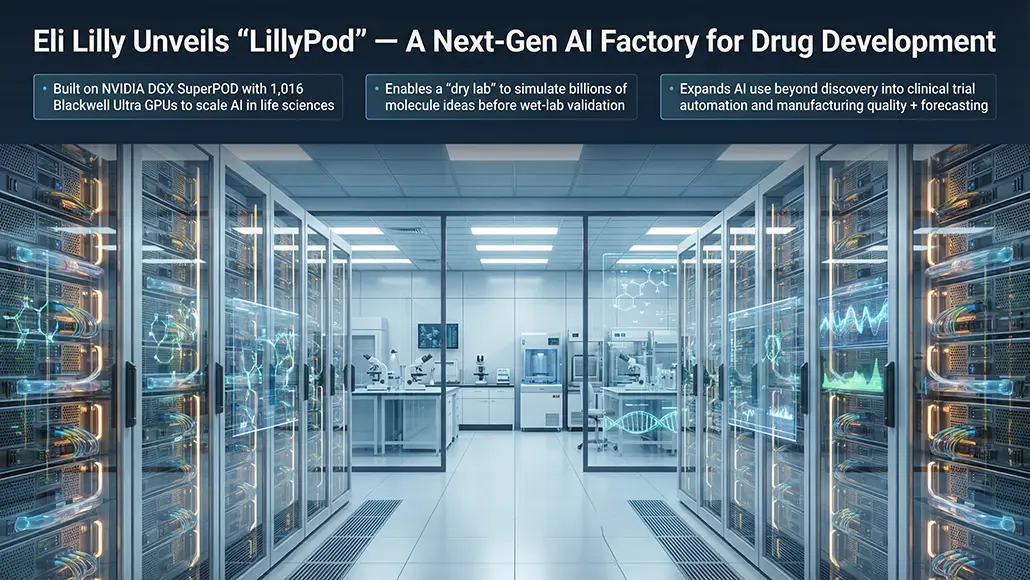
Eli Lilly has launched what it describes as the most powerful AI factory wholly owned and operated by a pharmaceutical company, marking a significant expansion of advanced computing infrastructure in life sciences. The system, named LillyPod, was inaugurated in Indianapolis and is built as the world’s first NVIDIA DGX SuperPOD with DGX B300 systems, powered by 1,016 NVIDIA Blackwell Ultra GPUs.
Developed in partnership with NVIDIA, LillyPod supercomputer for drug development delivers more than 9,000 petaflops of AI performance and was assembled in four months. The platform represents a major investment in computational capacity intended to support drug discovery, genomics, clinical development and manufacturing optimization.
“It’s a big day for us with the supercomputer coming on board, but it’s a day 150 years in the making,” said Diogo Rau, executive vice president and chief information and digital officer at Lilly. “LillyPod is a powerful symbol of who we are and why we do this work: to make life better for people around the world. We are, right here, right now, at the right moment to advance biology in a way that has just never been done before.”
Infrastructure and Technical Architecture
LillyPod is powered by a DGX SuperPOD architecture that includes accelerated computing, NVIDIA Spectrum-X Ethernet networking and optimized AI software. NVIDIA Mission Control software enables workload orchestration, performance monitoring and secure automation of AI operations. The system contains nearly 5,000 connections built with more than 1,000 pounds of fiber cables.
The supercomputer for drug development allows Lilly’s genomics teams to harness 700 terabytes of data using over 290 terabytes of high-bandwidth GPU memory. According to the company, computational power that once required 7 million Cray supercomputers now fits inside a single NVIDIA GPU, and LillyPod contains more than 1,000 of them.
“Computation is at the heart of biology and it is at the heart of science,” said Thomas Fuchs, senior vice president and chief AI officer at Lilly. “Being able to compute at scale is not something optional for a company like ours, it is absolutely necessary. So we are building the computational future of medicine and you see that in all areas along the pharmaceutical value chain.”
Lilly aims for the infrastructure to run on 100% renewable electricity by 2030, supported by efficient liquid cooling and minimal incremental energy impact.
Financial Commitments and Strategic Collaboration
Following the initial announcement of the supercomputer in October, Lilly and NVIDIA expanded their collaboration with a $1 billion commitment for a new Bay Area AI co-innovation lab, announced at the January J.P. Morgan Healthcare Conference in San Francisco.
The partnership is designed to combine Lilly’s scientific data assets with NVIDIA’s AI model-building expertise. “It’s really a beautiful combination of very orthogonal capabilities and interests,” Fuchs said. “Nvidia is not going to be a medicines company and Lilly will not start producing our own GPUs (graphics processing units).”
Lilly’s broader strategy includes positioning itself as a central player in global innovation networks. In addition to TuneLab, the company operates Gateway Labs incubators in San Francisco, Boston, San Diego, Philadelphia, Beijing and Shanghai, and collaborates with Indiana University, Purdue University, Massachusetts Institute of Technology and the California Institute of Technology.
Application Across Discovery, Clinical and Manufacturing Workflows
LillyPod is set to support the large-scale training of protein diffusion models, small-molecule graph neural network models and genomics foundation models. The system enables simulation of billions of molecular hypotheses in parallel before laboratory validation, effectively creating a large-scale computational “dry lab.”
Historically, drug discovery teams have been limited to analyzing roughly 2,000 molecular ideas per target per year due to wet-lab constraints. “Now the supercomputer center essentially just breaks the physical limit [of the wet lab],” said Yue Wang Webster, vice president of research and development informatics at Lilly. “Now in the dry lab, you can test billions of molecule ideas at your fingertips.”
Tim Coleman, senior vice president and chief technology officer at Lilly, said: “LillyPod will usher in a new era of AI-driven drug discovery. We believe that computation is foundational to science and that Lilly patients deserve every advantage that we can give them.”
Beyond discovery, Lilly is deploying AI across clinical development and manufacturing. Rau said automation of clinical trial tasks such as patient enrollment and manufacturing optimization could help reduce the typical 10-year timeline for a new drug to five years, although he cautioned against overstated expectations.
“There’s a tendency to think that we’re now going to be able to discover new medicines in three months,” Rau said. “That’s one that’s particularly damaging and destructive.”
In manufacturing, AI is already embedded across production processes. For example, auto-injectors can be photographed 70 or 80 times in a “split second” and analyzed for defects by AI. The company also uses AI extensively in forecasting to improve supply and demand balance.
Platform Expansion Through TuneLab
Select models developed on LillyPod will be made available through TuneLab, Lilly’s AI and machine learning platform. TuneLab provides biotech companies with access to drug discovery models built on proprietary Lilly data generated at a cost of over $1 billion.
As the first drug discovery platform with plans to offer both Lilly models and NVIDIA BioNeMo open foundation models for healthcare and life sciences, TuneLab operates on a federated learning infrastructure built on NVIDIA FLARE. This enables biotech companies to use proprietary AI models while keeping their data private and separate from other users. As additional participants contribute data, the models are designed to improve collectively.
“The hype is actually a serious threat to the research itself,” Rau said. “Because if the hype becomes the story, then we’re all going to be disappointed.”
Lilly executives emphasized that while AI significantly expands computational capabilities across the pharmaceutical value chain, human oversight and scientific direction remain central. As Fuchs stated, “AI in its form today, these are fabulous tools, but it’s still a piece of software. It doesn’t have will or volition.”