













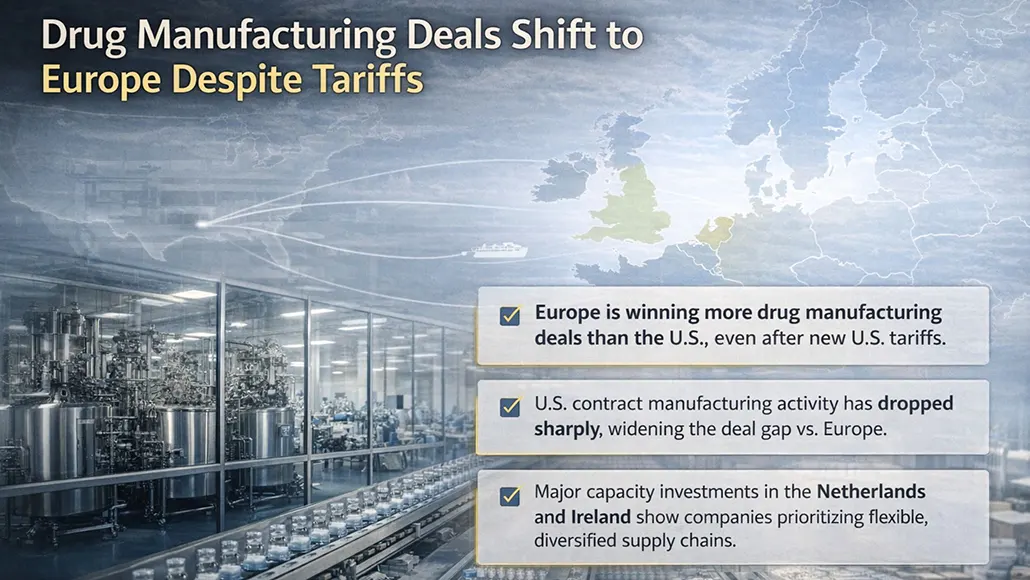
Biopharma companies are continuing to redirect production strategies toward Europe, even as U.S. policymakers attempt to strengthen domestic output through tariffs and onshoring measures. According to GlobalData, the latest data highlights a clear divergence in deal activity, with drug manufacturing deals increasingly favoring European markets over the United States. The shift underscores how companies are managing exposure to policy uncertainty while maintaining operational flexibility across regions.
The fluctuation in contract manufacturing (CM) agreements over recent years reflects the broader disruption caused by the COVID-19 vaccine cycle. Between 2020 and 2023, both the U.S. and Europe saw declining activity tied to changing vaccine demand. A rebound followed between 2023 and 2024, but by 2025, a pronounced gap emerged. Katia Djebbar, a pharma analyst at GlobalData, stated that the difference between domestic and European deals reached “its widest yet.” Data shows U.S. CM agreements for FDA-approved drugs fell to 10 in 2025, compared to 28 in the previous year and 47 in 2020.
Europe, meanwhile, has strengthened its position as a preferred outsourcing destination. In 2025, the region secured more than three times as many CM agreements as the U.S., with Germany accounting for 12 out of 34 deals. Despite a 15% U.S. tariff on EU pharmaceuticals introduced in August, companies have continued to prioritize European capacity. Of the 14 U.S.-based firms outsourcing production last year, nine including Johnson & Johnson and Vertex Pharmaceuticals were involved in 13 European deals, while domestic investments accounted for only eight.
Large-scale investments further reinforce Europe’s growing role. Eli Lilly committed $3 billion in November to develop a manufacturing facility in Katwijk, the Netherlands, aimed at scaling production of its obesity treatment Foundayo (orforglipron). Similarly, Novo Nordisk allocated $506 million last month to expand its Athlone, Ireland facility to support Wegovy tablet production. Djebbar noted, “A diversified global supply chain, particularly amid the current unpredictability of the U.S. political climate, will allow biopharma companies to minimize the risk of sudden, catastrophic disruptions to production.” The continued expansion of drug manufacturing deals in Europe suggests that tariff-driven reshoring efforts may face structural limitations.