











The modern pharmaceutical industry is defined by a relentless pursuit of innovation, yet the path from a conceptual molecule to a life-saving medication is fraught with immense financial and scientific challenges. On average, it takes over a decade and billions of dollars to bring a single new drug to market, with the majority of candidates failing during clinical trials. This high rate of attrition is not just a financial burden; it represents a delay in providing critical treatments to patients suffering from chronic and rare diseases. In this high-stakes environment, the strategic use of data has emerged as the most powerful tool for improving efficiency. By leveraging global drug databases in pharma research and development, pharmaceutical companies are finding ways to navigate the complexities of discovery and clinical testing with unprecedented speed and precision. These databases are no longer just repositories of information; they are the intellectual engines driving the future of pharmaceutical innovation.
The impact of these comprehensive datasets is felt most strongly in the earliest stages of the drug development process. In the traditional discovery model, identifying a viable lead compound involved significant physical experimentation and trial-and-error. Today, researchers can perform “in silico” screenings virtual simulations that test thousands of chemical structures against biological targets. This digital approach is made possible by the wealth of chemical and biological data stored in global drug databases in pharma research and development. By analyzing the structure-activity relationships of known compounds, scientists can predict which new molecules are most likely to be effective and safe. This ability to narrow down the field of candidates before ever entering a laboratory significantly reduces the time and cost associated with early-stage research.
Furthermore, these databases provide a historical perspective that is essential for avoiding redundant or misguided research. Science is a cumulative process, and the history of drug development is littered with failed molecules and abandoned pathways. By utilizing global drug databases in pharma research and development, organizations can gain access to millions of drug monographs and historical clinical research data. This allows researchers to see where others have failed and why. If a specific chemical moiety has been consistently associated with toxicity in previous studies, that information is readily available to steer current projects in a safer direction. This collective intelligence is a powerful safeguard against repeating the mistakes of the past, ensuring that R&D resources are focused on the most promising avenues of pharmaceutical innovation.
The transition from the laboratory to clinical trials represents one of the most significant hurdles in the pharma R&D lifecycle. Designing a clinical trial that is both scientifically robust and acceptable to international regulators is a complex task. Here, the strategic value of leveraging global drug databases in pharma research and development becomes even more apparent. Researchers can study the trial designs of successful precursors, understand the typical enrollment criteria, and identify the most sensitive biomarkers for measuring efficacy. Access to vast repositories of clinical research data allows for the creation of “synthetic control arms” using historical data from previous trials to supplement or even replace the need for a traditional placebo group in certain contexts. This not only accelerates the trial timeline but also addresses the ethical concerns of denying treatment to patients in a control group.
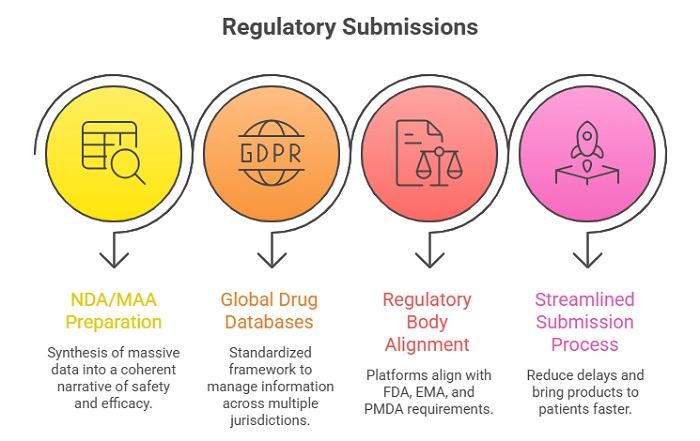
Regulatory submissions are another area where high-quality, centralized data is indispensable. The preparation of a New Drug Application (NDA) or a Marketing Authorization Application (MAA) requires the synthesis of massive amounts of data into a coherent narrative of safety and efficacy. Global drug databases in pharma research and development provide the standardized framework needed to manage this information across multiple jurisdictions. Many of these platforms are designed to align with the requirements of major regulatory bodies like the FDA, EMA, and PMDA, ensuring that data is formatted correctly and that all necessary documentation is included. By streamlining the submission process, companies can reduce the risk of delays and bring their products to patients much faster. This is particularly critical in the context of “accelerated approval” pathways for therapies targeting unmet medical needs.
 The strategic importance of these databases also extends into the realm of generic drug development and bioequivalence research. For manufacturers of generic medications, success depends on the ability to prove that their product is therapeutically equivalent to a branded reference drug. This requires access to granular data on the reference drug’s formulation, its pharmacokinetics, and its clinical performance. Global drug databases in pharma research and development provide this level of detail, allowing generic manufacturers to design studies that meet the rigorous standards of regulators. This transparency fosters a more competitive market, driving down the cost of medications and improving access to care for millions of people. Even for innovative companies, these databases are vital for monitoring the landscape of biosimilars and preparing for the end of patent protection.
In addition to traditional R&D, the integration of these databases with artificial intelligence and machine learning is opening new frontiers in drug repurposing. This is the process of finding new therapeutic uses for drugs that are already approved or have already been through clinical testing. By using AI to mine global drug databases in pharma research and development, researchers can identify hidden patterns that suggest a drug used for one condition might be effective for another. This approach significantly reduces the risk and cost of development, as the safety profile of the drug is already well-understood. A classic example of this is the use of certain oncology drugs to treat rare autoimmune diseases. As our understanding of genomics and proteomics deepens, the opportunities for such “data-driven discovery” will only continue to grow.
The globalization of the pharmaceutical industry has also made the need for standardized, accessible data more urgent. A single drug may be manufactured in one country, tested in another, and sold in a dozen more. Managing the regulatory and scientific information across these different markets is a massive logistical challenge. Global drug databases in pharma research and development act as a “common language” for the industry, ensuring that a researcher in Tokyo, a clinician in Berlin, and a regulator in Washington D.C. are all working from the same verified set of facts. This harmonization is essential for maintaining the integrity of the global supply chain and for ensuring that patients receive a consistent standard of care regardless of their geographic location.
As we look toward the future, the role of these databases will continue to expand as we move toward a more patient-centric model of research. We are seeing an increasing emphasis on real-world evidence (RWE) data collected from outside traditional clinical trials, such as from electronic health records, insurance claims, and even wearable devices. Integrating this RWE with the clinical data in global drug databases in pharma research and development will provide a much more complete picture of how drugs perform in the real world. This will allow for more personalized treatment strategies and more sophisticated post-market surveillance. The pharmaceutical industry is evolving from a model based on “average results” to one based on “individual outcomes,” and high-quality data is the engine of this transition.
Building a Future of Ethical and Data-Driven Leadership
As the pharmaceutical industry continues to navigate the complexities of the 21st century, the role of global drug databases in pharma research and development will transcend mere technological utility and become a cornerstone of ethical leadership. In an era where public scrutiny of drug pricing and clinical transparency is at an all-time high, the ability to demonstrate a rigorous, data-backed development process is a powerful way to build and maintain societal trust. Organizations that prioritize the use of verified, global datasets are sending a clear signal that their innovations are grounded in the highest standards of scientific integrity. This transparency is not just a regulatory requirement; it is a moral imperative in a world where the health of millions depends on the decisions made within research laboratories and corporate boardrooms.
Furthermore, the future resilience of the pharmaceutical sector will depend on its ability to participate in a more collaborative and open data ecosystem. While proprietary data will always remain a key asset, the sharing of non-competitive, pre-clinical, and safety data through global platforms can accelerate the collective response to global health crises. We saw the power of this collaboration during the rapid development of treatments and vaccines in recent years, and the lesson is clear: when we share high-quality data, we save lives. By leveraging global drug databases in pharma research and development to facilitate this exchange, the industry can move toward a “grand challenge” model of innovation, where the most pressing medical problems are addressed through the combined intelligence of the global scientific community.
In conclusion, the strategic use of global drug databases in pharma research and development is no longer a peripheral activity; it is a fundamental requirement for any organization that wishes to remain competitive and socially responsible. These platforms provide the insights needed to accelerate discovery, optimize clinical trials, and navigate the complex global regulatory landscape with confidence. By embracing a predictive, data-driven approach to innovation, the pharmaceutical industry can fulfill its primary mission to deliver safer, more effective medicines to the patients who need them most. The transition from a trial-and-error model to one based on the strategic synthesis of global information is the most significant shift in the history of medical science, and it is a journey that is fundamentally redefining the boundaries of what is possible in healthcare.