






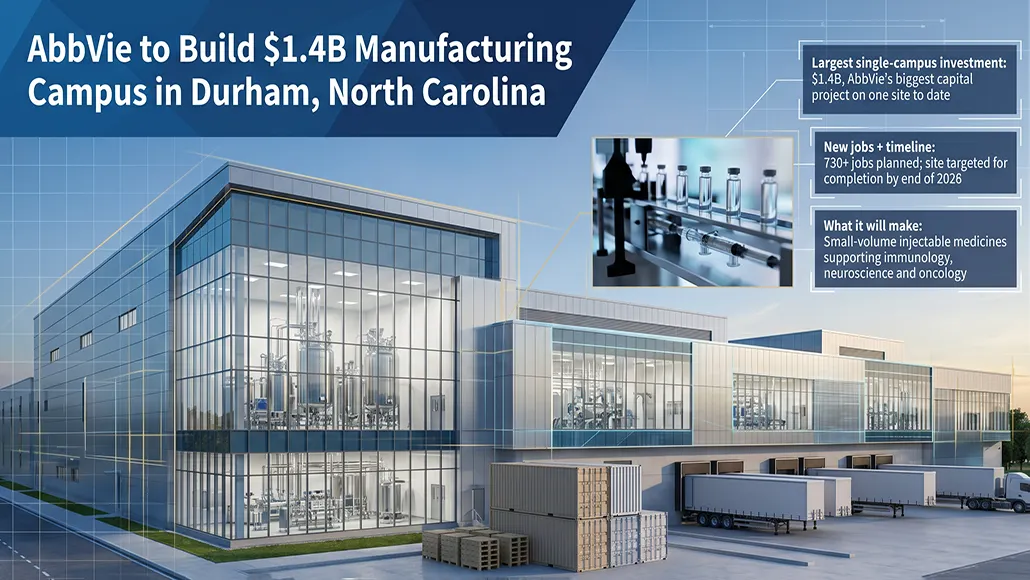

AbbVie has outlined plans to build a major new manufacturing facility in Durham, committing $1.4 billion to what will become its largest single-campus capital investment to date. The project, spread across 185 acres, is expected to generate more than 730 jobs and will support the production of medicines across the company’s immunology, neuroscience and oncology portfolios. The North Carolina manufacturing plant is scheduled for completion by the end of 2028, according to details released on April 22.
The development marks AbbVie’s first major expansion in North Carolina, a state that continues to attract leading pharmaceutical manufacturers amid ongoing reshoring efforts across the industry. In recent months, companies including Novartis, Roche and Biogen have also announced new investments in the region. AbbVie’s decision follows its broader commitment announced earlier this year to allocate $100 billion toward U.S. research, development and capital investments over the next decade, including projects in North Chicago, Arizona and Massachusetts.
Initial construction at the Durham site will focus on facilities dedicated to small-volume parenteral (SVP) drug manufacturing. These products typically involve small doses delivered through vials, prefilled syringes or cartridges for injection or infusion. In addition to production units, the campus will incorporate laboratories, warehousing capabilities and office infrastructure, forming a comprehensive manufacturing and operational base.
The company cited workforce strength and long-term growth potential as key factors in selecting the location. “AbbVie’s decision to make its largest-ever capital investment in North Carolina is a strong endorsement of the life sciences ecosystem we’ve built across the state,” Christopher Chung, CEO of the Economic Development Partnership of North Carolina, said in a statement. “With a deep talent pool and the ability to support everything from innovation to manufacturing at scale, North Carolina continues to be a top choice for companies looking to grow.” The North Carolina manufacturing plant also aligns with a broader surge in domestic pharmaceutical investment, as companies such as Johnson & Johnson, Eli Lilly, Gilead Sciences and Bristol Myers Squibb expand their U.S. production footprints.