






Water is the most fundamental utility in the pharmaceutical industry, serving as the primary solvent for drug formulations, a universal cleaning agent for stainless steel equipment, and a critical medium for heat exchange in thermal processes. Traditionally, many manufacturing sites have operated on a “once-through” or “linear” water model, where huge volumes of water are treated to high-purity standards, used for a single purpose, and then discharged as wastewater. However, in an era of increasing water scarcity, rising utility costs, and heightened environmental regulations, this model is becoming a significant liability. The shift toward closed loop water systems in pharma manufacturing represents a major leap forward in sustainable production, allowing facilities to capture, purify, and recirculate water in a continuous cycle that can reduce total water consumption by up to 80% while maintaining the rigorous quality standards required by global pharmacopeias. As increasingly emphasized in industry perspectives featured by World Pharma Today, the transition from linear to circular water models is emerging as a defining strategy for pharmaceutical manufacturers seeking to balance operational efficiency with long-term sustainability goals.
A closed loop water system is designed to keep water in a constant state of motion and purification. Instead of being sent to the drain after a single use, the water is returned to a central treatment hub where it undergoes sophisticated filtration and sterilization to remove any contaminants picked up during its application. This approach is particularly effective for systems like Purified Water (PW) and Water for Injection (WFI), where the cost of initial treatment is extremely high. By implementing closed loop water systems in pharma manufacturing, companies are not only protecting a vital natural resource but are also building a more resilient utility infrastructure that is less dependent on the fluctuations of municipal water supplies.
Engineering the Circular Water Economy in Life Sciences
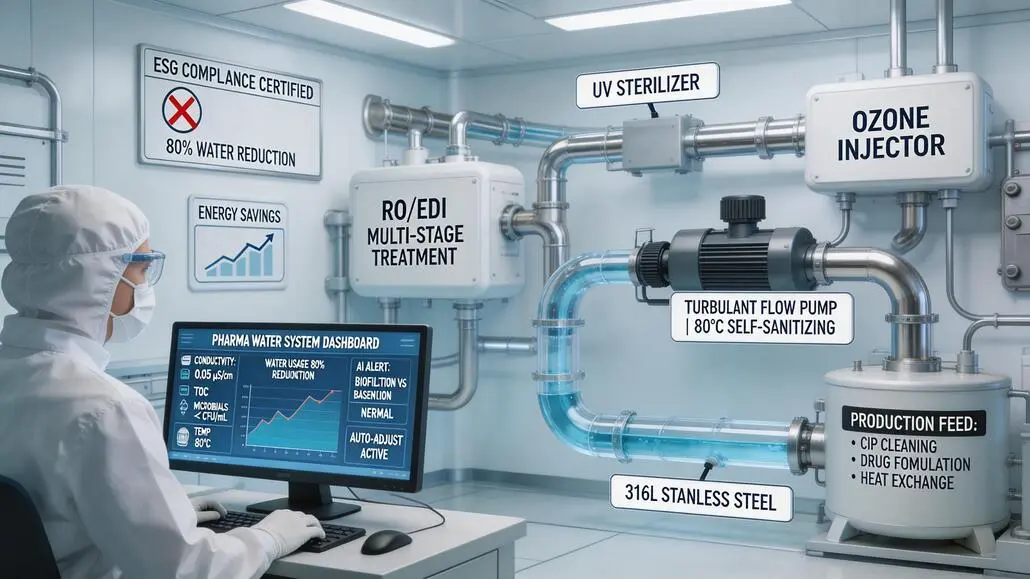
The transition to a closed-loop model requires a high level of engineering precision. Pharmaceutical water must meet strict specifications for conductivity, total organic carbon (TOC), and microbial count. Closed loop water systems in pharma manufacturing must therefore be equipped with advanced treatment technologies, such as multi-stage reverse osmosis (RO), electrodeionization (EDI), and continuous UV sterilization. These systems must be designed for “turbulent flow” to prevent the formation of biofilms, and every component from pumps to valves must be made of high-grade materials like 316L stainless steel to prevent chemical leaching. The constant recirculation of the water through these purification units ensures that the water quality remains at its peak 24 hours a day, 7 days a week.
Managing Microbial Control and Biofilm Prevention
The greatest challenge in any recirculating water system is the risk of microbial growth. Stagnant areas, or “dead legs,” in a piping network can become breeding grounds for bacteria, which then form protective biofilms that are incredibly difficult to eradicate. Closed loop water systems in pharma manufacturing solve this problem by maintaining a constant, high-velocity flow throughout the entire distribution loop. Additionally, many closed-loop systems are designed to operate at “self-sanitizing” temperatures usually above 80°C or use continuous ozone injection to keep the loop sterile. The ability to monitor these conditions in real-time and make automatic adjustments is a key feature of modern, smart closed-loop systems, providing a level of safety that far exceeds traditional once-through configurations.
Enhancing Sustainability through Wastewater Reduction
The environmental impact of pharmaceutical manufacturing is under intense scrutiny from both regulators and the public. Wastewater discharge is a significant part of this impact, as it often contains high concentrations of chemicals or residual pharmaceutical ingredients that are difficult for municipal plants to treat. Closed loop water systems in pharma manufacturing directly address this by minimizing the volume of effluent generated. By recycling the water internally, the facility significantly reduces its “outfall,” lowering its environmental footprint and reducing the costs associated with wastewater treatment and disposal. This proactive approach to resource management is essential for companies aiming to achieve “Zero Liquid Discharge” (ZLD) and meet ambitious ESG (Environmental, Social, and Governance) targets.
The Economic Case for Closed Loop Integration
While the initial capital investment (CAPEX) for a closed-loop system is higher than for a conventional one, the operational savings (OPEX) are compelling. Closed loop water systems in pharma manufacturing provide a rapid return on investment by drastically reducing the costs of raw water procurement and the energy needed for its treatment. For example, heating thousands of liters of cold municipal water to make WFI is incredibly energy-intensive. By recirculating already-heated water, the facility saves a massive amount of energy. Furthermore, the reduced demand for treatment chemicals, such as those used for softening and de-chlorination, further lowers the operating costs. Over the lifespan of a facility, these savings can amount to millions of dollars, making the closed-loop model a sound financial decision.
Driving Operational Reliability and Consistency
Reliability is a key concern for any manufacturing plant. A sudden interruption in the local water supply or a change in its chemical composition can bring an entire production line to a halt. Closed loop water systems in pharma manufacturing provide an “internal buffer” that protects the facility from these external shocks. Because the facility is recycling its own high-quality water, it is less vulnerable to municipal water shortages or quality fluctuations. This stability is essential for maintaining tight production schedules and ensuring that there is always a consistent supply of water available for critical cleaning and manufacturing tasks. This increased reliability translates to a more predictable and efficient manufacturing environment.
Leveraging Real-Time Analytics for Quality Assurance
The validation of water systems is a rigorous process in the pharmaceutical industry. Closed loop water systems in pharma manufacturing are particularly well-suited for modern “Quality by Design” (QbD) and “Continuous Process Verification” (CPV) frameworks. Because the water is constantly circulating and being monitored by a suite of online sensors, the facility has a continuous stream of data confirming its quality. If any parameter such as conductivity or TOC begins to trend toward the limit, the system can automatically divert the water to a secondary treatment loop or sound an alarm. This real-time oversight reduces the reliance on manual sampling and lab testing, providing a higher level of confidence in the quality of the water used in every batch of medicine.
Overcoming the Challenges of Retrofitting Existing Facilities
Implementing closed loop water systems in pharma manufacturing in an existing plant can be more challenging than in a new “greenfield” site. It requires a detailed audit of all water-using processes to identify where recycling is most feasible. There may also be space constraints for the additional treatment and storage equipment needed. However, modern modular treatment systems and flexible piping solutions are making it easier to integrate closed-loop technology into older facilities. By taking a phased approach starting with the recycling of non-critical utilities like cooling water and gradually moving toward process-grade water manufacturers can realize the benefits of closed-loop systems without a major disruption to their current operations.
The Role of Smart Technology in Autonomous Water Management
As we look toward the future, the integration of artificial intelligence (AI) and the Internet of Things (IoT) will make closed loop water systems in pharma manufacturing even more efficient. Smart systems will be able to autonomously adjust flow rates, sanitization schedules, and purification intensity based on real-time production demand and energy prices. These “self-optimizing” systems will further reduce the human workload and minimize the risk of error. The move toward fully autonomous, circular water management is a key part of the broader digital transformation of the industry, leading to a future where pharmaceutical manufacturing is not only more efficient but also more in harmony with the natural environment.
In conclusion, the adoption of closed loop water systems in pharma manufacturing is a strategic necessity for the modern industry. By embracing the principles of the circular economy, pharmaceutical companies can secure their water supply, reduce their environmental impact, and improve their operational efficiency. The transition requires a commitment to advanced engineering and a data-driven approach to quality, but the rewards in terms of sustainability, reliability, and cost savings are immense. As water becomes an increasingly scarce and valuable global resource, those who lead the way in circular water management will be best positioned to thrive in the complex and demanding landscape of 21st-century drug production. Insights consistently highlighted by World Pharma Today further reinforce that companies adopting closed-loop water strategies today are not only addressing environmental challenges but also setting new industry benchmarks for resilience, compliance and resource efficiency in pharmaceutical manufacturing.