





The pharmaceutical industry stands at a critical juncture where the traditional methods of drug discovery are being challenged by the need for unprecedented speed and accuracy. In this landscape, the implementation of lab automation in drug discovery has moved from being a luxury to a fundamental necessity. The complexity of modern biological targets requires a level of precision that human hands simply cannot replicate consistently over thousands of iterations. As we look toward the future of medicine, the role of automated systems in screening, synthesis, and analysis is becoming the primary driver of therapeutic breakthroughs.
The Paradigm Shift from Manual to Automated Workflows
For decades, the standard image of a laboratory was a scientist at a bench, manually transferring fluids and carefully labeling tubes. While this foundational work built the industry, it is fraught with limitations. Human fatigue, cognitive bias, and physical variability introduce a “noise” into data that can obscure potential breakthroughs. Lab automation in drug discovery addresses these challenges by introducing robotic arms and high-speed dispensers that operate with sub-microliter precision. This shift is not merely about replacing human labor; it is about elevating the standard of scientific inquiry.
Precision Engineering in Liquid Handling
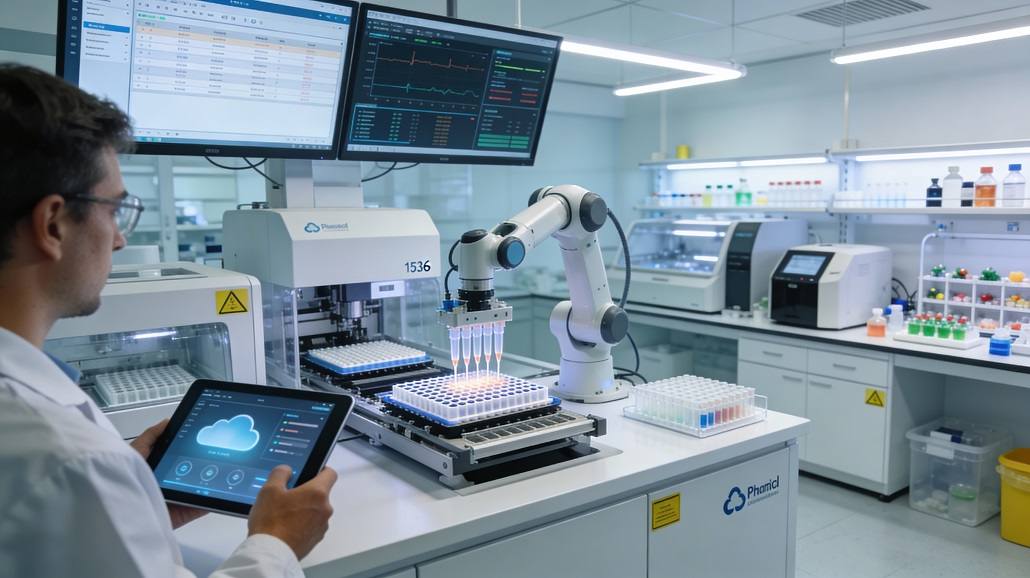
One of the most significant hurdles in early-stage research is the consistency of sample preparation. Small deviations in volume can lead to massive discrepancies in results when dealing with high-potency compounds. Automated liquid handling systems utilize air-displacement or positive-displacement technology to ensure that every well in a 384- or 1536-well plate receives the exact same treatment. This level of smart lab technologies integration allows for the miniaturization of assays, which saves on expensive reagents and precious biological samples.
Integration of Robotic Plate Movers
Beyond simple dispensing, the movement of samples between incubators, readers, and washers must be fluid. Integrated robotic systems act as the central nervous system of the laboratory, coordinating the movement of plates without human intervention. This 24/7 operational capability means that experiments which once took weeks can now be completed in a matter of days. The speed provided by lab automation in drug discovery is particularly vital during the “hit-to-lead” phase, where thousands of compounds must be screened against a target to find the most promising candidates.
Accelerating Pharmaceutical Research Through Digital Connectivity
The physical hardware of automation is only one side of the coin. The true power of modern labs lies in their digital workflows. When a robotic system is connected to a cloud-based management platform, the data generated is immediately available for analysis. This connectivity eliminates the traditional silos that often exist between different departments, such as medicinal chemistry and biology. By creating a unified data environment, pharmaceutical research becomes a more collaborative and iterative process.
The Role of High-Throughput Screening
High-throughput screening (HTS) is perhaps the most visible application of lab automation in drug discovery. HTS allows researchers to test vast libraries of compounds against biological targets at a scale that was once unimaginable. Automated systems can process hundreds of thousands of samples per day, identifying “hits” with a high degree of confidence. The use of smart lab technologies in this context ensures that the environmental conditions for each plate are monitored and maintained, providing a stable backdrop for sensitive biological assays.
Data Capture and Real-Time Optimization
A significant advantage of automated systems is their ability to capture metadata. Every action, from the temperature of the room to the exact second a reagent was added, is recorded. This allows for digital workflows that include real-time optimization. If a system detects a drift in experimental results, it can automatically trigger a recalibration or alert a technician. This proactive approach to pharmaceutical research prevents the loss of valuable time and resources on failed runs, ensuring that the path to discovery remains clear and efficient.
Overcoming Barriers to Automation Adoption
Despite the clear benefits, the transition to a fully automated lab is not without its hurdles. The initial capital investment can be substantial, and the requirement for specialized staff to maintain and program these systems is high. However, the long-term return on investment is found in the reduced cost per data point and the increased probability of success. Lab automation in drug discovery is an investment in the quality of the pipeline. Companies that fail to adapt risk falling behind as competitors leverage smart lab technologies to bring drugs to market faster.
Cultural Shifts in the Laboratory
Moving to an automated model requires a change in mindset for many scientists. The fear of being replaced by a machine is a common concern, but the reality is quite different. Automation frees researchers from the “drudgery” of the bench, allowing them to engage in more creative and strategic scientific thinking. In this new era of pharmaceutical research, the most valuable skill is not the ability to pipette perfectly, but the ability to design experiments that leverage the full power of digital workflows.
The Future of the Autonomous Lab
We are rapidly approaching a state where laboratories can operate semi-autonomously. Imagine a system where lab automation in drug discovery is combined with advanced AI that can design its own follow-up experiments based on the results of a previous run. This “closed-loop” system would represent the pinnacle of smart lab technologies. By removing the delays inherent in human decision-making, we could see a future where the time from target identification to clinical trials is cut in half. The focus on pharmaceutical research will then shift entirely to the biological nuances of the human body, supported by a flawless mechanical and digital infrastructure.
In conclusion, the integration of lab automation in drug discovery is the defining characteristic of the modern pharmaceutical era. By embracing smart lab technologies and sophisticated digital workflows, we are not just making the process faster; we are making it better. The reduction of error, the increase in throughput, and the seamless integration of data are all vital components of a system designed to solve the most pressing health challenges of our time. As we continue to refine these systems, the boundary between what is possible and what is achievable will continue to expand, leading us toward a new frontier of medical innovation.