














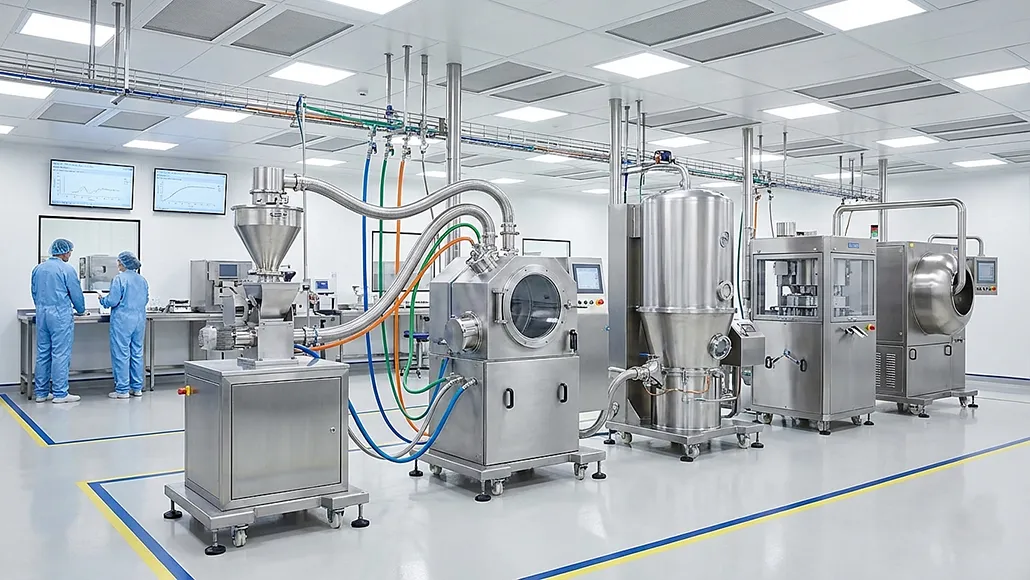
Modular pharmaceutical equipment differs fundamentally from traditional systems through its architectural approach prioritizing reconfigurability over singular optimization. Rather than integrating all processing functions into monolithic machines customized for specific products, modular systems decompose manufacturing operations into discrete functional modules, each performing a defined process step. These modules feature standardized mechanical and electrical interfaces enabling connection into various configurations without custom fabrication, much as standardized shipping containers revolutionized logistics by enabling universal handling regardless of contents.
The principle of functional modularity manifests differently across pharmaceutical operations. In tablet production, modular systems might separate powder dispensing, blending, granulation, drying, compression, and coating into independent modules connected through standardized material transfer interfaces. For sterile injectable manufacturing, modular architectures enable separation of solution preparation, filtration, filling, and terminal sterilization into units that can be arranged in multiple floor plans or even distributed across separate facilities. This decomposition creates flexibility to scale individual process steps independently, replace or upgrade specific modules without affecting upstream or downstream operations, and reconfigure workflows to accommodate different products or batch sizes.
Standardization represents the cornerstone enabling modular flexibility. Equipment vendors developing modular platforms establish common base frames with consistent footprints, utility connection points located at standardized positions, and universal control interfaces allowing modules from different manufacturers to communicate. Hybrid connector systems consolidate power, compressed gases, cooling water, and data networks into single quick-disconnect couplings that technicians can connect within minutes, contrasting sharply with traditional hard-piped installations requiring days of contractor labor. This standardization extends to software, with modular systems increasingly adopting industry-standard communication protocols enabling supervisory control and data acquisition systems to integrate diverse equipment without custom programming.
The concept of process modules rather than product modules guides contemporary thinking in modular pharmaceutical design. Early modular attempts focused on creating complete mini-facilities for specific products, essentially replicating fixed installations at smaller scale. Modern approaches instead create modules optimized for specific unit operations applicable across multiple products. A single high-shear granulation module might support formulations ranging from immediate-release analgesics to modified-release cardiovascular drugs, with product differentiation achieved through recipe parameters rather than hardware changes. This process-centric philosophy maximizes equipment utilization while minimizing the number of modules organizations must maintain.
Application Domains for Modular Laboratory Equipment
Contract development and manufacturing organizations represent perhaps the most natural application domain for modular pharmaceutical equipment. These service providers face extreme product diversity, potentially handling dozens of distinct active pharmaceutical ingredients annually across development phases from early toxicology batches through commercial production. Traditional dedicated equipment proves economically impractical given the relatively small volumes per product, while shared equipment requires extensive changeover time and cleaning validation. Modular systems offer an elegant solution, allowing contract manufacturers to maintain equipment suites that reconfigure rapidly between clients while validated cleaning procedures focus on standardized module interfaces rather than complex internal geometries.
The economics for contract manufacturers prove compelling when modular investments are compared against traditional alternatives. Organizations report changeover time reductions from four to six hours down to 30 to 45 minutes when implementing modular tablet production lines, translating directly into increased billable production hours. Simplified cleaning enabled by smooth module surfaces and quick-disconnect utilities reduces validation sampling points and accelerates turnaround between products. Perhaps most significantly, modular architectures enable contract manufacturers to accept smaller batch sizes economically, opening market segments previously considered unviable and differentiating their service offerings from competitors constrained by traditional equipment.
Clinical trial material production presents operational challenges distinct from commercial manufacturing, with frequent protocol amendments, small batch quantities, and compressed timelines that punish inflexibility. Modular laboratory equipment addresses these demands by enabling rapid implementation of protocol changes through software recipes rather than mechanical modifications requiring revalidation. A clinical trial investigating multiple dose strengths can employ a single modular filling line with software-controlled fill volumes rather than maintaining multiple dedicated fillers. When protocols evolve during development, as they invariably do, adjustments that would necessitate weeks of revalidation on fixed equipment may require only amended batch records on modular systems.
The geographic distribution of clinical trial sites creates additional opportunities for portable laboratory solutions. Modular clean rooms deployed at clinical sites enable on-site preparation of personalized cell therapies or radiolabeled compounds with short half-lives, eliminating logistics challenges associated with shipping temperature-sensitive materials across potentially vast distances. These portable facilities arrive pre-configured and pre-validated, with installation timelines measured in weeks rather than the years required for conventional pharmaceutical construction. Upon trial completion, modules can be relocated to subsequent trial sites or returned to central facilities, providing utilization flexibility impossible with permanent construction.
Capacity expansion represents a third major application domain where modular equipment delivers strategic value. Pharmaceutical organizations facing unexpected commercial success or supply chain disruptions requiring rapid capacity additions confront lengthy timelines associated with traditional facility expansion. Purpose-built facilities typically require three to five years from initial planning through regulatory approval and commissioning, during which market opportunities may disappear or unmet patient needs persist. Modular manufacturing platforms compressed these timelines dramatically, with some organizations achieving capacity increases within six to twelve months through deployment of pre-engineered modular units.
The modular approach to capacity expansion offers graduated investment paths particularly attractive to organizations with uncertain demand forecasts. Rather than building large facilities based on optimistic projections that may not materialize, companies can implement initial modular capacity meeting known demand, then add parallel modules as market growth justifies. This scale-out rather than scale-up philosophy distributes capital expenditure over time, reduces financial risk, and maintains flexibility to pivot should products underperform. For smaller pharmaceutical companies and biotechnology startups with limited capital, modular solutions may represent the only economically viable path to manufacturing capability.
Technical Implementation and Integration Considerations
Successful modular pharmaceutical systems require careful attention to interfaces ensuring seamless integration despite component diversity. Material transfer between modules demands particular care, as incompatible connections or contamination during transfers can compromise product quality regardless of how well individual modules perform. Modern modular systems employ various transfer technologies depending on material characteristics. Single-use systems utilizing disposable tubing and connectors dominate liquid transfers in biologics manufacturing, while rigid quick-disconnect couplings with contained split-valve designs enable powder transfers in small molecule applications. The selection of appropriate transfer technology balances contamination risk, material compatibility, operator ergonomics, and validation requirements.
Utility distribution represents another critical integration consideration. Modular equipment requires electrical power, compressed air, nitrogen or other inert gases, vacuum, cooling water, and potentially steam or specialized solvents, all delivered at appropriate qualities and flow rates. Traditional installations hard-pipe utilities from central plants to equipment locations, creating inflexibility as layouts evolve. Modular approaches instead employ overhead utility grids or underfloor distribution galleries with standardized drop points at regular intervals. Equipment modules connect to the nearest drop points using flexible hoses and quick-disconnect couplings, enabling repositioning without plumbing modifications. More advanced implementations incorporate mobile utility carts containing compressors, chillers, and gas supplies that roll alongside equipment modules, providing complete utility independence.
Control system integration determines whether modular equipment truly functions as a coordinated manufacturing line or merely a collection of standalone machines. Modern modular systems embrace hierarchical control architectures with three distinct levels. At the lowest level, embedded controllers within individual modules manage real-time process control such as temperature regulation or motor speed adjustment. Mid-level controllers coordinate sequences across multiple modules, managing material transfers and ensuring proper timing between upstream and downstream operations. Enterprise-level manufacturing execution systems provide batch record generation, electronic signature capture, and integration with quality management systems, ensuring modular operations meet good manufacturing practice documentation requirements.
The validation strategy for modular systems fundamentally differs from traditional approaches, offering potential advantages but requiring adjusted thinking from quality assurance organizations. Rather than validating entire production lines as integrated systems, modular validation qualifies individual modules independently based on their specific functions. A granulation module undergoes installation qualification, operational qualification, and performance qualification demonstrating its ability to consistently produce granules meeting predetermined specifications regardless of where it physically resides or what equipment precedes or follows it. This module-centric validation enables enormous flexibility, as qualified modules can be rearranged into different configurations without revalidating the entire system, only the interfaces between modules.
However, this validation advantage requires upfront investment establishing the standardized module qualification protocols and defining the interface specifications. Organizations must develop validation master plans addressing how changes in module sequencing affect overall process validation status, when revalidation becomes necessary, and how to maintain adequate documentation linking module qualification studies to specific batch records. Regulatory agencies increasingly accept modular validation approaches, recognizing their scientific soundness, though manufacturers must often educate inspectors unfamiliar with these methodologies during facility reviews.
Portable and Rapidly Deployable Laboratory Solutions
The concept of portable pharmaceutical laboratories extends modular principles to their logical conclusion, creating complete manufacturing capabilities within transportable enclosures. These solutions, often built into standard shipping containers or custom-designed mobile trailers, integrate all equipment, utilities, and environmental controls necessary for pharmaceutical production into self-contained units requiring only connection to external power and, in some implementations, water supplies. Applications range from emergency pandemic response, as demonstrated during recent vaccine development efforts, to routine support of geographically distributed clinical trials and personalized medicine production.
Container-based modular laboratories typically measure either 20 or 40 feet in length, matching standard intermodal container dimensions to enable road, rail, and maritime transport using existing logistics infrastructure. Within these constrained footprints, designers integrate cleanroom environments achieving ISO Class 7 or better through compact HEPA filtration systems, process equipment scaled appropriately for container dimensions, and utilities including electrical distribution, compressed gases, and environmental control. More sophisticated implementations incorporate multiple containers that interconnect at deployment sites, creating larger cleanroom suites while maintaining individual container transportability.
The deployment timeline for portable laboratory solutions represents their most compelling advantage over traditional construction. A conventional pharmaceutical cleanroom facility requires 18 to 36 months from initial design through commissioning, with regulatory approval processes potentially adding further delays. Container-based laboratories arrive at sites factory-configured and largely pre-validated, requiring only utility connections, qualification of site-specific installations, and performance verification under local environmental conditions. Organizations report deployment timelines as short as four to eight weeks, enabling pharmaceutical production to commence months or years before traditional facilities could operate.
Regulatory pathways for portable pharmaceutical facilities initially created uncertainty, as drug regulations developed around permanent installations. However, health authorities increasingly recognize these solutions’ value, particularly for addressing supply chain vulnerabilities exposed during recent drug shortages and pandemic responses. The United States Food and Drug Administration has approved multiple portable manufacturing units for emergency use, while European regulatory frameworks acknowledge modular facilities within their good manufacturing practice guidance. Keys to regulatory acceptance include demonstrating equivalent process controls to fixed facilities, maintaining comprehensive qualification documentation, and ensuring that equipment mobility does not compromise validation status.
The economic model for portable laboratories differs substantially from traditional capital equipment purchases. Some organizations invest in owned portable units that relocate as operational needs evolve, effectively amortizing the initial investment across multiple projects rather than single facilities. Alternative models employ leased portable facilities from specialized vendors, converting capital expenditure into operational expense and gaining flexibility to return units when capacity needs diminish. This leasing approach particularly suits organizations with temporary capacity requirements such as clinical trial support or bridge manufacturing during facility transitions.
Market Dynamics and Future Evolution
Industry analysis reveals robust growth trajectories for modular pharmaceutical equipment markets, driven by multiple converging trends. Market research firms project the modular pharmaceutical manufacturing equipment sector will expand at compound annual growth rates between 10 and 13 percent through 2034, with valuations potentially exceeding 15 billion United States dollars by that horizon. This growth reflects not merely incremental technology adoption but fundamental shifts in how pharmaceutical organizations approach manufacturing strategy.
Contract development and manufacturing organization expansion represents a primary market driver. As pharmaceutical companies increasingly outsource manufacturing to focus resources on drug discovery, contract manufacturers require flexible capacity accommodating diverse client products. Simultaneously, these organizations face intense competition compelling efficiency improvements and capability differentiation, both addressed through modular equipment investments. Geographic expansion of contract manufacturing into Asia-Pacific regions, where modular approaches enable faster facility establishment compared to traditional construction in regions with infrastructure constraints, further accelerates market growth.
The personalized medicine revolution creates arguably the most transformative impetus for modular equipment adoption. Cell and gene therapies manufactured from individual patient materials represent the ultimate in product diversity, potentially requiring a unique manufacturing campaign for every patient. Traditional pharmaceutical manufacturing models optimized for millions of identical doses prove economically untenable for such applications. Modular systems enabling rapid reconfiguration between patients, combined with portable platforms that can deploy near patients rather than requiring long-distance shipping of temperature-sensitive materials, provide the only viable manufacturing paradigm for these revolutionary therapies.
Emerging technologies continue enhancing modular equipment capabilities and expanding application domains. Additive manufacturing, commonly known as three-dimensional printing, enables production of pharmaceutical dosage forms with complexity impossible through traditional compression or molding. Integration of additive manufacturing modules into flexible pharmaceutical platforms creates unprecedented ability to customize drug products, potentially producing different dosage forms, release profiles, or even active ingredient combinations from the same equipment suite simply by adjusting digital recipes. While regulatory frameworks for printed pharmaceuticals remain under development, the technical capability already exists.
Artificial intelligence and advanced process control algorithms promise to further enhance modular manufacturing flexibility. Traditional pharmaceutical processes follow fixed recipes established during development, with operators responding to deviations through predetermined action plans. Emerging control strategies employ machine learning algorithms that optimize process parameters in real time based on in-process measurements, potentially achieving consistent product quality across different equipment configurations that would previously require distinct validated recipes. This technology could enable truly equipment-agnostic manufacturing where products can be produced on any compliant equipment regardless of manufacturer or configuration.
The pharmaceutical industry stands at an inflection point where operational flexibility transitions from competitive advantage to existential necessity. Modular and portable laboratory equipment provides the technological foundation enabling this transformation, offering pharmaceutical manufacturers the agility to respond to diversifying product portfolios, compressed development timelines, and evolving patient needs. Organizations embracing these technologies gain strategic options unavailable to competitors constrained by traditional fixed installations, positioning themselves to lead in an era where adaptability determines success as much as scientific innovation.