











In the high-stakes world of pharmaceutical manufacturing, the journey from the production line to the patient’s medicine cabinet is often long and fraught with environmental hazards. A drug molecule, no matter how potent or innovative, is only as good as its stability. If a medication breaks down before it is used, it can become ineffective at best and toxic at worst. This reality has placed drug formulation stability challenges at the center of pharmaceutical research and development. As we move away from simple, stable small molecules toward increasingly complex biologics, gene therapies, and nano-formulations, the difficulty of maintaining the “molecular status quo” has grown exponentially. Ensuring formulation stability is now a multidisciplinary endeavor, combining deep chemical knowledge with advanced material science and rigorous quality control.
The fundamental issue is that drugs are not static entities; they are chemical systems in a state of dynamic equilibrium with their environment. Factors such as temperature, humidity, light, and even the materials of the container can trigger pharmaceutical degradation. For the manufacturer, the goal is to define and extend the drug shelf life the period during which the product is expected to remain within its approved specifications. Achieving this requires a thorough understanding of the degradation pathways and the implementation of sophisticated stabilization strategies that begin long before the first batch is even produced.
The Chemistry of Pharmaceutical Degradation
Degradation in complex drug formulations can take many forms, broadly categorized into chemical and physical changes. Chemical degradation involves the breaking or forming of covalent bonds, leading to a change in the molecular structure of the active pharmaceutical ingredient (API). Common pathways include hydrolysis, where the drug reacts with water; oxidation, triggered by exposure to oxygen or light; and deamidation, a frequent problem in protein-based drugs. Each of these reactions results in a loss of potency and the creation of “impurities” that must be carefully monitored and limited to ensure patient safety.
Physical degradation, on the other hand, involves changes in the three-dimensional arrangement or the state of the formulation without changing the individual molecules’ chemical identity. For small molecules, this might involve “polymorphism” the drug changing from one crystal form to another, which can drastically alter its solubility and absorption. For biologics, physical stability is even more critical; proteins must maintain a very specific “folded” shape to function. If a protein unfolds or aggregates (clumps together), it loses its therapeutic power and can even trigger a dangerous immune response in the patient. These drug formulation stability challenges are often invisible to the naked eye but have profound clinical consequences.
Environmental Stressors and the Cold Chain
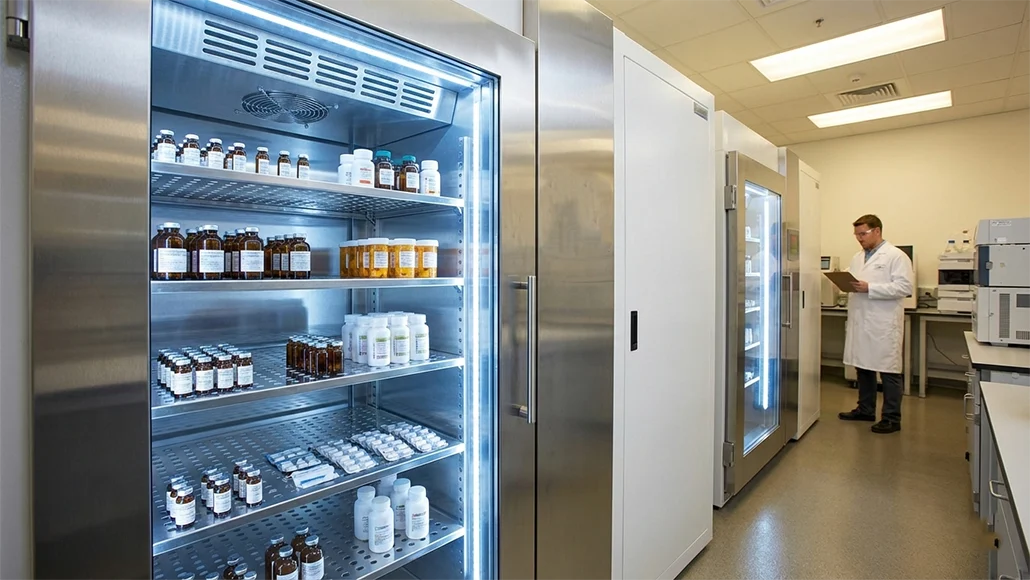
The environment is the primary enemy of formulation stability. Temperature is perhaps the most significant factor, as most chemical reactions accelerate as heat increases. This is why many modern biologics require “cold chain” logistics, necessitating constant refrigeration from manufacture to administration. However, even a few hours outside the required temperature range can compromise the product’s integrity. To combat this, stability testing often includes “excursion studies” to determine exactly how long a drug can survive at room temperature or under extreme heat before it begins to degrade.
Light exposure is another critical stressor. Many drugs are “photosensitive,” meaning they can be broken down by specific wavelengths of light. This is why many medications are packaged in amber glass vials or opaque blister packs. Humidity can also play a major role, particularly for solid oral dosage forms like tablets and capsules. Moisture can act as a catalyst for hydrolysis or can cause the tablet to soften and disintegrate prematurely. Managing these environmental drug formulation stability challenges requires a holistic approach to packaging and distribution, ensuring that the “protective bubble” around the drug remains intact throughout its entire journey.
The Role of Excipients and pH Optimization
In the face of these threats, formulation development relies on a toolkit of “excipients” inactive ingredients that are added to the drug to enhance its stability. Stabilizers come in many forms: antioxidants to prevent oxidation, chelating agents to tie up trace metals that catalyze degradation, and cryoprotectants to protect biologics during freezing or lyophilization. Furthermore, the pH of a liquid formulation is a critical determinant of its stability. Most drugs have a “pH of maximum stability” where the rate of degradation is at its lowest. Finding and maintaining this exact pH through the use of buffer systems is a foundational task in the development of any liquid medication.
For proteins, the use of surfactants like polysorbates is common to prevent the molecules from sticking to each other or to the walls of the container, which is a major cause of aggregation. However, the excipients themselves can sometimes introduce new drug formulation stability challenges. For example, some surfactants can undergo their own degradation over time, producing peroxides that then attack the drug molecule. This “interactive” degradation underscores the complexity of modern formulation science, where every ingredient must be scrutinized for its long-term impact on the system as a whole.
Advanced Stability Testing and Predictive Modeling
To ensure that a drug will remain safe and effective, regulatory agencies like the FDA require extensive stability testing before a product can be marketed. This involves storing the drug under a variety of conditions including “accelerated” conditions of high heat and humidity and testing it at regular intervals over several years. These studies provide the data used to set the official expiration date and the required storage conditions. However, traditional stability testing is time-consuming and expensive, often taking years to produce final results.
To speed up this process, the industry is increasingly turning to predictive modeling and “Advanced Stability” protocols. By using mathematical models based on the Arrhenius equation, researchers can predict the long-term drug shelf life based on just a few weeks of high-stress data. This allows for much faster iteration during the formulation development phase, helping scientists to quickly rule out unstable versions of a drug and focus on the most promising candidates. While it does not replace the need for long-term “real-time” data, predictive modeling is a powerful tool for navigating the complex landscape of pharmaceutical stability.
The Future of Stability: Smart Packaging and Beyond
Looking ahead, the field is moving toward “active” and “smart” packaging solutions to address drug formulation stability challenges. Imagine a pill bottle that changes color if it has been exposed to too much heat or a “smart” vial that can wirelessly transmit its temperature history to a pharmacist’s computer. These technologies would provide an extra layer of assurance that the medication a patient receives is exactly as the manufacturer intended.
Furthermore, the rise of personalized medicine and on-demand manufacturing may change how we think about stability entirely. If a drug is printed in a hospital pharmacy for use that same day, the need for a multi-year shelf life may be greatly reduced. However, this shift would introduce new challenges in ensuring that the localized manufacturing process itself is consistent and that the “freshly made” drug is stable for the duration of its use. As the pharmaceutical world continues to evolve, the science of stability will remain the silent guardian of patient safety, ensuring that the promise of a new therapy is never compromised by the passage of time.