











The UK government and national regulators have introduced a coordinated regulatory roadmap aimed at enabling space-based drug manufacturing, marking a significant step toward commercialising drug production in microgravity environments. The initiative brings together the UK Space Agency, the Medicines and Healthcare products Regulatory Agency (MHRA), the Regulatory Innovation Office (RIO) within the Department for Science, Innovation and Technology (DSIT), and the Civil Aviation Authority (CAA) to establish clearer regulatory pathways and industry guidance for companies exploring in-orbit drug development and production.
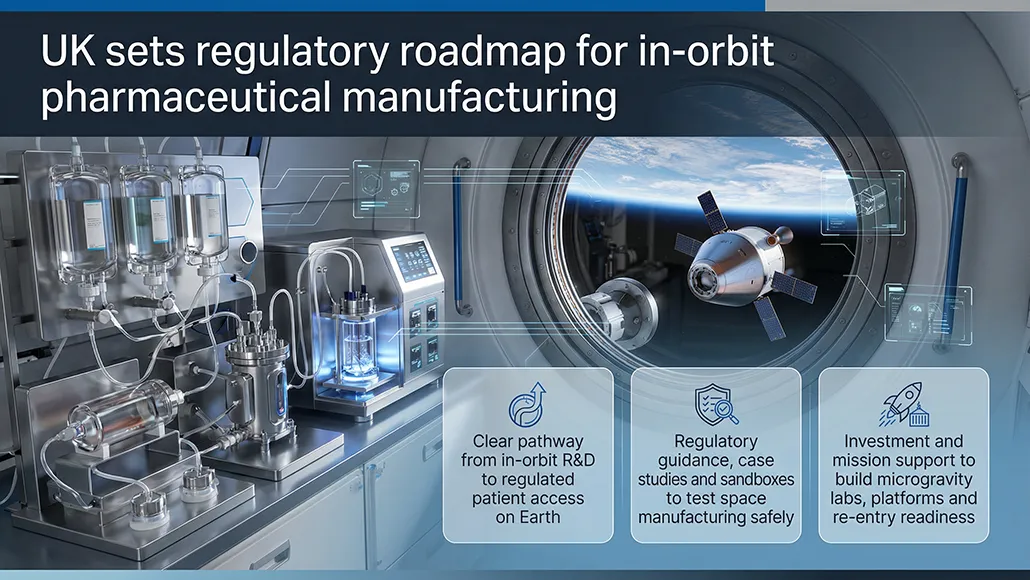
Announced on 5 March 2026 and presented during Space-Comm Expo at ExCeL London, the measures are designed to provide companies developing medicines in orbit with greater regulatory clarity and a defined pathway from research conducted in space to regulated patient access on Earth. The initiative forms part of the UK Government’s £2 billion Life Sciences Sector Plan and aims to address regulatory and supply-chain barriers that have historically limited commercial in-orbit pharmaceutical manufacturing.
The package of measures for space-based drug manufacturing includes regulatory guidance, principles-based case studies, strengthened supply-chain engagement and the introduction of regulatory sandboxes intended to allow controlled testing of emerging technologies. By clarifying compliance requirements early, regulators aim to support pharmaceutical and biotechnology companies seeking to use microgravity conditions for advanced drug manufacturing while maintaining existing safety and quality standards.
Microgravity environments provide conditions that are difficult to replicate on Earth and can influence how biologic medicines form and behave. These conditions may enable more precise drug formulation, particularly for complex biologics and protein-based therapies such as monoclonal antibodies, vaccines and insulin. Microgravity can support improvements in drug crystallisation, solubility, purity and stability, potentially enabling more reproducible protein crystals and highly concentrated formulations. Such characteristics could support the development of therapies targeting oncology and rare diseases while improving the shelf life and delivery performance of certain medicines.
The regulatory roadmap also builds on the MHRA’s framework for decentralised and modular manufacturing launched in 2025. That framework allows small-scale or mobile manufacturing units to operate within the UK’s medicines regulatory system, providing a basis for adapting compliance requirements to unconventional production environments, including manufacturing conducted in microgravity or other atypical locations.
Lawrence Tallon, CEO at the Medicines and Healthcare products Regulatory Agency, said: “The UK is well placed to enable safe, cutting-edge innovation in space-enabled biomanufacturing. Our existing medicines regulations already support advanced and novel manufacturing approaches, including those that take advantage of microgravity. Through joint case studies and early scientific and regulatory advice, the MHRA is helping to shape a clear pathway from in-orbit manufacture to patient access supporting innovation while maintaining the highest standards of safety, quality and patient protection.”
The regulatory initiative is accompanied by targeted investment programmes supporting early-stage research and feasibility studies related to pharmaceutical production in orbit. The National Space Innovation Programme has invested around £2.2m in grants to support emerging technologies linked to in-orbit manufacturing, including projects focused on microgravity laboratories and bio-manufacturing platforms.
Among the supported initiatives is a £250,000 feasibility study awarded to BioOrbit Ltd for its ‘PHARM’ project, which is developing an end-to-end mission design for manufacturing biologic medicines in microgravity. The project aims to explore the crystallisation of biologic drugs for cancer treatments using microgravity conditions that enable the formation of more precise and reproducible protein crystals than those achievable on Earth. BioOrbit’s demonstrator study, funded by the UK Space Agency and running until March 2026, includes work to clarify how existing pharmaceutical regulations would apply to medicines manufactured in orbit.
Dr Katie King, chief executive officer of BioOrbit, said: “Space made pharmaceuticals will have a dramatic impact on all of our lives. BioOrbit’s PHARM study ensures that we can produce drugs in space under the same regulation as drugs made on Earth which will be a world first.”
Additional research funding has been directed toward enabling infrastructure that could support pharmaceutical production in space. Grants have been allocated to companies including Frontier Space Technologies to expand microgravity research capabilities through its SpaceLab platform, supporting pharmaceutical development, drug discovery, materials research and industrial biotechnology. Funding has also been provided to Biologic Technologies to develop a “Space Biocomputer” intended to enable bio-manufacturing capabilities for products such as RNA medicines.
Regulators are also preparing further guidance and operational frameworks to support future missions. The Civil Aviation Authority is developing a “Re-entry Regulatory Sandbox” aimed at streamlining licensing processes for returning manufactured products from orbit to Earth, while agencies are working on new guidance and regulatory case studies to support pharmaceutical and biotechnology companies navigating the emerging sector.
Rosemary Whitbread, Head of Space Regulation Policy at the UK Civil Aviation Authority, said: “Space manufacturing unlocks cutting-edge products that simply can’t be made here on Earth. As the UK space regulator, we play a key role in enabling these groundbreaking innovations, which have the potential to deliver real health benefits and drive economic growth.”
Government agencies have identified in-orbit servicing, assembly and manufacturing as a strategic capability area for future economic growth and national security. Demonstration missions such as Space Forge’s ForgeStar 1 and Astroscale UK’s ELSA-D have already demonstrated the UK’s ability to license novel space technologies, providing operational experience that regulators say will support the development of commercial pharmaceutical manufacturing in orbit.
Officials say the combined regulatory guidance, investment programmes and industry engagement are intended to create a structured framework allowing pharmaceutical developers to move from experimental microgravity research toward regulated medicines production, while ensuring that drugs manufactured in orbit meet the same safety, quality and regulatory requirements as those produced on Earth.