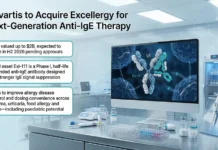










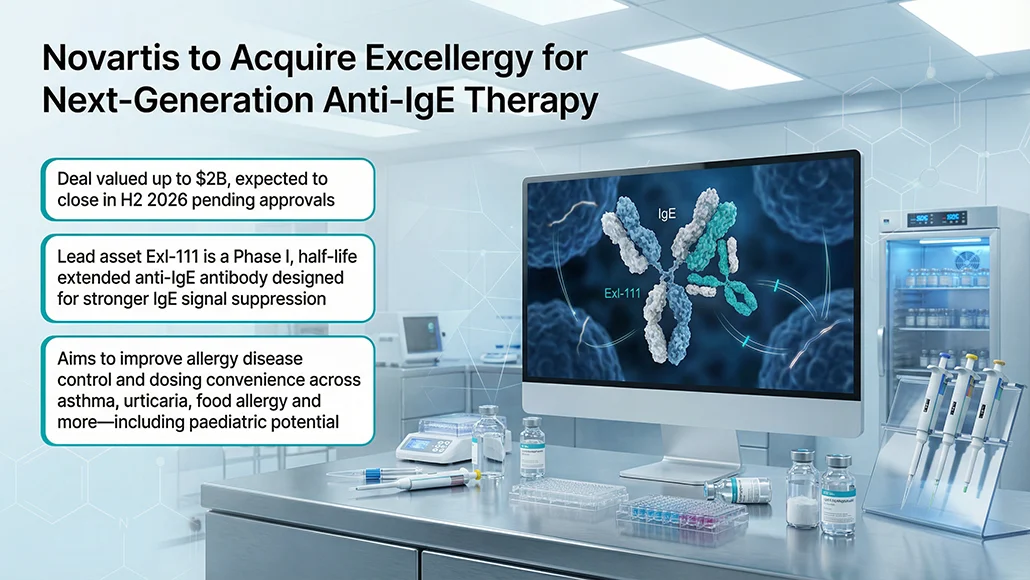
Novartis has entered into an agreement to acquire biotech firm Excellergy, a move that will bring a next-generation anti-immunoglobulin e (IgE) programme into its pipeline. Excellergy acquisition is structured at up to $2bn in upfront and milestone payments and is expected to close in the second half of 2026, subject to regulatory approvals and customary closing conditions. Through this transaction, Novartis aims to strengthen its position in IgE-mediated disease treatment.
Central to the Excellergy acquisition is Exl-111, a half-life extended, high-affinity anti-IgE antibody currently undergoing Phase I clinical trials. Built upon the established biology of validated anti-IgE therapies, Exl-111 is designed to complement Novartis’ existing allergy portfolio across a broad range of allergic conditions and patient settings. Unlike conventional approaches, the candidate therapy seeks to dissociate receptor-bound IgE and enable faster, deeper Fc epsilon RI alpha (FcεRIα) downregulation. Early Phase I findings indicate sustained exposure aligned with its extended half-life profile.
If these early observations are confirmed in further studies, Exl-111 could support improved disease control, more convenient dosing regimens and expanded applicability across allergic asthma, chronic inducible urticaria, food allergy and other IgE-mediated diseases, including potential use in paediatric populations. The mechanism under investigation highlights a potential shift in how anti-IgE therapies may be deployed in clinical practice.
Novartis biomedical research president Fiona Marshall said: Excellergy adds a differentiated next-generation anti-IgE programme that builds on biology Novartis knows well, supported by preclinical evidence and early clinical pharmacokinetic data.
Exl-111 is designed to go beyond conventional anti-IgE therapy, with the potential to deliver faster and deeper suppression of IgE signalling, as well as improved symptom control.
This proposed acquisition strengthens our allergy portfolio and reflects our strategy of advancing innovative, bold science to bring meaningful additional benefits to patients.
Separately, the company also recently agreed to acquire SNV4818, a pan-mutant selective Phosphoinositide 3-kinase alpha (PI3Kα) inhibitor, from Synnovation Therapeutics, further expanding its development pipeline.