














We live in an age of data abundance, but as the volume of information available to the pharmaceutical industry continues to grow at an exponential rate, the paradox of choice becomes increasingly apparent. For a researcher designing a clinical trial, a regulatory specialist preparing a submission, or a pharmacist checking for potential contraindications, the problem is no longer a lack of data, but rather the overwhelming task of identifying which data is accurate, relevant, and trustworthy. In the high-stakes world of healthcare, where the cost of an error can be measured in both financial loss and human lives, the quality of information is paramount. This is why the strategic importance of editorially curated drug databases in pharma has become so critical. Unlike automated data aggregators or raw data feeds, curated databases involve a rigorous process of expert review and clinical validation that turns raw information into actionable knowledge.
The concept of curation is often misunderstood as simple data cleaning, but in the context of pharmaceuticals, it is a sophisticated scientific process. Editorial curation involves a team of experts including clinical pharmacists, toxicologists, and medical researchers who systematically review the latest clinical trials, regulatory updates, and peer-reviewed literature. This “human-in-the-loop” approach is essential because medical data is rarely straightforward. Two different studies might report conflicting results on a drug’s efficacy, or a regulatory warning in one country might not yet be reflected in another. Editorially curated drug databases in pharma address these discrepancies by synthesizing multiple sources of information into a single, verified drug monograph. This process of filtering and validation ensures that the end-user is working with the most current and reliable evidence available.
One of the most immediate strategic benefits of using curated data is the enhancement of pharmaceutical compliance. The regulatory landscape is a minefield of changing requirements and regional variations. A global pharmaceutical company must ensure that its product information, marketing materials, and safety reports are in absolute alignment with the latest rules in every market where they operate. Editorially curated drug databases in pharma provide a centralized and verified source of regulatory intelligence that is updated in real-time. This reduces the risk of administrative errors that can lead to expensive fines or product recalls. Furthermore, during a regulatory inspection, being able to demonstrate that your decisions were based on a validated, expert-reviewed dataset is a powerful way to show your commitment to quality and safety.
The role of a drug interaction checker within a curated database is another area where the value of expert oversight is clearly demonstrated. Interactions between medications are one of the leading causes of adverse drug events, but the data surrounding these interactions is often complex and nuanced. Purely automated systems frequently suffer from “alert fatigue,” where they flag every theoretical interaction regardless of its clinical significance. This leads to healthcare providers ignoring important warnings because they are overwhelmed by a sea of irrelevant ones. By contrast, editorially curated drug databases in pharma provide clinical context for each interaction. Experts evaluate the strength of the evidence, the severity of the potential outcome, and the recommended management strategy. This allows the system to prioritize the most critical alerts, helping clinicians make better-informed decisions at the point of care.
In the realm of research and development, the strategic use of curated data can significantly accelerate the path to market. During the discovery and pre-clinical phases, scientists need access to high-fidelity information on the pharmacokinetics and pharmacodynamics of similar compounds. While raw databases may provide some of this information, the accuracy is not always guaranteed. Using editorially curated drug databases in pharma allows research teams to build their models on a foundation of verified facts. This reduces the need for redundant internal validation and helps in making more accurate “go/no-go” decisions early in the process. When a company is spending millions of dollars on a single research project, the efficiency gained from using high-quality, pre-verified data can have a massive impact on the overall return on investment.
Furthermore, the integration of these datasets into drug database software has transformed how information is utilized as a strategic asset across the entire enterprise. Modern pharma knowledge management is about breaking down the silos between departments. When the research team, the medical affairs team, and the commercial team are all using the same curated dataset, the organization achieves a level of consistency that is impossible with fragmented systems. This “single source of truth” ensures that every communication, whether it is a scientific paper, a regulatory submission, or a sales brochure, is based on the same verified clinical evidence. This consistency is essential for building a strong brand and for maintaining the scientific credibility of the organization in the eyes of healthcare professionals and patients.
The shift toward evidence-based medicine has also increased the demand for transparency and traceability in medical information. When a clinician or a regulator asks why a certain dosage was recommended or why a specific interaction was flagged, the company must be able to provide a clear and defensible answer. Editorially curated drug databases in pharma provide this traceability by linking every piece of information back to the original source material. This audit trail is an essential component of modern quality assurance and risk management. It ensures that the information is not just accurate, but also defensible in a court of law or a regulatory hearing. In an increasingly litigious environment, the value of this “scientific insurance” cannot be overstated.
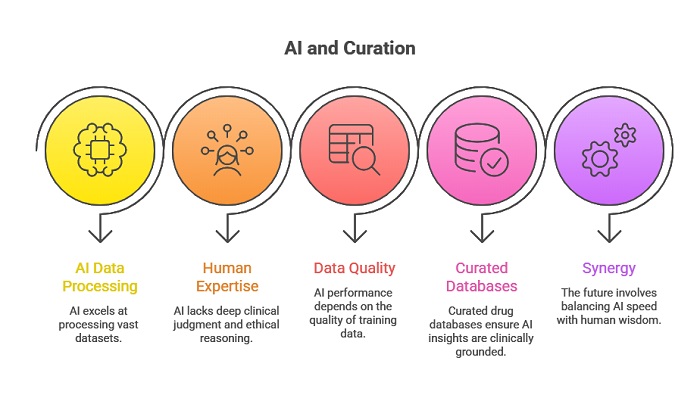
As we look toward the future, the importance of curation will only grow with the rise of artificial intelligence. While AI is incredibly powerful at processing large amounts of data, it is not yet capable of the deep clinical judgment and ethical reasoning that a human expert provides. In fact, AI systems are only as good as the data they are trained on. If an AI model is trained on poor-quality or biased data, it will produce poor-quality and biased results. Using editorially curated drug databases in pharma to train and feed AI systems ensures that the resulting insights are grounded in clinical reality. The future of the industry lies in the synergy between “artificial” intelligence and “curated” intelligence, where the speed of the machine is balanced by the wisdom of the expert.
 The democratization of information also means that patients are increasingly accessing drug databases themselves. While this is a positive development for patient empowerment, it also increases the risk of self-diagnosis and the misuse of medications based on incomplete or misunderstood information. Pharmaceutical companies have a social responsibility to ensure that the information available to the public is accurate and easy to understand. By providing patient-facing versions of their editorially curated drug databases in pharma, companies can help bridge the gap between complex scientific data and the needs of the general public. This not only improves patient safety but also builds trust between the industry and the communities it serves.
Navigating the Future with Human-Centric Data Integrity
The role of editorially curated drug databases in pharma will become even more critical as the industry moves toward more complex and individualized therapies. The emergence of personalized medicine, cell therapies, and genomic-based treatments introduces a level of biological and data complexity that far exceeds traditional pharmaceuticals. In this environment, the “average” data point is no longer sufficient; researchers and clinicians require highly specific, verified information that accounts for genetic variations and unique patient circumstances. Expert curation provides this necessary depth and specificity, ensuring that the data used to guide these cutting-edge treatments is as precise as the therapies themselves. This human-centric approach to data integrity is what will allow the industry to translate the promise of advanced science into safe and effective clinical realities.
Furthermore, the strategic investment in curated data is a key driver of corporate sustainability and ethical leadership. In an era of misinformation and digital vulnerability, providing a “single source of truth” is a powerful way for a pharmaceutical company to demonstrate its commitment to the public good. Editorially curated drug databases in pharma are not just business tools; they are public safety assets. By ensuring that every clinical interaction and regulatory submission is based on the highest standards of verified evidence, companies build a legacy of trust that transcends a single product lifecycle. This commitment to the “verified truth” is what will define the industry leaders of the future, who recognize that in the knowledge economy, integrity is the most valuable currency of all.
In conclusion, the strategic value of editorially curated drug databases in pharma lies in their unique ability to transform the chaotic noise of raw data into the clear, actionable signal of verified knowledge. They provide an indispensable layer of quality assurance that safeguards patient health, empowers healthcare providers, and secures the long-term operational success of the pharmaceutical enterprise. By prioritizing the human-in-the-loop curation process, organizations are making a profound investment in their scientific credibility and their ethical responsibility. As we look toward an increasingly automated and data-saturated future, the role of the expert editor will remain the ultimate check and balance, ensuring that the march of medical progress is always guided by accuracy, safety, and truth.