









The biopharmaceutical industry is currently witnessing an unprecedented surge in the development of complex biologics, including monoclonal antibodies, vaccines, and advanced therapies. Unlike traditional small-molecule drugs, which are synthesized through predictable chemical reactions, biologics are produced by living cells in highly sensitive environments. This inherent biological complexity necessitates a move toward advanced process automation in biopharma to ensure consistency, quality, and scalability. By replacing manual interventions with sophisticated control systems, manufacturers can navigate the narrow operating windows required for cell growth and protein expression, ultimately bringing life-saving treatments to market more rapidly.
Advanced process automation in biopharma begins with the integration of Process Analytical Technology (PAT). PAT involves the use of sensors and analyzers to monitor critical process parameters (CPPs) and critical quality attributes (CQAs) in real-time. In a traditional batch process, quality is often assessed retrospectively, meaning that a deviation early in the cycle might not be discovered until weeks later. With advanced automation, however, continuous data streams from Raman spectroscopy, mass spectrometry, and other at-line tools allow for immediate adjustments. If the pH levels or dissolved oxygen concentrations in a bioreactor begin to drift, the automation system can automatically adjust the feed rates or gas flow to maintain the optimal environment for the cells.
The Role of Digital Twins and Soft Sensors in Bioprocessing
A significant innovation within the realm of advanced process automation in biopharma is the development of “digital twins.” A digital twin is a virtual representation of a physical manufacturing process, created using historical data and mathematical models. By running simulations on a digital twin, engineers can predict how a biological system will respond to changes in environmental conditions without risking an actual batch. This capability is particularly useful during the scale-up phase, where moving from a lab-scale flask to a 2,000-liter bioreactor often introduces unforeseen challenges. The digital twin acts as a predictive engine, guiding the automation system toward the most efficient production pathway.
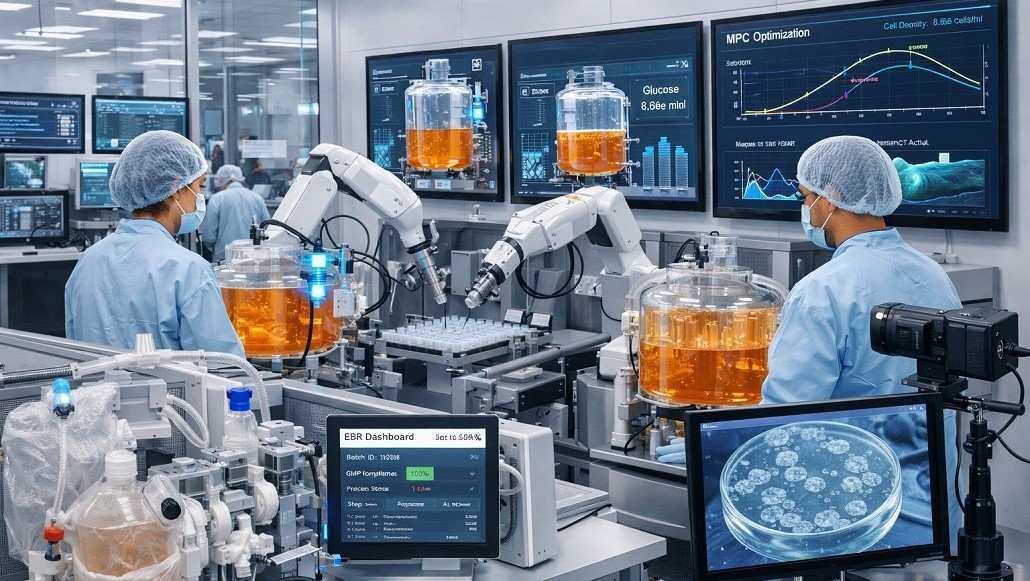
Furthermore, the use of “soft sensors” is enhancing the visibility of complex biological states that cannot be measured directly. Soft sensors are algorithms that estimate variables—such as viable cell density or metabolite concentrations—by correlating data from multiple physical sensors. These virtual measurements are then used to drive advanced control strategies, such as model predictive control (MPC). By anticipating the future state of the bioreactor based on current trends, advanced process automation in biopharma can proactively manage the metabolic needs of the culture, maximizing yield and reducing the formation of unwanted byproducts.
Enhancing Quality Control and GMP Compliance in Biologics
The sensitivity of biologics manufacturing means that even minor contaminations or process variations can have catastrophic consequences. Advanced process automation in biopharma addresses this risk by creating closed-loop systems that minimize human contact with the product. Robotic systems are increasingly used for sterile filling and finish operations, where the risk of particulate or microbial contamination is highest. These robots can operate in highly controlled environments with a level of precision and repeatability that is unattainable by human operators. By automating these critical steps, manufacturers can significantly reduce the rate of batch rejections and ensure the highest standards of patient safety.
In addition to physical automation, the digitalization of quality management systems is a key component of advanced process automation in biopharma. Electronic Batch Records (EBRs) ensure that every step of the production process is documented in real-time, with automated checks to verify that all parameters are within the validated range. This integration simplifies the path to GMP (Good Manufacturing Practice) compliance, as it provides a transparent and immutable record of the manufacturing history. For regulators, the presence of robust automation systems provides a higher degree of confidence that the manufacturing process is in a state of control, facilitating faster approvals and more streamlined inspections.
Modular Manufacturing and Single-Use Technologies
As the biopharma industry moves toward more personalized and niche therapies, the need for flexible manufacturing is becoming more acute. Traditional stainless-steel facilities are increasingly being replaced by modular, single-use technologies (SUTs) that allow for rapid product changeovers. These disposable systems, such as single-use bioreactors and filtration units, eliminate the need for time-consuming cleaning and sterilization cycles (CIP/SIP). However, the complexity of managing a diverse fleet of single-use components requires advanced process automation in biopharma to coordinate the logistics and ensure the integrity of each connection.
Automation platforms are now being designed with “plug-and-play” capabilities, allowing different single-use modules to be integrated into a unified control network regardless of the equipment vendor. This interoperability is essential for the rapid reconfiguration of production lines in response to shifting clinical trial results or sudden market demands. By leveraging standardized communication protocols like OPC-UA, manufacturers can create a seamless data flow from the shop floor to the enterprise level. This architectural flexibility is a cornerstone of the “Factory of the Future,” where agility and efficiency are harmonized through advanced digital orchestration.
Artificial Intelligence in Cell Line Development and Optimization
The future of advanced process automation in biopharma is being shaped by the integration of Artificial Intelligence (AI) in the early stages of the production lifecycle. AI algorithms are now being used to screen thousands of cell lines and identify the most productive clones with specific quality profiles. This high-throughput screening, facilitated by automated micro-bioreactors, significantly shortens the timeline for process development. Once a cell line is selected, AI can continue to optimize the media composition and feeding strategies throughout the production run, learning from each batch to continuously improve performance.
Moreover, AI-driven image analysis is revolutionizing the monitoring of cell health and morphology. High-resolution cameras integrated into bioreactors can capture thousands of images per second, which are then analyzed by machine learning models to detect early signs of apoptosis or viral contamination. This level of granularity provides a much deeper understanding of the biological process than traditional chemical sensors alone. By incorporating these “intelligent” sensors into the automation framework, biopharmaceutical companies can achieve a level of process robustness that was previously thought impossible.
Cybersecurity and Data Governance in a Connected Ecosystem
With the increasing reliance on networked systems, the importance of cybersecurity in biopharmaceutical manufacturing cannot be overstated. Advanced process automation in biopharma creates multiple entry points for cyber threats, making the protection of sensitive process data and intellectual property a top priority. Manufacturers must implement multi-layered security architectures, including network segmentation, encryption, and continuous monitoring, to safeguard their production assets. A breach in a bioprocessing facility could not only lead to financial loss but also compromise the safety of medications destined for patients.
Robust data governance is also essential for maintaining the integrity of the “digital thread” that connects research, development, and manufacturing. Advanced automation systems must ensure that all data is captured, stored, and analyzed in compliance with global regulatory standards. This includes maintaining strict access controls and ensuring that the context of the data (metadata) is preserved throughout its lifecycle. As the biopharma industry continues to embrace digital transformation, the ability to manage and protect data will be a key differentiator in a competitive market.
In conclusion, the adoption of advanced process automation in biopharma is a fundamental requirement for the future of medicine. The ability to manufacture complex biologics with precision, consistency, and speed is the key to expanding patient access to these transformative therapies. As the technology continues to evolve, we can expect to see even greater levels of integration, from autonomous bioreactors to AI-driven supply chain management. The journey toward fully automated bioprocessing is well underway, and its impact on global health will be measured in the millions of lives saved and improved by more effective medications.
Regulatory Outlook for Automated Bioprocessing
The regulatory environment is also evolving to keep pace with the advancements in advanced process automation in biopharma. Agencies such as the FDA and EMA are increasingly encouraging the use of automated technologies and real-time monitoring tools to enhance product quality. Initiatives like the ‘Emerging Technology Program’ provide a platform for manufacturers to discuss innovative automation strategies with regulators before they are implemented in production. This collaborative approach reduces the regulatory uncertainty and facilitates the adoption of new technologies. Furthermore, the development of international standards for data exchange and system interoperability is helping to create a more harmonized global landscape for biopharmaceutical manufacturing. As the industry moves toward ‘Quality by Design’ (QbD) principles, advanced process automation in biopharma will play an even more central role in demonstrating that a manufacturing process is robust and capable of consistently producing high-quality biologics. The shift toward more flexible, automated, and data-driven facilities is not just a technological change; it is a fundamental reimagining of how the pharmaceutical industry operates in a globalized world.
In addition to the technical and regulatory benefits, advanced process automation in biopharma also offers significant sustainability advantages. By optimizing resource usage and minimizing waste through precise process control, automated facilities can significantly reduce their environmental footprint. This is particularly important for bioprocessing, which often requires large volumes of water and energy for cell culture and purification. Automation systems can manage these resources with a level of precision that is impossible to achieve manually, ensuring that every drop of water and every kilowatt-hour of energy is used as efficiently as possible. As the biopharmaceutical industry continues to grow, the integration of sustainability and automation will be essential for meeting the increasing global demand for medications in a way that is both responsible and resilient. The future of biopharma is automated, intelligent, and sustainable, and the companies that embrace this vision today will be the ones that lead the industry tomorrow.