










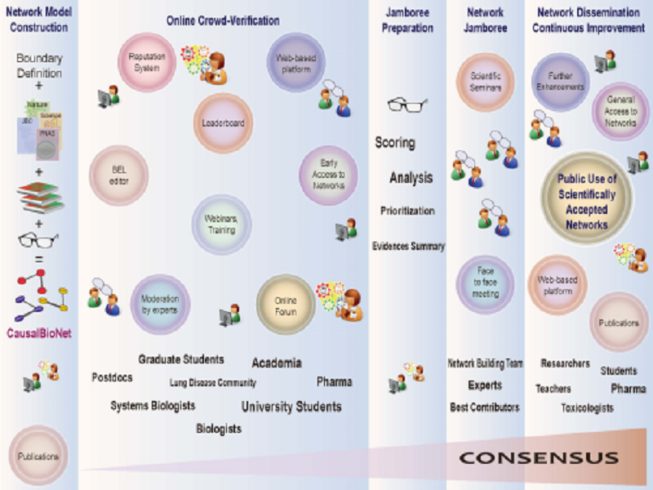
A new set of community-produced biological network models has been shown to allow a deeper understanding of the mechanisms underlying a range of diseases.
The models, of which earlier versions have been described in detail in the past [1,2] have been shown to have important applications in toxicology and drug discovery in a new paper in Gene Regulation and Systems Biology. The models are the latest output of the Network Verification Challenge (NVC), a global crowdsourcing initiative designed to draw on expertise from many scientific areas in order to verify and enhance understanding of biological networks [3].“The Network Verification Challenge represents a powerful new approach in the identification and validation of new drug targets,” said Borislav Simovic, Quality Control at FM Pharma and one of the challenge best-performers. “Due to the volume of data involved, only through structured, collaborative working are we able to achieve the best understanding of biological pathways. In bringing together leading experts in toxicology and systems biology, the Network Verification Challenge gives us valuable new insights into the complex relationships involved in these pathways.”
The NVC, which is led and funded by Philip Morris International, has involved online and in-person collaborations between a global network of scientists (173 individuals from 26 countries in the latest iteration of the challenge). Networks were built using the Biological Expression Language (BEL), which captures relationships between biological entities and provides information on activation or inhibition. Applications for toxicology and drug discovery come through the overlay of data onto pathways of interest and / or the use of computational inference techniques.
The networks produced in the NVC offer a detailed and comprehensive representation of selected biological processes which is not seen in other available network resources (eg, KEGG and Reactome). NVC networks are open to the crowd for editing, which facilitates a peer-review process which helps to ensure that networks are both comprehensive and current. They also contain many layers of information with direct causal, indirect causal, correlative and other non-causal relationships being captured. The networks explored in the NVC relate to lung biology and respiratory disease, but many also apply to other tissues and disease contexts and can be built on according to scientists’ specific needs.
Participants were motivated to take part in the NVC due to the opportunity to further their understanding of the biology involved in the networks, to share their knowledge, to learn and use BEL and to collaborate with leading experts in the fields of toxicology and systems biology. Gamification principles were employed to incentivize activity on the networks, with participants able to move up a leader board based on their contributions. Best-performers had further opportunities for collaboration, including contributing to peer-reviewed papers.
“As part of the Network Verification Challenge community I have been able to contribute to state-of-the-art research in network biology,” said Aravind Tallam, Postdoctoral Fellow at TWINCORE Centre for Experimental and Clinical Infection Research. “As well as improving my own understanding of disease mechanisms and underlying biology, on a personal level the challenge has also allowed me to meet and collaborate with a diverse group of scientists who are working at the cutting edge of research.”
The NVC is the third challenge under the sbv IMPROVER umbrella. The two previous challenges were the Diagnostic Signature Challenge, which asked participants to identify robust diagnostic signatures across four disease areas, and the Species Translation Challenge, which sought to refine understanding of the limits of rodent models as predictors of human biology. The outcomes of a fourth challenge – the Systems Toxicology Computational Challenge – were recently presented at the Intelligent Systems for Molecular Biology conference in Orlando, FL, USA. For further information about the sbv IMPROVER project, please visit http://www.sbvimprover.com.
References
1. Boue, S. et al. Causal biological network database: a comprehensive platform of causal biological network models focused on the pulmonary and vascular systems. Database 2015, bav030, doi:doi:10.1093/database/bav030 (2015)
2. The sbv IMPROVER project team, et al. Enhancement of COPD biological networks using a web-based collaboration interface. F1000Research 4, 32, doi:10.12688/f1000research.5984.1 (2015)
3. The sbv IMPROVER project team and NVC best performers. Community-reviewed biological network models for toxicology and drug discovery applications. Gene Regulation and Systems Biology 2016:10 1–16