












Britain has finalised a UK-US pharma trade deal, securing tariff-free access for UK-made medicines to the United States while committing to higher domestic spending and pricing adjustments for new drugs. The agreement, part of a broader bilateral trade framework first outlined in December and signed in June 2025, establishes zero tariffs on pharmaceutical exports to the U.S. for at least three years, positioning the UK as the only country with such preferential access.
Key Terms of the Agreement
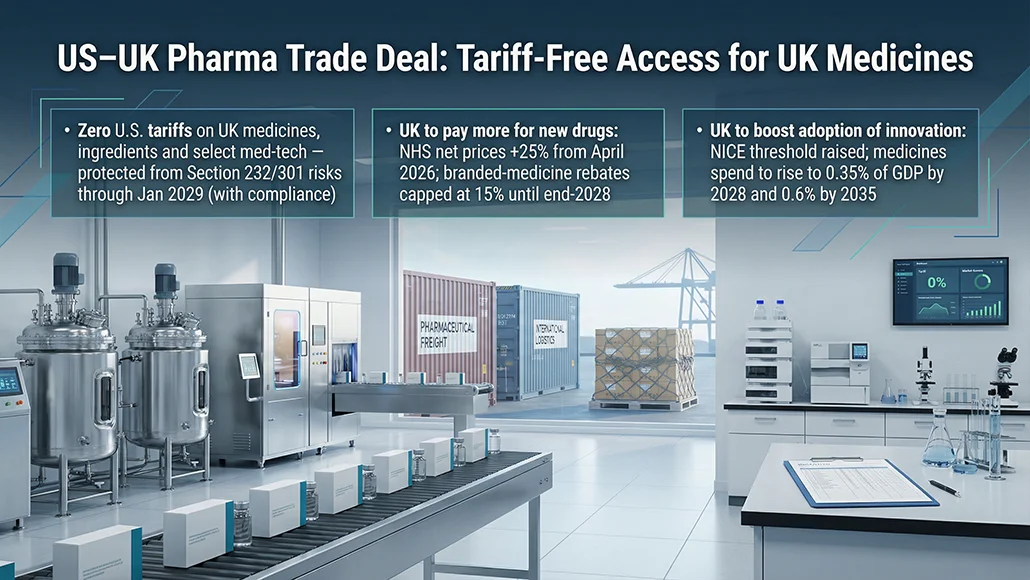
Under the US-UK pharma trade deal, Washington will maintain a zero-tariff regime on UK pharmaceutical exports, including medicines, drug ingredients, and certain medical technologies. The arrangement also shields these exports from potential U.S. Section 232 and Section 301 tariffs through January 2029, provided compliance conditions are met.
In return, the UK has agreed to a structural shift in its domestic pharmaceutical pricing and reimbursement framework. The National Health Service (NHS) will increase the net price paid for new medicines by 25% starting April 2026, applicable to drugs launched after the agreement takes effect. Additionally, the UK will raise its medicines spending from 0.3% of GDP to 0.35% by 2028 and further to 0.6% by 2035.
Zero tariffs on UK pharmaceutical exports to the U.S. for at least three years
NHS to increase net prices for new medicines by 25% from April 2026
Medicines spending to rise to 0.35% of GDP by 2028 and 0.6% by 2035
Tariff exemptions conditional on compliance with U.S. pricing agreements
Protection from Section 232 and Section 301 tariffs through January 2029
Regulatory and Pricing Framework Adjustments
A central component of the deal involves revisions to the UK’s cost-effectiveness evaluation system, overseen by the National Institute for Health and Care Excellence (NICE). The threshold for assessing new medicines has been increased from a historical range of £20,000–£30,000 per quality-adjusted life year (QALY) to £25,000–£35,000.
This adjustment is designed to accommodate higher valuations for innovative treatments and create stronger incentives for pharmaceutical companies to launch products in the UK market. The agreement also caps rebates on branded medicines sold to the NHS at 15% until the end of 2028, compared to 22.9% in 2025.
The deal further outlines closer regulatory cooperation between the UK’s Medicines and Healthcare products Regulatory Agency (MHRA) and the U.S. Food and Drug Administration (FDA), including alignment efforts in medical device regulation to accelerate market access.
Industry and Market Implications
From an industry perspective, the agreement is expected to reinforce the UK’s position as a competitive life sciences hub. The pharmaceutical sector contributes £28.5 billion to the UK economy and employs over 50,000 people, with exports to the U.S. valued at approximately £5 billion annually.
Companies including AstraZeneca and GSK have already secured separate “most favoured nation” pricing agreements with the U.S. administration, ensuring temporary protection from tariff risks. Industry responses indicate cautious optimism, with executives highlighting the need for swift implementation of the framework to deliver tangible investment outcomes.
World Pharma Today observes that the UK-US pharma trade deal reflects a broader strategic recalibration, where tariff relief is increasingly linked to domestic pricing commitments and long-term market access guarantees.
Strategic and Policy Considerations
The agreement aligns with the U.S. administration’s policy objective of redistributing the global cost burden of pharmaceutical innovation. By requiring trading partners to pay higher prices for new medicines, the U.S. aims to reduce the disproportionate share of research and development costs borne by its domestic healthcare system.
However, the deal has prompted debate within the UK regarding fiscal sustainability. Estimates suggest that increased spending on new medicines could reach £9 billion annually by 2035, raising questions about resource allocation within the NHS.
At the same time, the revised pricing framework is expected to expand patient access to advanced therapies, including newly approved cancer treatments, as higher cost-effectiveness thresholds enable broader adoption of innovative drugs.
Investment and Competitive Positioning
The agreement is also positioned as a mechanism to re-attract pharmaceutical investment into the UK following a period of reduced activity. Several global drugmakers had previously paused or scaled back UK-based R&D investments, citing pricing constraints and market conditions.
By enhancing pricing flexibility and ensuring tariff-free export conditions, the UK government aims to restore investor confidence and strengthen its long-term competitiveness in the global pharmaceutical market. Early industry signals suggest a reassessment of investment plans, contingent on the execution of the agreement’s provisions.