










The concept of the “Smart Lab” is no longer a futuristic vision but a present-day reality, driven by the rapid adoption of IoT in laboratory operations. The Internet of Things (IoT) represents a network of physical devices from simple thermometers to complex analytical instruments that are connected to the internet, allowing them to collect and exchange data. In the context of a pharmaceutical laboratory, this connectivity provides a powerful tool for enhancing operational efficiency, ensuring data integrity, and accelerating the pace of discovery. By creating a responsive and data-rich environment, IoT is transforming the laboratory from a passive workspace into an active participant in the scientific process.
The Foundation of IoT in Modern Science
The core value of IoT in laboratory operations lies in its ability to provide real-time visibility into the physical environment of the lab. Traditionally, monitoring laboratory conditions was a manual and intermittent process. A technician might check a refrigerator’s temperature once or twice a day and record it in a logbook. However, if the unit failed between those checks, precious samples could be lost without anyone knowing. IoT sensors solve this problem by providing continuous, 24/7 monitoring. This constant stream of data ensures that any deviation from the required parameters is detected and addressed immediately, providing a much higher level of security for the laboratory’s most valuable assets.
Real-Time Environmental and Asset Monitoring
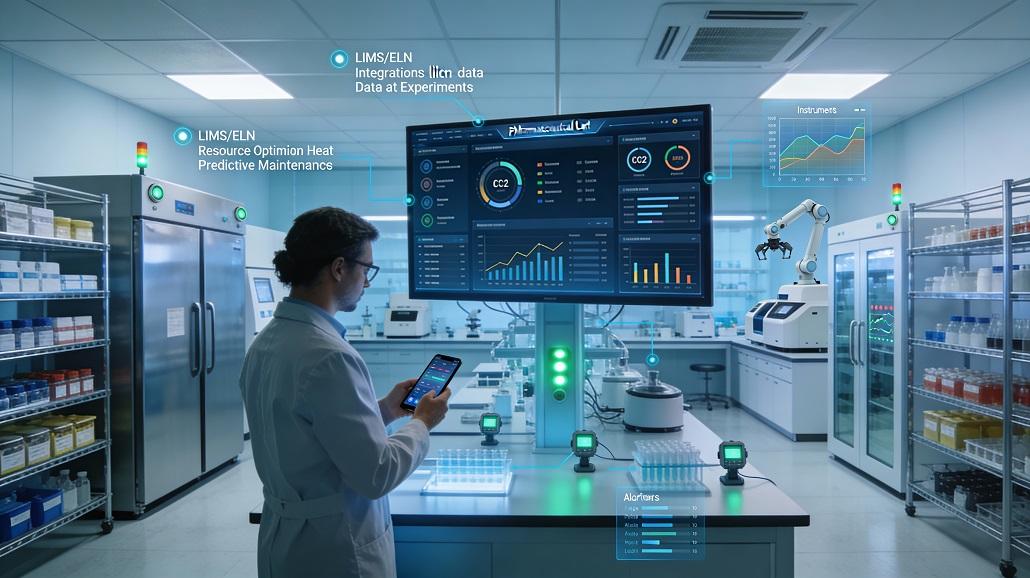
Precision is the hallmark of successful pharmaceutical research. Even minor fluctuations in the laboratory environment can lead to inconsistent results and failed experiments. IoT in laboratory operations allows for the precise monitoring of temperature, humidity, CO2 levels, and even vibration. These sensors are often small, wireless, and easy to deploy, making it possible to monitor every corner of the facility. This level of smart lab monitoring provides researchers with the confidence that their experiments are being conducted under the exact conditions required, significantly improving the reproducibility of their findings.
Predictive Maintenance and Equipment Reliability
Laboratory instruments are significant investments, and their downtime can be incredibly costly to a research project. IoT in laboratory operations enables a shift from reactive to predictive maintenance. By monitoring the performance metrics of an instrument such as the vibration of a centrifuge or the pressure in a chromatography system IoT platforms can identify patterns that precede a failure. This allows maintenance teams to service the equipment before it breaks down, minimizing unplanned downtime and extending the lifespan of the asset. This proactive approach to equipment management is a major driver of operational efficiency in modern labs.
Optimizing Resource Utilization and Workflow
Beyond monitoring the environment, IoT in laboratory operations provides valuable insights into how laboratory resources are actually used. In many large facilities, certain instruments may be overbooked while others sit idle. By tracking the usage of connected devices, management can identify these imbalances and optimize the laboratory’s layout and scheduling. This data-driven approach to resource management ensures that the facility is operating at its peak capacity, allowing more research to be conducted with the same amount of equipment and space.
Enhancing Safety and Compliance Through Connectivity
Safety and compliance are paramount in pharmaceutical research. IoT in laboratory operations enhances these areas by providing a secure and automated record of laboratory activities. For example, IoT-enabled safety cabinets can monitor the flow of air to ensure that researchers are protected from hazardous fumes. Similarly, smart waste containers can alert staff when they are reaching capacity, preventing overflows and spills. By automating these safety checks and maintaining a digital log of the results, IoT helps laboratories meet the strict requirements of regulatory bodies while protecting the well-being of their staff.
Inventory Management and the Smart Supply Chain
The management of laboratory consumables such as reagents, pipettes, and gloves is a complex and time-consuming task. IoT in laboratory operations can simplify this by utilizing smart shelving and RFID tags to track inventory in real-time. When a researcher takes a bottle of reagent from the shelf, the system automatically updates the inventory count and can even trigger a reorder if the supply is running low. This seamless integration of the laboratory with the supply chain ensures that researchers always have the materials they need, preventing delays and reducing the amount of capital tied up in excess inventory.
The Role of IoT in Data Integrity and Reproducibility
One of the most significant challenges in science today is the “reproducibility crisis.” If an experiment cannot be replicated by another scientist, its results are often questioned. IoT in laboratory operations addresses this issue by providing a comprehensive record of the experimental conditions. By capturing every environmental and instrumental variable, IoT provides a complete “biography” for every piece of data. This level of detail allows other researchers to recreate the exact conditions of the original study, providing a more robust foundation for the validation of new scientific discoveries.
Integrating IoT with Laboratory Information Systems
To realize the full potential of IoT, the data generated by connected devices must be integrated with the laboratory’s broader information systems, such as a Laboratory Information Management System (LIMS) or an Electronic Lab Notebook (ELN). This integration allows the environmental data captured by IoT in laboratory operations to be linked directly to specific experiments and results. When a scientist reviews a data point, they can also see the exact temperature and humidity of the lab at the moment that point was generated. This context is vital for accurate data interpretation and for identifying any external factors that may have influenced the outcome.
Future Trends: Toward the Autonomous Lab
As IoT technology continues to mature, we are moving toward a state where laboratories can operate with increasing levels of autonomy. Imagine a lab where the IoT in laboratory operations is combined with robotics and AI to create a fully closed-loop system. The system could design an experiment, execute it using robotic arms, monitor the results using IoT sensors, and then automatically adjust the parameters for the next run. While this level of automation is still in its early stages, the foundation is being laid today through the widespread adoption of smart lab monitoring and connected devices.
Conclusion
The integration of IoT in laboratory operations is a transformative force that is redefining the boundaries of what is possible in pharmaceutical research. By providing real-time visibility, enabling predictive maintenance, and optimizing resource utilization, IoT is driving a massive leap in operational efficiency. More importantly, it is providing the data-rich environment needed to solve the reproducibility crisis and ensure the highest standards of data integrity. As we continue to connect more of our laboratory assets to the internet, we are building a more responsive and intelligent research infrastructure that will be the engine of scientific discovery for decades to come.