










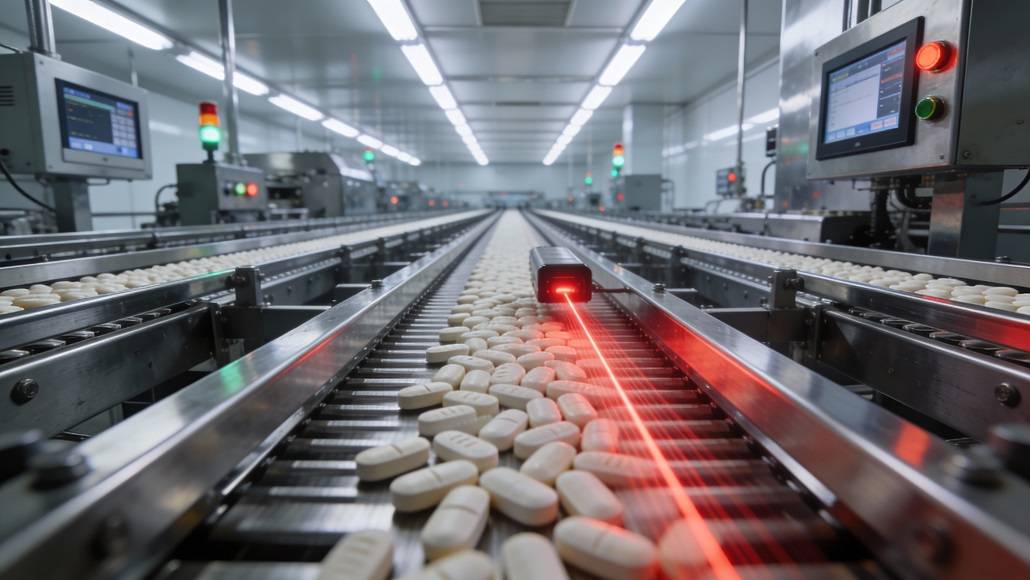
The transition from batch to continuous processing is arguably the most significant modernization effort in the pharmaceutical industry today. Promising reduced footprint, lower costs, and higher quality, continuous pharmaceutical manufacturing equipment represents the future of drug production. However, despite strong encouragement from the FDA and the introduction of guidelines like ICH Q13, widespread adoption remains slow. The hesitation is not due to a lack of vision but stems from tangible barriers in technology, workforce readiness, and regulatory alignment.
The Hardware Hurdle: Feeders and Flow Dynamics
In batch manufacturing, precision is achieved by weighing ingredients into a fixed vessel. In continuous manufacturing, precision is a function of flow over time. This fundamental shift places an immense burden on specific pieces of equipment, most notably gravimetric feeders.
The Feeder Conundrum
Loss-in-Weight (LIW) feeders are the heart of any continuous line. They must deliver Active Pharmaceutical Ingredients (APIs) and excipients with consistent accuracy, second by second, for days or weeks. The technical challenge arises when dealing with materials that have poor flow properties—sticky, cohesive, or hygroscopic powders. If a feeder bridges or refills poorly, the disturbance propagates instantly downstream. Equipment manufacturers have responded with advanced agitation systems and fast-response load cells, but “feeder robustness” remains a top technical anxiety.
- Refill Disturbances: The most critical moment in a continuous process is the “refill” phase, where the feeder hopper is topped up. During this brief window, the gravimetric control is blind (since weight is being added, not lost), and the system switches to volumetric control. If the powder density has changed even slightly, this switch can cause a mass flow deviation. Advanced algorithms and “smart refill” technologies are required to mitigate this, adding complexity to the control strategy.
Continuous Granulation and Drying
Beyond feeding, unit operations like granulation and drying must be reimagined. Twin-screw wet granulators offer excellent mixing but require precise control over Residence Time Distribution (RTD). Understanding RTD—the statistical probability of how long a particle stays in the system—is critical for material traceability. If a deviation occurs, manufacturers must know exactly which “slice” of production to reject. This requires a level of process characterization that is significantly more complex than standard batch validation.
The Role of Process Analytical Technology (PAT)
Continuous pharmaceutical manufacturing equipment is effectively blind without Process Analytical Technology (PAT). In a batch process, you can stop and sample. In continuous, you must measure on the fly.
The Sensor Suite
Integrating Near-Infrared (NIR), Raman spectroscopy, or TeraHertz sensors for real-time blend uniformity monitoring creates a massive data stream.
- NIR Spectroscopy: Used for moisture content and blend uniformity. The challenge is that NIR is surface-weighted; it sees the outside of the tablet or powder bed.
- Raman Spectroscopy: Offers better chemical specificity but can be slower and requires laser safety controls.
- Laser Diffraction: Used for real-time particle size analysis (PSA), critical for bioavailability.
The Data Burden and Chemometrics
The barrier here is often not the hardware, but the soft skills required to manage it. Building robust chemometric models that can distinguish between a good blend and a bad one—while accounting for raw material variability—is a specialized skill. The industry faces a shortage of qualified chemometricians. Furthermore, maintaining these models over the lifecycle of a product (model maintenance) is a new regulatory obligation. If the raw material supplier changes the particle shape of the excipient, does the NIR model need to be re-validated? This uncertainty slows adoption.
Economic and Infrastructure Readiness
The “Sunk Cost” Fallacy
The pharmaceutical industry sits on billions of dollars of existing batch infrastructure. Convincing management to invest in new continuous pharmaceutical manufacturing equipment when the old stainless steel tanks still work is a difficult financial pitch, especially for generic drugs with thin margins. The Return on Investment (ROI) for continuous manufacturing is clear in the long term (reduced waste, no scale-up issues, 30-50% reduction in facility footprint), but the initial capital outlay and the cost of decommissioning legacy sites create significant friction.
The Hybrid Approach
To mitigate this, many companies are adopting a “hybrid” approach. They may implement continuous blending and direct compression (CDC) for the final stages while keeping batch synthesis for the API. This reduces the complexity but also dilutes the benefits. True end-to-end continuous manufacturing (from chemical synthesis to final tablet) remains the domain of a few pioneering innovators.
Regulatory and Cultural Barriers
Global Regulatory Divergence
While the FDA has established a dedicated Emerging Technology Team (ETT) to support continuous manufacturing, other global agencies are at different levels of maturity. A company launching a global product faces the risk that their continuous process might be accepted in the US but scrutinized or delayed in emerging markets that lack the framework to audit continuous lines. This regulatory heterogeneity often pushes companies back to the “safe” choice of batch processing for blockbuster drugs intended for simultaneous global launch.
Cultural Inertia
Finally, the shift requires a cultural change from “testing quality into the product” (batch) to “designing quality into the process” (continuous). It demands a cross-functional collaboration between engineers, material scientists, and quality assurance that legacy organizational structures often inhibit. In a batch world, if a Quality Attribute fails, you investigate the batch. In a continuous world, you must investigate the moment—requiring a forensic level of data alignment that many organizations are not yet culturally ready to support.
Conclusion
The potential of continuous pharmaceutical manufacturing equipment to revolutionize drug supply chains is undeniable. It offers the agility to prevent drug shortages and the precision to improve patient safety. However, crossing the chasm from pilot scale to full commercial adoption requires solving the “feeder problem,” bridging the skills gap in PAT/chemometrics, and harmonizing global regulatory expectations. As the equipment matures and the first wave of “continuous” blockbusters proves the business case, these barriers will inevitably fall, paving the way for a more efficient manufacturing future.