











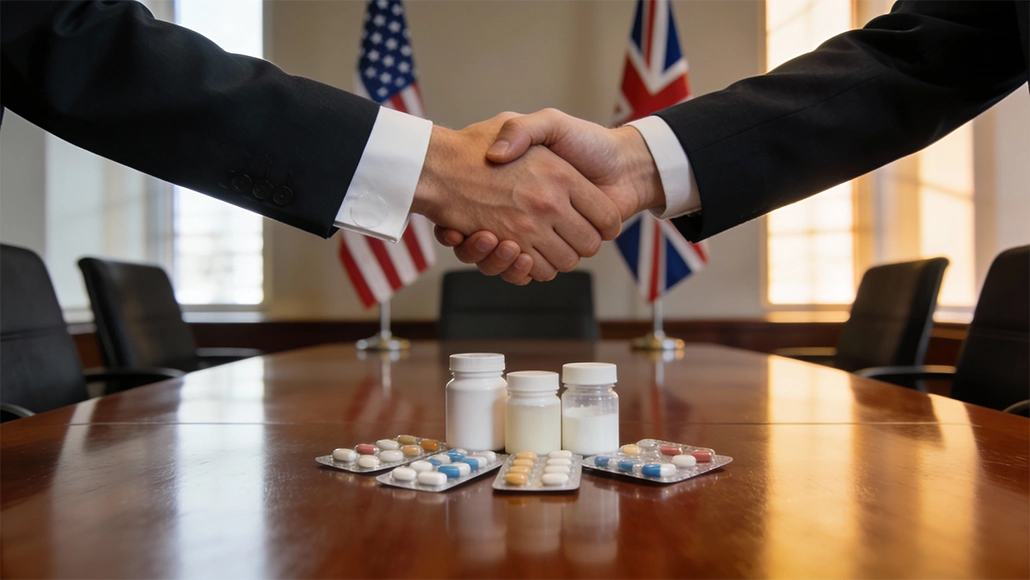
The Trump administration has lined up yet another country-specific trade agreement, and this time it is going to be with the U.K., which confers the biggest break on pharmaceutical import tariffs yet with Washington.
For its part, the U.K., which has indeed faced tough policy scrutiny from the biopharma industry in the recent months, is going to draft certain major changes to the way it goes on to pay for and appraise the value of the drugs.
On December 01, 2025, the U.S. government went ahead and unveiled an agreement in principle with the U.K., which is going to exempt UK-origin pharmaceuticals, medical technology, and pharmaceutical ingredients from the industry-specific tariffs of the administration. The tariff exemption when it comes to medicines as well as related products is going to last for at least three years, as per a separate release from the U.K. government.
Moreover, the U.S. has also agreed to refrain from targeting the U.K. pharmaceutical pricing practices in any of the future Section 301 investigations during the duration of President Trump’s term, said a joint press release from the U.S. Office of the United States Trade Representative, the Commerce Department as well as the Department of Health and Human services – HHS.
In exchange, the U.K. is going to boost the net price its National Health Service – NHS pays pertaining to the novel treatments by 25%, the countries said.
The British government has also gone ahead and pledged to safeguard higher prices for new drugs from getting materially eroded due to a demand for portfolio-wide concessions as per its Voluntary Scheme for Branded Medicines Pricing, Access and Growth – VPAG scheme or any other form of drug cost rebate scheme.
Moreover, the agreement is also going to alter the framework in which the drug cost watchdog of Britain, the National Institute for Health and Care Excellence – NICE goes on to judge the value of the innovative medicines.
The change will get reflected in the quality-adjusted life year metric of the organization, which goes on to measure the cost of a treatment for every healthy year it affords a patient. NICE makes use of its quality-adjusted life year metrics after weighing if it should go ahead and recommend a drug for the NHS coverage.
The deal is anticipated to bolster prominent biopharma investment throughout both countries, confirmed their respective governments on December 01.
According to Robert F. Kennedy Jr., the HHS secretary, this agreement with the UK goes on to make the global environment for innovative medicines more robust and also brings long-overdue balance to the U.S.–UK pharma trade.
It is well to be noted that the commitments from the U.K. in order to increase the spending on innovative drugs align along with the most favored nation drug pricing strategy from the Trump administration. The tactic, which has already rolled out a series of drug pricing agreements within the U.S., broadly looks forward to aligning the pharmaceutical costs in the U.S. with the lower prices that are paid in certain other comparable developed nations.
Apparently, the move is also likely to appease the prominent biopharma players that are operating in the U.K. by ascribing greater value when it comes to their respective drugs. Earlier in 2025, many large drugmakers pulled or even paused projects in the U.K. due to perceived flaws in the valuation of novel drugs that exist in the country and also its attractiveness in terms of future life sciences investments.
To exempt UK-origin pharmaceuticals from tariffs, goes on to mark the latest in a series of nation-specific deals that apparently are penned by the Trump administration.
Among those prior agreements with countries as well as authorities such as Switzerland, the EU, and Japan, the U.S. has already capped import tariffs on numerous goods, which includes drugs at 15%, as well as largely exempted generic medicines from the trade duties.
Across the pond, on the other hand, there are many pharma giants who appeared to sour on the U.K. business environment earlier in 2025.
In September 2025, Merck & Co. went on to announce it was pulling out of a new R&D center located in London as well as nixing all the research and development operations in Britain. At the time, a company spokesperson went on to tell Fierce Biotech that the move indeed reflected the challenges of the U.K. not making meaningful growth when it comes to addressing the dearth of investment within the life science industry and the complete undervaluation pertaining to innovative medicines as well as vaccines by the successive U.K. governments.
During the same time, Sanofi said that it was going to temporarily freeze any substantial investment within the U.K. drug R&D due to a breakdown in industry pricing talks. AstraZeneca, on the other hand, which is the biggest listed company on the London Stock Exchange – LSE in terms of market value, also paused a 200-million-pound investment in its research site at Cambridge, England.
Notably, AstraZeneca is among the handful of drugmakers that have struck a most-favored nation drug pricing deal along with the U.S. government, thereby affording the British drug giant a three-year grace period that came from pharmaceutical tariffs rolled out by President Trump.
In September 2024, AstraZeneca also announced plans to go ahead and list its shares directly on the NYSE, while at the same time maintaining listings on the LSE as well as Nasdaq Stockholm too. AZ anticipates its shares to get listed stateside on Feb. 2, 2026.