











The chemical synthesis of active pharmaceutical ingredients (APIs) is traditionally one of the most resource-intensive and waste-generating industrial activities. For every kilogram of finished drug produced, the industry has historically generated between 25 and 100 kilograms of waste, much of it consisting of hazardous organic solvents. However, the paradigm is shifting toward sustainable chemical processes in drug manufacturing, driven by a combination of regulatory pressure, environmental consciousness, and the realization that efficiency is synonymous with profitability. By adopting green chemistry principles and innovative engineering solutions, pharmaceutical companies are proving that they can deliver high-quality medicines while minimizing their impact on the planet.
Sustainable chemical processes in drug manufacturing revolve around the “12 Principles of Green Chemistry,” which emphasize the prevention of waste, the use of safer solvents, and the design for energy efficiency. One of the most impactful strategies is the optimization of “atom economy”—the measure of how much of the starting material ends up in the final product. By designing more elegant synthetic routes that avoid unnecessary steps and reagents, chemists can significantly reduce the “E-factor” (Environmental factor) of a process. This focus on efficiency not only reduces the environmental burden but also lowers the cost of raw materials and waste disposal, providing a clear economic incentive for sustainable innovation.
The Transition from Batch to Continuous Flow Chemistry
A major technological catalyst for sustainable chemical processes in drug manufacturing is the adoption of continuous flow chemistry. In traditional batch manufacturing, chemical reactions occur in large stirred-tank reactors, which can be inefficient in terms of heat and mass transfer. Continuous flow, on the other hand, involves pumping reagents through narrow tubes or microreactors where reactions happen in a controlled, steady stream. This approach offers several environmental benefits: it allows for much smaller reactor volumes, reduces the amount of solvent required, and enables precise control over reaction conditions. The improved efficiency often leads to higher yields and fewer side-products, directly contributing to a more sustainable production model.
Furthermore, continuous flow systems facilitate the use of “on-demand” synthesis, where chemicals are produced only when needed and in the required quantities. This reduces the need for large-scale storage of hazardous intermediates and finished APIs, mitigating the risk of chemical spills and degradation over time. The compact footprint of flow reactors also means that manufacturing can be decentralized, potentially reducing the carbon emissions associated with the global transport of bulk chemicals. As the pharmaceutical industry embraces these engineering advancements, the vision of “local-for-local” sustainable manufacturing is becoming a reality.
Solvent Recovery and the Circular Economy in API Production
Solvents account for the vast majority of the waste generated in pharmaceutical manufacturing, often making up over 80% of the total mass used in a process. Therefore, the development of robust solvent recovery and reuse systems is a cornerstone of sustainable chemical processes in drug manufacturing. Modern facilities are increasingly equipped with advanced distillation and membrane separation technologies that allow for the purification of used solvents, which can then be fed back into the production cycle. This circular approach to resource management drastically reduces the volume of hazardous waste that must be incinerated, thereby lowering the plant’s overall carbon footprint.
When solvent reuse is not possible, the industry is turning toward “bio-based” or “green” solvents derived from renewable agricultural sources rather than petroleum. These alternatives often have lower toxicity profiles and are more readily biodegradable, further enhancing the safety and environmental compliance of the manufacturing process. The integration of biocatalysis—using enzymes instead of heavy metal catalysts—is another growing trend in sustainable chemical processes in drug manufacturing. Enzymes operate under mild conditions (such as room temperature and neutral pH) and are highly selective, which reduces energy consumption and eliminates the need for toxic metal residues in the final drug product.
The Integration of Biocatalysis and Enzymatic Synthesis
The move toward biocatalysis represents a significant leap forward in sustainable chemical processes in drug manufacturing. Enzymes are nature’s catalysts, capable of performing highly specific chemical transformations with unmatched precision. Unlike traditional metal catalysts, which often require extreme pressures and temperatures, enzymatic reactions typically take place in aqueous solutions at ambient temperatures. This drastically reduces the energy intensity of the manufacturing process. Furthermore, because enzymes are biodegradable and non-toxic, they offer a much safer alternative for both the environment and the workers on the factory floor.
Advancements in protein engineering and directed evolution are allowing scientists to create “designer enzymes” that are optimized for specific industrial applications. These engineered biocatalysts can perform reactions that are difficult or impossible to achieve using traditional synthetic methods, often shortening a multi-step synthesis into a single, highly efficient transformation. By incorporating biocatalysis into the API manufacturing toolkit, pharmaceutical companies are not only reducing their environmental impact but also unlocking new possibilities for the synthesis of complex, next-generation medications.
Life Cycle Assessment (LCA) and Environmental Data Management
To truly measure the success of sustainable chemical processes in drug manufacturing, companies are increasingly relying on Life Cycle Assessment (LCA) tools. LCA provides a comprehensive framework for evaluating the environmental impact of a drug from the extraction of raw materials to the final disposal of the product. By quantifying the carbon footprint, water usage, and toxicity of each step in the manufacturing process, companies can identify “hotspots” where improvements are most needed. This data-driven approach ensures that sustainability efforts are targeted and effective, rather than merely performative.
Furthermore, the integration of digital environmental management systems is allowing manufacturers to monitor their resource consumption and emissions in real-time. By connecting these systems to the production floor, companies can automatically track the sustainability performance of every batch. This level of transparency is becoming essential for meeting the reporting requirements of global regulatory bodies and for satisfying the growing demand for green products from healthcare providers and patients. As sustainability data becomes as important as quality data, the ability to manage this information effectively will be a key differentiator in the pharmaceutical market.
Regulatory Compliance and the Business Case for Sustainability
The shift toward sustainable chemical processes in drug manufacturing is not just a voluntary ethical choice; it is increasingly mandated by regulatory bodies like the European Medicines Agency (EMA) and the U.S. Environmental Protection Agency (EPA). These agencies are imposing stricter limits on VOC (volatile organic compound) emissions and wastewater discharge, forcing manufacturers to innovate. Additionally, the pharmaceutical industry is being included in broader sustainability frameworks, such as the EU Taxonomy for sustainable activities. Compliance with these regulations is no longer just about avoiding fines; it is about maintaining a “license to operate” in an increasingly regulated global market.
From a business perspective, the case for sustainable manufacturing is equally compelling. Companies that lead in green chemistry are often the ones with the most efficient processes and the lowest operating costs. Furthermore, the pharmaceutical supply chain is increasingly being evaluated based on its environmental performance. Large healthcare providers and national health systems are starting to incorporate sustainability criteria into their procurement processes, meaning that companies with a lower environmental impact may gain a competitive advantage in securing contracts. In this context, sustainable chemical processes in drug manufacturing are a key driver of long-term commercial resilience and brand value.
In conclusion, the transformation of pharmaceutical chemistry is a testament to the industry’s ability to innovate in the face of global challenges. By marrying the precision of molecular design with the principles of sustainability, the sector is paving the way for a more responsible future. The journey toward zero-waste API production is complex and requires a multi-disciplinary approach, but the progress made thus far is encouraging. As more companies adopt sustainable chemical processes in drug manufacturing, the industry will continue to demonstrate that the pursuit of human health does not have to come at the expense of the health of our planet.
The Role of Digitalization in Green Chemistry
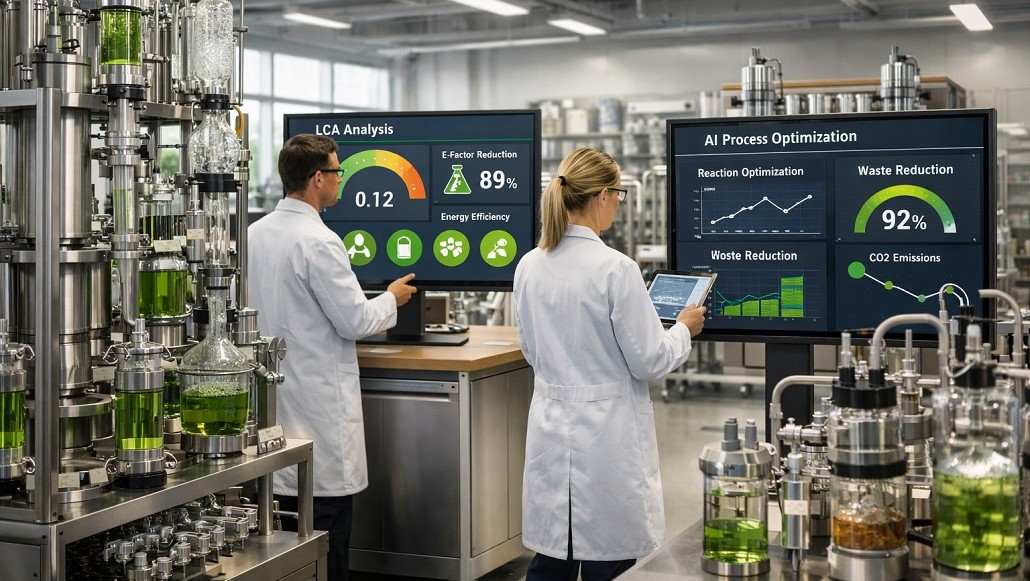
The marriage of digital technology and green chemistry is creating new opportunities for sustainable chemical processes in drug manufacturing. Advanced computational modeling and molecular simulation tools allow chemists to predict the environmental impact of a reaction before it is even performed in the lab. This ‘in silico’ screening process can identify safer solvents and more efficient catalysts, significantly reducing the amount of experimental waste generated during the development phase. Furthermore, the use of AI in process optimization is helping manufacturers to fine-tune their chemical reactions for maximum yield and minimum waste. By analyzing real-time data from sensors in flow reactors, AI systems can identify the exact conditions required for a sustainable process and adjust parameters on the fly. This level of precision is essential for achieving the high standards of efficiency required for a truly sustainable manufacturing model. As digitalization continues to permeate the pharmaceutical sector, the integration of ‘green’ and ‘digital’ will be the primary driver of innovation in chemical synthesis. This synergy ensures that sustainable chemical processes in drug manufacturing are not only environmentally friendly but also technically advanced and economically viable.
Moreover, the adoption of ‘green’ digital platforms for supply chain management is helping manufacturers to track the sustainability performance of their raw material suppliers. By using blockchain and IoT sensors, companies can ensure that the chemicals they purchase have been produced using sustainable methods and have been transported in an environmentally responsible way. This end-to-end visibility is essential for meeting the growing demand for transparent and sustainable products from healthcare providers and patients. As the pharmaceutical industry continues to evolve, the ability to demonstrate a clear and verifiable commitment to sustainability will be a key differentiator in a competitive market. By investing in both digital and green technologies today, pharmaceutical companies are building the foundation of a more resilient and responsible future, where human health and environmental integrity are seen as two sides of the same coin. The transformation is well underway, and the impact will be felt across the entire global healthcare ecosystem.