




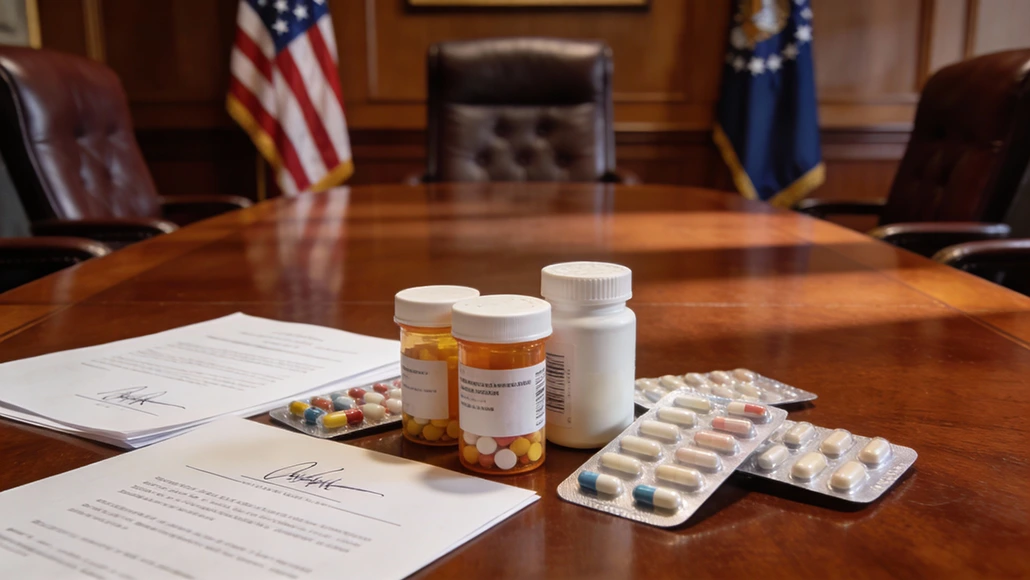
President Donald Trump on December 19, 2025, said that his administration has reached agreements with nine additional pharmaceutical companies, therefore extending a campaign that is aimed at decreasing the prescription drug prices for certain Americans while at the same time, temporarily shelving the threatened import tariffs.
Notably, these latest agreements bring the total to 14 out of the 17 drugmakers that the White House targeted earlier in 2025. Bloomberg confirms that the companies have committed to a mix of measures, which include lowering the prices for Medicaid recipients, selling some medicines directly to the consumers at discounted rates, and also launching new drugs in the US at prices that are comparable to those that are charged overseas. In return, they get to have a three-year pause from the potential tariffs.
According to Trump in an Oval Office meeting, the U.S. drug prices are going to come down fast and furiously and are soon going to be among the lowest throughout the developed world.
The companies newly signing on are Genentech, a unit of Roche Holding AG; Novartis AG; Bristol-Myers Squibb Co.; Boehringer Ingelheim; Gilead Sciences Inc.; Amgen Inc.; GSK Plc; and Sanofi, as well as Merck & Co. According to Bloomberg, the structure of these agreements closely resembles the earlier deals that were struck with Pfizer Inc. as well as AstraZeneca Plc.
Three major companies, namely, AbbVie Inc., Johnson & Johnson, and Regeneron Pharmaceuticals Inc., are apparently yet to finalize agreements. All have gone on to confirm that they are in ongoing discussions along with the administration. Trump said they would still be required to offer price reductions in order to avoid tariffs, reported Bloomberg.
Howard Lutnick, the Commerce Secretary, went on to indicate that additional announcements could also come after the holidays since the administration prepares to launch the TrumpRx website early in 2026. The platform is anticipated to serve as a marketplace for discounted medicines that are covered by the agreements, says Bloomberg.
In addition to the pricing deals, the Food and Drug Administration – FDA said that it would grant Merck the much-required expedited review for the two drugs in development, which are a cholesterol treatment as well as a cancer therapy. The accelerated pathway is intended to shrink the review timelines from almost a year to as little as just one or two months, remarked Bloomberg.
Executives from the participating companies went on to highlight manufacturing investments and price cuts, which they said would bolster the US health-care system. However, Bloomberg went on to note that some of the spending plans had been disclosed in the past and that many of the drugs that have been highlighted by the administration already go on to face competition coming from lower-cost alternatives.
As part of the agreements, Bristol-Myers said that it is going to provide Eliquis, its top-selling blood thinner, free of charge to Medicaid, whereas Gilead, on the other hand, has pledged to decrease the price of Epclusa, which is its hepatitis C drug, to under $2,500 on the TrumpRx platform, which is down nearly ten times that amount, confirmed Bloomberg.
Trump added that this is going to have a tremendous impact on health care.
Critics, however, have argued that some of the touted savings may well be limited. Bloomberg reported that there are certain sets of medicines, like the insulin products from Sanofi, that are already sold at the same prices via present patient assistance programs, and there are others that have generic versions that are available at a lower cost.
At the time of the event, Trump also went ahead and said that he intends to convene the insurance companies to discuss lowering premiums – which apparently is an issue that has drawn renewed attention since the Affordable Care Act marketplace enrollees go on to face higher monthly costs after their subsidies did not get the extension. His comments did weigh on the health insurance stocks, with companies like UnitedHealth Group Inc., Elevance Health Inc., and CVS Health Corp. retreating at the time of the trading session.
Interestingly, the insurance industry pushed back, stating that premiums largely reflect the underlying medical costs. AHIP, which is the main trade group of the industry, said that the margins of insurers and administrative expenses are indeed regulated, and it did express its openness to discussions pertaining to cost reduction.
Apparently, drug pricing goes on to remain a politically charged issue as Americans are paying more for medicines vis-à-vis consumers based out of other countries. Pharmaceutical companies go on to argue that higher U.S. drug prices help in funding research and development and at the same time reflect differences within the foreign pricing systems. As part of the new deals, Bloomberg remarked that there are many companies who have agreed to donate certain raw drug materials of six months’ worth to a national stockpile and to also manufacture finished medicines in emergencies, including the likes of antibiotics as well as inhalers.