



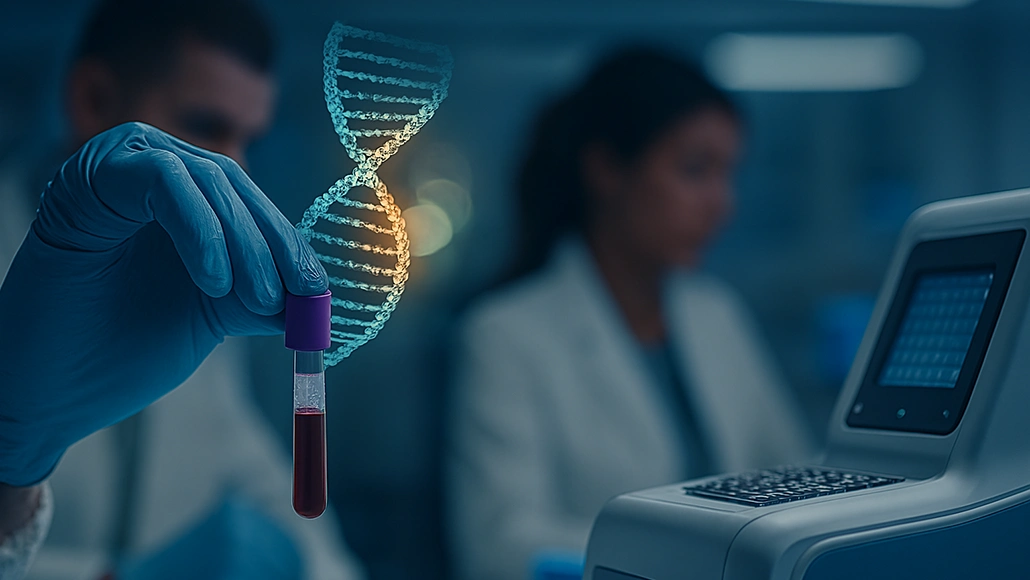

Liquid biopsy has become the quiet revolution of early cancer detection. It helps analyze circulating tumor DNA or tumor cells directly from blood. But behind the buzz lies a reality every scientist knows: for early-stage disease, detecting circulating tumor DNA is painfully rare. Often less than 0.1% of the total circulating DNA, these fragments are like whispers buried inside molecular noise.
To hear those whispers clearly, labs need more than equipment. They need chemistry with discipline, digital platforms that refuse to panic, and bioinformatics that knows how to separate truth from nonsense. This article breaks down the emerging strategies behind high-fidelity ctDNA assays—especially the role of high-performance probes engineered to boost the all-important Signal-to-Noise Ratio (SNR).
1. Why Signal-to-Noise Is the Real Battleground
Most circulating DNA is just benign background—healthy, abundant, and loud. Tumor DNA fragments carrying cancer mutations are the “whispers”; by comparison, is small, fragmented, and scarce. Sometimes it shows up at 0.01% VAF—one mutated molecule in ten thousand.
So the mission becomes twofold:
- Detect the truth: rare tumor variants hiding beneath the baseline.
- Crush the noise: prevent wild-type DNA and incidental errors from drowning everything out.
The Foundation of Discipline: The successful quantification of rare ctDNA relies on disciplined PCR amplification. High-performance probes take control of this process from the first moment by managing their relationship with high-quality pcr primers. The integrity of the primers is just as critical as the design of the probe.
This balance defines whether a liquid biopsy test performs like a scalpel—or a shrug. And achieving it requires discipline across every stage: sample handling, chemistry, partitioning, sequencing, and computational filtering.
2. DNA Probes: The Molecular Bouncers of ctDNA Testing
High-performance DNA probes are no longer passive reporters. They’ve become molecular gatekeepers, purpose-built to enforce order in a chaotic mixture of DNA fragments.
Critical elements of a deliberate, high-performance probe design strategy focused on controlling the binding kinetics within the PCR reaction include;
- Thermodynamic gating: Their melting temperature sits 5–10°C higher than the primers.
- That temperature gap is deliberate—thermodynamic crowd control.
- It ensures the probe binds early and blocks the nonsense before it starts.
Add to that structural intelligence—designs that stay silent until opened by a perfect match—and double-quenched architectures that erase background signal. These probes aren’t just tools; they’re guardians of assay integrity.
And yes, this applies across platforms, including the qPCR probes often used as orthogonal validation steps for NGS results.
3. Digital Detection: Where the Signal Gets Its Own Room
Digital PCR steps in when ctDNA levels fall below 0.1%. By partitioning reactions into thousands of tiny chambers, each target molecule gets the dignity of being counted individually.
This isn’t magic. It’s simply giving the rare signal a chance to speak without being trampled by wild-type DNA. The result: cleaner detection and more trustworthy confirmations.
4. NGS Error Suppression: Teaching Sequencing to Slow Down and Listen
NGS is powerful, but naturally noisy. Standard chemistry creates errors that look disturbingly like true mutations.
To clean this up, high-fidelity assays use strategies such as:
- Molecular barcoding to track original molecules
- Duplex verification to confirm matches on both strands
- Consensus modeling that filters chemical and amplification-induced artifacts
The outcome is straightforward: fewer false positives and dramatically higher confidence at the ultra-low VAF levels meaningful for early cancer screening.
5. Sample Integrity: Because Even Great Chemistry Can’t Fix Chaos
Every lab knows: garbage in, garbage out. Clean ctDNA detection starts with the fundamentals—proper stabilization, precise centrifugation timing, and fragment-size enrichment that removes large genomic DNA. These steps don’t just “help.” They define whether downstream analysis is coherent or clouded.
6. Bioinformatics with a Backbone
Even after perfect prep and perfect chemistry, the final truth emerges in the computational layer. High-performance pipelines correct artifacts, model background error behavior, and filter signals associated with unrelated biology. This is where sensitivity transforms into specificity—and where good assays become reliable ones.
In essence, creating a truly high-fidelity liquid biopsy assay is not about a single breakthrough. It’s about an ecosystem of precision—probes, enrichment, partitioning, sequencing, bioinformatics—all tuned to the same goal: amplifying truth and silencing noise. Labs and researchers that partner with reliable genomics technologists can adopt this unified approach consistently and take advantage of lower detection limits, cleaner baselines, and higher confidence in early-stage cancer markers. Because in the end, the science isn’t just about sensitivity. It’s about clarity, integrity, and the discipline to listen for the rarest voices in biology.